

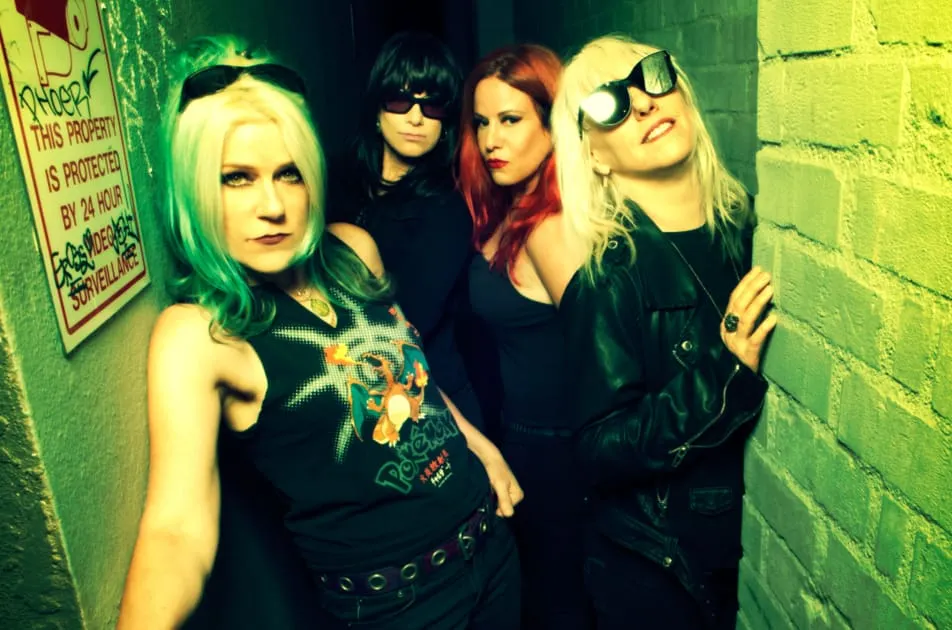
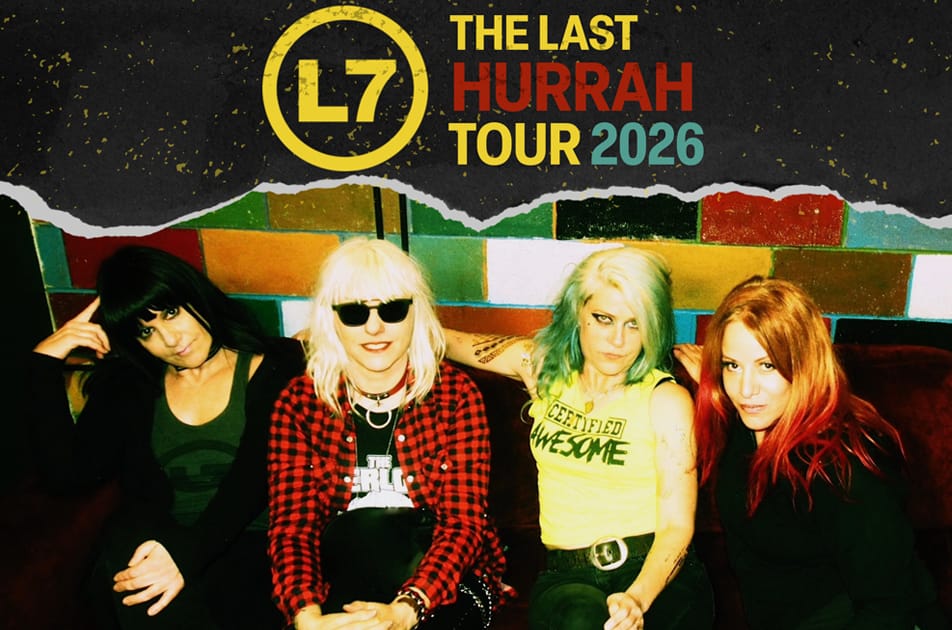
When the news broke that L7 would embark on their “Last Hurrah” farewell tour, many fans immediately returned to the same infamous image: frontwoman Donita Sparks at the Reading Festival, responding to a hostile crowd by throwing a used tampon into the audience and yelling:
“Eat my used tampon, fuckers!”
More than thirty years later, the “tampon incident” still follows the band everywhere. And although reducing L7’s live legacy to one outrageous moment misses the bigger story, the truth is that this take-no-prisoners grunge band played some raucous, chaotic, and confrontational concerts over the years. Yet, always with a bit of a funny side, always a bit on the political side, and always with a subtextual mission to push the boundaries of what rock shows led by women should look, feel, and sound like.
L7 built an entire reputation around the idea that anything could happen once they stepped on stage. Here's a brief history of L7's live legacy.
The Tampon Incident Became Punk Rock Folklore
The Reading Festival moment in the summer of 1992 became instantly legendary because it condensed everything L7 represented into one unforgettable act of rebellion.
At the time, women in heavy music were routinely mocked, antagonized, or treated as novelties by festival crowds and media alike. L7 responded not by attempting to smooth over the hostility, but by escalating it into absurdist confrontation. The moment was shocking, confrontational, and undeniably effective.
In hindsight, the incident also feels strangely ahead of its time. Kate Hutchinson called it:
"One of the ultimate fuck-yous to the sexism of the male-dominated rock scene."
Modern discourse around bodily autonomy, feminist protest, and refusing respectability politics now features (semi-)prominently in music media, yet these topics were covered very differently, if at all, in 1992. Even the framing of such an incident would've changed had it happened now; what was once treated purely as "scandal" can now also be viewed as a refusal to be humiliated publicly in a male-dominated live music environment.
L7 has always understood something fundamental about live music: audiences remember the risks you take.
One of the Loudest and Most Unpredictable Bands of the Alternative Boom
Though often grouped into the grunge explosion of the early 1990s, L7 occupied a category all their own live. Touring alongside bands like Nirvana, Faith No More, Rage Against the Machine, and Red Hot Chili Peppers, L7 developed a reputation for stealing attention from larger acts through sheer force of presence.
Emerging from the Los Angeles punk scene, the band mixed punk abrasion, metal heaviness, sardonic humor, and riotous stage chemistry into performances that critics frequently described as overwhelming. Their concerts could feel less like tightly choreographed productions and more like controlled demolition.
Importantly, they accomplished this without polish. Their appeal was danger, and they lived it too.
A now-infamous 1989 tour with Cat Butt — referred to as the "Swapping Fluids Across America" tour — featured intense partying, heavy drug use, and violent incidents. Besides bar brawls, a machete-wielding gang banger, and a separate stabbing incident, L7 bassist Jennifer Finch recalled:
"I barely remember the tour... I was on so much heroin.”
For many, L7’s concerts possibly felt just as unstable.
+Read more: "The Stage Is a Microphone — Use It Like One"
Even in Their Reunion Era, Fights Followed Them
The band went on an indefinite hiatus in 2001 following the commercial decline of grunge and financial strain, but reunited in 2014. But what made L7’s reunion years so compelling was that they never fully sanded down their confrontational instincts.
During a 2022 performance, the band stopped mid-show after a fight broke out in the crowd, halting the performance until the situation was handled.
That moment may seem minor compared to the infamous Reading Festival tampon incident and those early debaucherous years, but it speaks to the same underlying philosophy: L7 concerts have always felt intensely present. The audience is not merely watching the band — they are participating in an unpredictable social experience unfolding in real time.
Their shows still carry the feeling that something unscripted could happen at any moment.
Activism Was Part of the Show
Through initiatives like Rock for Choice, the band fused activism directly into live touring culture.
These shows transformed concerts into organizing spaces years before the music industry widely embraced social-impact branding or cause-driven touring. For L7, politics were not an accessory added to the performance; they were embedded in the band's ethos fundamentally.
That legacy feels newly relevant today as artists increasingly use stages to speak openly about reproductive rights, gender politics, labor issues, war, climate, and identity. In many ways, L7 helped normalize the idea that a live performance could also function as a political gathering space. Their approach to gigging was cued up to provoke reactions.
+Read more: "Ora Cogan on Asking Big Questions and the Choice Not to Be Perfect"
What Happens When One of Rock’s Last Truly Confrontational Live Bands Says Goodbye?
This is an unusual moment for live music. Modern concerts are bigger than ever commercially, yet indie touring has become prohibitively expensive, and many major label artist performances feel increasingly standardized.
Consistency, control, and brand management now dominate much of the touring economy. Even viral moments in the live music space, when they happen, feel almost predictable because so many are engineered instead of being accidental.
L7 came from an entirely different philosophy of performance. Their concerts embraced risk and unpredictability, mess, the tension between artist and audience. They treated the stage less like a customer experience and more like a volatile exchange of energy.
That spirit feels increasingly rare... unless you know where to look for it.
Follow L7 on Bandsintown and catch the band on tour in 2026.
L7 2026 Tour Dates
JUN 04 — Toronto, ON @ RBC Amphitheatre
JUN 05 — Laval, QC @ Place Bell
JUN 17 — Morrison, CO @ Red Rocks Amphitheatre
JUL 12 — Lille, Belgium @ Sjock Festival 2026
AUG 29 — Ontario, CA @ Toyota Arena
OCT 09 — Phoenix, AZ @ Walter Studios
OCT 12 — Austin, TX @ Emo's Austin
OCT 13 — Dallas, TX @ The Echo Lounge & Music Hall
OCT 14 — Houston, TX @ House of Blues Houston
OCT 16 — Nashville, TN @ Cannery Hall
OCT 17 — Atlanta, GA @ The Masquerade
OCT 19 — Charlotte, NC @ Neighborhood Theatre
OCT 21 — Washington, DC @ Howard Theatre
OCT 22 — Philadelphia, PA @ Brooklyn Bowl Philadelphia
OCT 24 — Maspeth, NY @ Knockdown Center
OCT 26 — Boston, MA @ The Wilbur
OCT 27 — Cleveland, OH @ Globe Iron
OCT 31 — Detroit, MI @ Saint Andrew's Hall
NOV 01 — Chicago, IL @ The Vic Theatre
NOV 03 — Minneapolis, MN @ Fine Line
NOV 04 — Kansas City, MO @ Warehouse On Broadway
NOV 06 — Denver, CO @ Summit Music Hall
NOV 07 — Salt Lake City, UT @ The Urban Lounge
NOV 10 — Seattle, WA @ The Showbox
NOV 11 — Vancouver, BC @ Vogue Theatre
NOV 13 — San Francisco, CA @ The Regency Ballroom
NOV 14 — Los Angeles, CA @ The Wiltern