___________________
Guest post by Cherie Hu on Medium[Due to the granularity of the graphs you are about to see, this piece is best enjoyed on a desktop!]As a music journalist, and as a genuinely curious human being, I love attending conferences.If that sentence makes you cringe, I completely understand. At their worst, music conferences are time-sucking, self-promotional, useless showcases of bullshit that trade in deflection and avoid any honest conversation about the industry. Unfortunately, most conferences have at least one panel that ends up in this bucket, due to factors both controllable (e.g. booking a panel entirely of male CEOs that lasts only 30 minutes) and uncontrollable (e.g. a panelist shows up stoned or on three hours of sleep after taking a redeye flight from across the ocean).At their best, however, music conferences are vibrant scenes of intellectual inquiry and cross-pollination that scrape this aforementioned bullshit from our eyes. It’s basically the only chance that otherwise siloed stakeholders get to convene in one room, illuminate mutual pain points and growth opportunities, and subsequently make deals that enact meaningful change. I would certainly not be where I am now professionally were it not for attending my first conference back in 2015, and I’ve also made some of my closest friends at these events.For better or for worse, conferences serve as social tokens in business and commercial culture, and particularly in music. As a space we all share, this culture must be taken seriously—and challenged.One axis that I believe is not being taken seriously, hence my writing this article, is gender representation. As a 21-year-old woman passionate about meeting, interviewing and learning from leaders in my field, I am consistently the outlier in a sea of older males. I usually don’t bring it up—I’m frankly used to hanging out with an older, mostly-male crowd at this point, and many of these males have become invaluable, supportive mentors that are the farthest thing away from sexist—but am well aware that gender equality in the music business, and particularly at music conferences, is still a remote fantasy.Moreover, I’ve noticed a recent deluge of anecdotal coverage about sexism and discrimination in the music business, without any quantifiable benchmarks illustrating how significant the magnitude of the problem actually is. Of course, data does not provide the ultimate infallible answer, but people still need numbers to be convinced. Gender equality advocates in Silicon Valley constantly demand more statistics about their industry, and they are slowly but surely achieving the right results. Why shouldn’t the music industry, which supposedly celebrates multifaceted creativity and diversity, follow suit?Interestingly, the few reliable measures I’ve seen on gender in the music industry have all come from across the pond. PRS for Music, one of the largest collection societies in the UK, revealed in its latest Women Make Music report that only 16% of its membership is female. Trade group UK Music recently launched its first-ever Diversity Taskforce, which found that females in the UK music industry account for around 60% of entry-level employees, but only for 30% of senior executives. Back in 2012, the UK’s Association of Independent Music (AIM) found that only 15% of its label members were majority-owned by women.To date, no such measures have been taken in the US, or on a global scale. The likes of Nielsen, the Music Business Association and the RIAA regularly publish gender-related studies about music consumers and fans, but never about music professionals or their own membership.I decided to fill in that gap by quantifying the gender inequality problem at music conferences, the hubs where some of the industry’s most powerful leaders and decision-makers converge to take the pulse on what’s next. Data about who speaks at these conferences is widely and publicly available, but has never really been dissected or critically examined—perhaps because we are afraid to discuss the results.Data Summary
I compiled and analyzed a dataset of 1,644 total speakers from the following music industry conferences, listed in chronological order:- NY:LON Connect (January 24–25, 2017 in London, UK)
- Pollstar Live! (January 31–February 2, 2017 in Los Angeles, CA)
- FastForward (February 23–24, 2017 in Amsterdam, NL)
- SXSW Music (March 13–17, 2017 in Austin, TX)
- Canadian Music Week (April 19–21, 2017 in Toronto, ON)
- Music Biz (May 15–18, 2017 in Nashville, TN)
- IMS Ibiza (May 24–26, 2017 in Ibiza, Spain)
- A2IM Indie Week (June 5–8, 2017 in New York, NY)
- Midem (June 6–9, 2017 in Cannes, France)
- CD Baby DIY Musician Conference (August 25–27, 2017 in Nashville, TN)
- Bigsound (September 5–8, 2017 in Brisbane, AU)
- Future Music Forum (September 13–15, 2017 in Barcelona, Spain)
- NYME Digital Music Forum (September 26, 2017 in New York, NY)
View from the top
From a bird’s-eye gender parity perspective, music conferences exacerbate real-world imbalances. 73% of speakers at these conferences are male. The percentage inches even higher among C-Suite executive speakers (CEOs, COOs, CMOs, etc.), 81% of whom are male.Compare this to the findings from the UK Music Diversity Taskforce, which we can assume is directionally similar to the US: the UK music industry overall is 54% male, while, as previously cited, the distribution skews to 70% male among senior executive ranks. This means that music conferences on average are actually doing a worse job with gender equality than the real world!By Conference: More equitable = less distinct
To better understand each conference’s positioning, I mapped them onto a bubble chart along axes of % male speakers and % speaker overlap (the proportion of speakers that a conference shares with other conferences in the dataset), as shown below. The bubble sizes refer to the relative conference size, as measured by the number of speakers (Future Music Forum, the unlabeled yellow dot, is the smallest, while Canadian Music Week is the largest).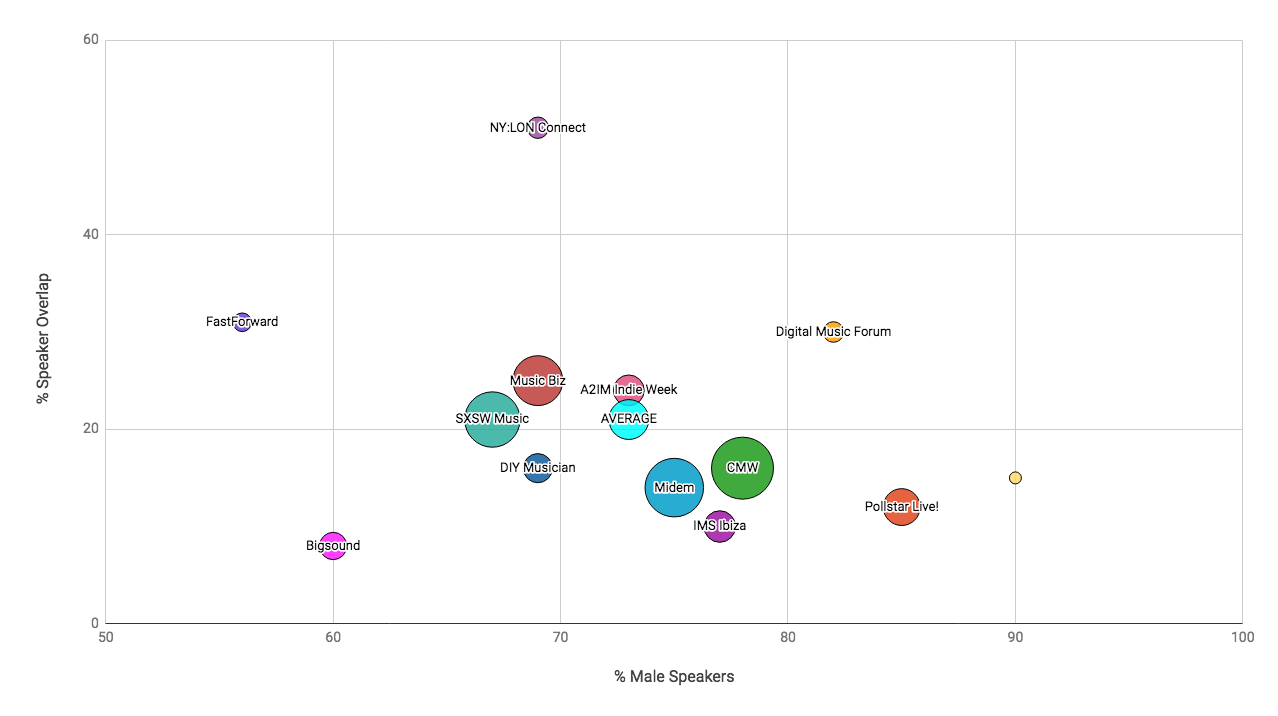
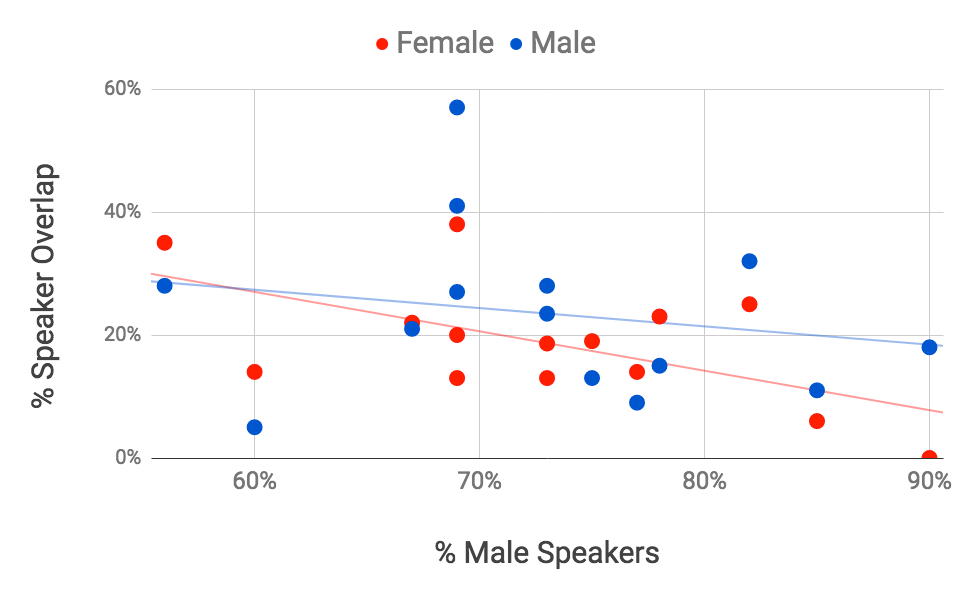
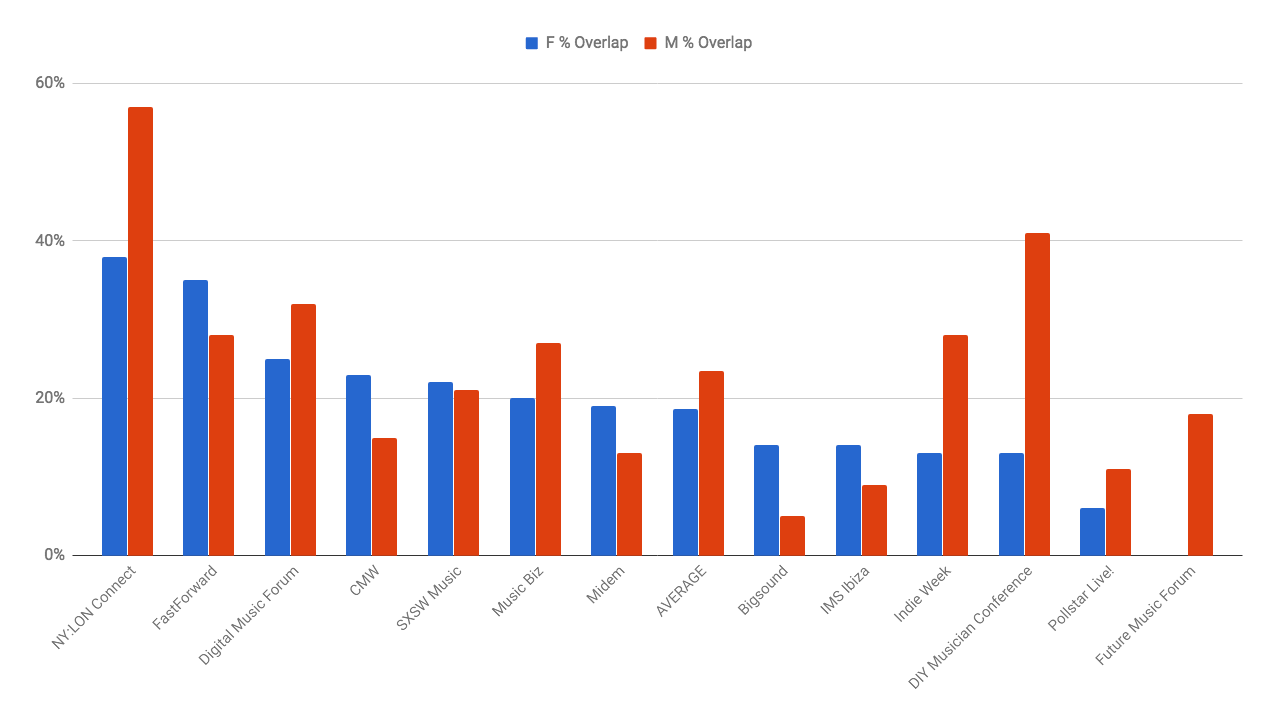
By Company/Role Vertical: Females lead the creative conversation, but tech and live events are male turf
After quantifying gender inequality on a conference level, I investigated whether certain types of music companies had a worse gender imbalance than others — a topic that I’ve never seen come up in conversations around conference diversity. The following chart shows the gender split across 34 company verticals, as parsed out from speakers’ job descriptions: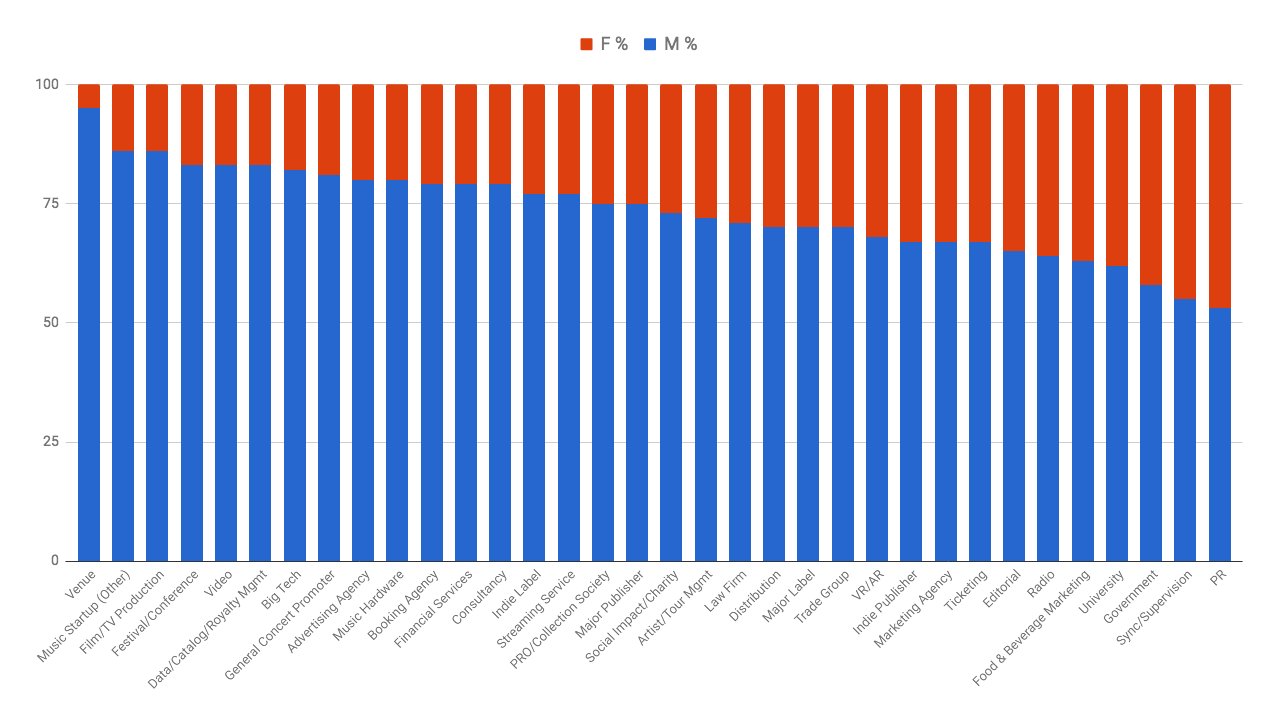
- LIVE EVENTS. This umbrella category includes venues (a staggering 95% male), festivals and conferences (83% male), concert promoters (81% male) and booking agencies (80% male). Ticketing companies have a slightly more equitable representation (67% male), but more often than not are detached from direct interactions with talent. It’s no coincidence that some of the most harrowing, most widely-circulated accounts of sexism in the music industry have originated in live performance and promotion (here, here, here, here), but the extent to which conferences continue to perpetuate this excessive masculine energy is pretty shocking. Especially considering that live events account for a growing proportion of music-industry revenue every year, a growing diversity of music professionals should have stakes in the conversation.
- STARTUPS AND TECH. This includes big-tech firms like Google and Facebook (82% male), hardware manufacturers (80% male), streaming services (77% male), VR/AR studios (68% male) and other music startups (86% male). Given all the recent coverage of sexism and gender inequality in Silicon Valley, and the subsequent ousting and resigning of previously powerful tech executives, this is hardly breaking news. Nonetheless, just as with live music, I think the fact that males are leading the conversation about how streaming and tech are almost singlehandedly responsible for the music industry’s financial recovery is problematic and understated.
- VIDEO AND FILM. This category includes video companies like Vevo and Musical.ly (83% male) and film/TV studios like 20th Century Fox (86% male). Video is essential to the music industry for the same reason that live events are thriving: regardless of their gender, artists are nothing without their visual brand, and the digital age makes it easier to ideate, evolve and distribute this brand in real time. Yet, at least as displayed at music conferences, the demographic of key decision-makers in this space remains one-dimensional.
- MARKETING AND PUBLIC RELATIONS (PR). This category includes PR firms (53% male, the most even split out of all company types) and independent marketing & creative agencies (67% male). These findings are consistent with research beyond music: according to the US Bureau of Labor Statistics, women make up 63% of all PR specialists and 59% of PR managers, while a 2013 survey in the UK found that a whopping 75% of marketing professionals in the country are female (although only 7% make it to the senior executive ranks).
- SYNC AND MUSIC SUPERVISION. Right after PR, this is the next most equitable company vertical, with 55% male speakers. As a profession, sync is particularly interesting because it combines creative and fiscal challenges: in addition to developing an intimate knowledge of songs’ lyrical, emotional and cultural currency, being successful in this role requires adept skills in financial budgeting, licensing and contract negotiation. The success of women in sync gained more public traction when the first-ever Emmy Award for Outstanding Music Supervision was issued this year to a woman (Susan Jacobs for Big Little Lies), and was the only music award at the ceremony that was not heavily dominated by men.
- RADIO AND EDITORIAL. At this year’s music conferences, Radio reps skew 64% male, while Editorial (online or print magazine writers and editors—yes, this includes me!) skews 65% male. This is consistent with some findings in the wider journalism industry: a 2014 study by UNESCO, for instance, found that 37% of radio stories were reported by women. It’s worth noting that the vast majority of editorial reps are invited to music conferences as panel moderators, not as actual speakers, and are often the token female presence in an otherwise all-male session.
By Role Hierarchy: Hail to the [male] chief
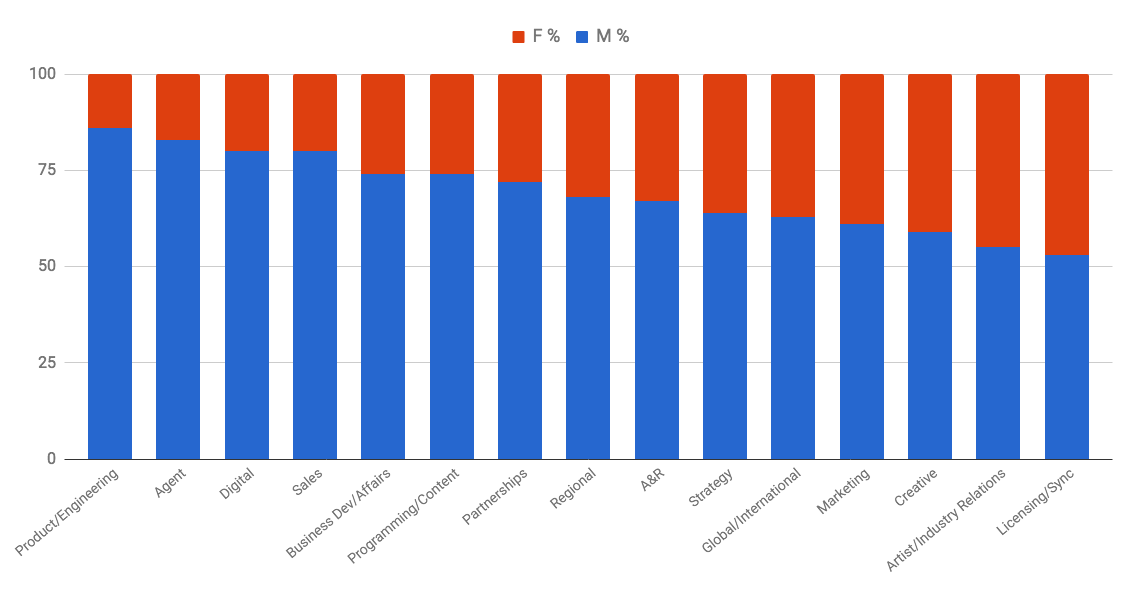
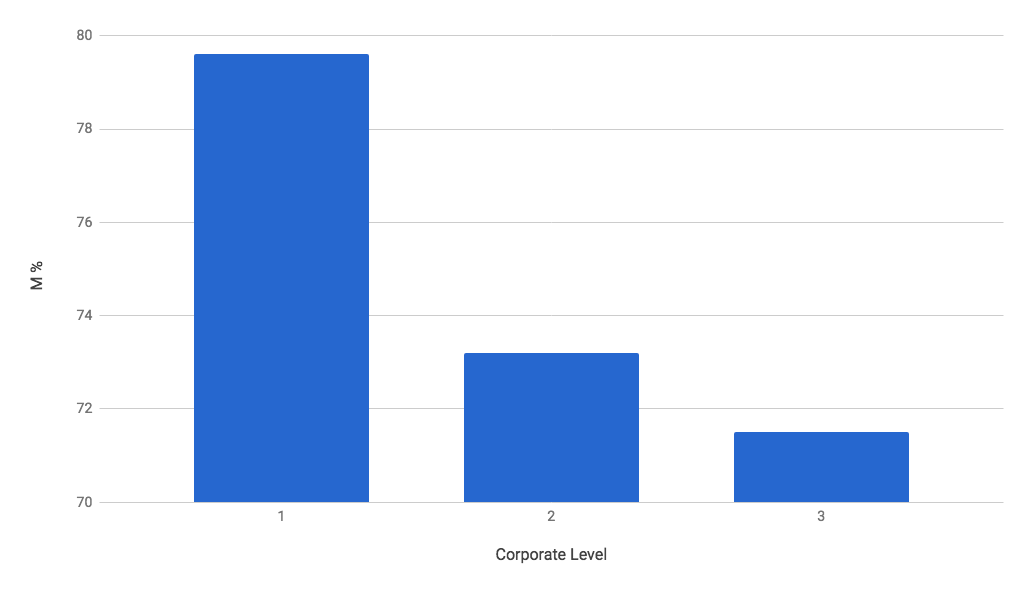
Nearly 20% of speakers in this dataset are CEOs or Owners of their respective companies. As I previously mentioned, 81% of these high-level speakers are male, which certainly skews the overall gender imbalance across conferences.What about the rest of the corporate ladder? Taking conference names and company/role verticals out of the equation now, is gender parity at music conferences correlated with corporate hierarchy?At first, there doesn’t seem to be any clear pattern: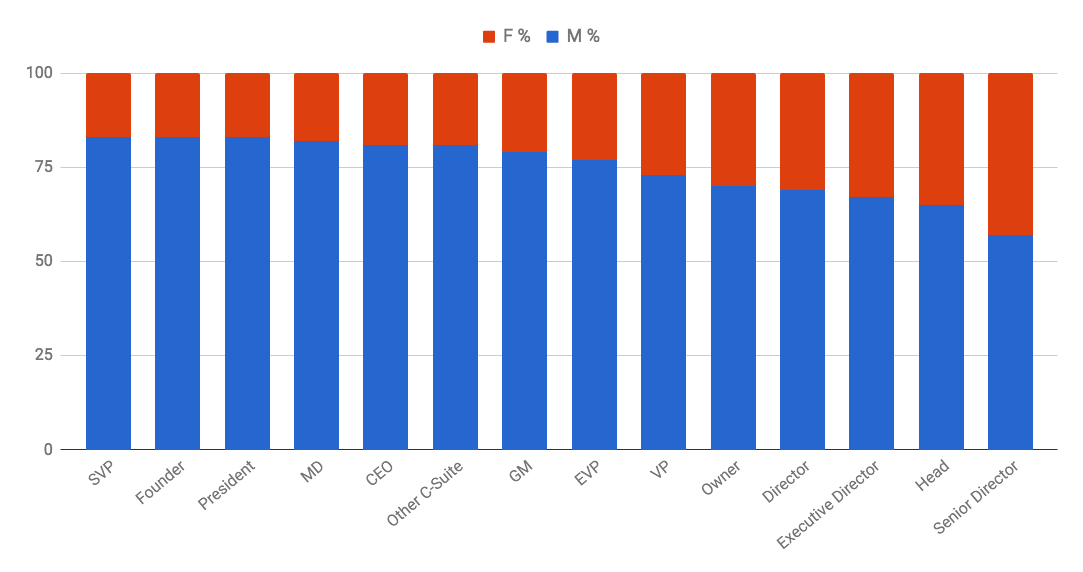
- Level 1 = CEO, Other C-Suite, Founder, Owner, President
- Level 2 = EVP, SVP, Executive Director, Senior Director, Managing Director
- Level 3 = VP, General Manager, Head, Director
Conclusion: What comes next?
I hope my analysis shows that gender inequality at music conferences, and in the music business at large, is both rampant and complex. Certain sectors and roles in music face a more drastic imbalance than others, while conferences seem to be making unnecessary, completely avoidable tradeoffs between achieving gender parity and providing a unique experience to attendees.Yes, each conference has a specific audience and goal in mind, which impacts who they book as speakers. However, gender parity is never a factor that should be compromised—and, especially for today’s new entrants into the industry who prize diversity, gender parity is becoming a stronger mark of authority and respect. I don’t think it’s asking too much of conferences to reflect seriously on what kind of community and industry they are hoping for, and what standards they are emulating and elevating for acknowledging this community as a result.Speaking of diversity, there are so many missing dimensions from my analysis that warrant further research. In focusing on gender, I did not analyze other demographics of the speakers such as age and ethnicity; nor did I incorporate the geographical headquarters of the companies involved, which I am sure are heavily US- and Eurocentric. It would be interesting to explore whether the burgeoning music conference circuit in Asia and South America (especially in Brazil, Singapore, India, China and Japan) ends up being more progressive on the axes of gender and age over the next few years. Finally, while speaker data is widely available, only a few conferences publicly release demographic and professional data about their attendees, the latter of which would probably provide a more accurate sample of professionals in the music industry (e.g. I’m sure there are many more entry-level conference attendees than there are entry-level speakers).As for action items, my analysis illuminates potential focus areas for conference organizers who want to elevate female voices in the most meaningful ways. For instance, can we imagine and create a world where female energy infuses the conversation around video and live events, which today is more than 80% male? Can we build a platform where intelligent women steer and contribute to discussions on the future of music-tech with equal weight as men? Is it really that hard?Conference-oriented gender parity campaigns like Let’s Be the Change and female-oriented music mentorship programs and networks like shesaid.so are making it easier. Industry bodies are also stepping in: the PRS Foundation just launched its two-year talent development program for women in music called Keychange, with the help of €200,000 in funding from the EU. Even editorial initiatives like Music Business Worldwide’s “Inspiring Women” series are pushing the needle by raising awareness of power female players in higher ranks.To quote Facebook COO Sheryl Sandberg, “you can’t be what you can’t see.” Conferences are in a unique position to change what we can see and widen the horizon of possibility in the industry, instead of simply rewriting an old, gendered script in a different language.Thanks for reading! If you have any feedback or questions with regards to my analysis, please reply below—I’d love to keep the conversation going from here.
To follow more of my thoughts and analyses at the intersection of music, business, tech and creativity, you can follow me on Twitter, read my articles on Forbes and Billboard, and/or sign up for my newsletter, Water & Music.
Related articles