__________________________________
Guest Post by Mark Mulligan on his Music Industry BlogThe artist-and-labels-versus-YouTube crisis is going to run and run, even if some form of settlement is actually reached…the divisions and ill feeling run too deep to be fixed solely by a commercial deal. What’s more, a deal with better rates won’t even fix the underlying commercial problems. Music videos under perform on YouTube because they don’t fit YouTube in 2016 in the way they did YouTube in 2010. The 4 minute pop video was a product of the MTV broadcast era and still worked well enough when online video was all about short clips. But the world has moved on, as has short form video (in its new homes Snapchat, Musical.ly and Vine). Short videos are no longer the beating heart of YouTube viewing and quite simply they don’t make the money anymore. This is why music videos represent 30% of YouTube plays but just 12% of YouTube time. If record labels, publishers, performers and songwriters want to make YouTube pay, they need to learn how to play by the new rules. And to do that they need work out what to do with ‘15’.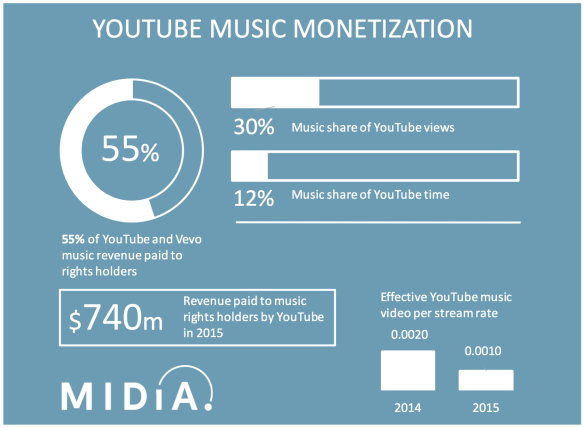
- YouTube pays out as a share of ad revenue (55%) not on a per stream basis. So when the value of its ad inventory goes down (due to factors such as more views coming from emerging markets with weaker ad markets) the revenue per stream goes down too. This is something the labels can do little about, though an increased revenue share will soften the blow as YouTube globalizes.
- YouTube serves its in-stream video ads (the most value ad format) on a time-spent basis, not on a per-video basis. Our research found that the average number of video ads per hour of viewing comes out at about 4. That means if you have 15 minute videos (like many YouTubers do) you will get a video ad every play. But if you have 3 or 4 minute pop videos you may only get 1 video ad for every 4 or 5 plays. Which means 4 or 5 times less video ad revenue. In fact, our research revealed that just 26% of music video views have video ads. This is the underlying issue the industry needs to address, and unlike global ad market dynamics, this is something it can indeed fix.
- 3 track ‘EP’ videos interspersed with artist narrative and reportage coverage
- Live sessions (recorded by, and uploaded by labels so they get revenue as well as publishers)
- Mini-documentaries such as ‘the making of’s
- On-the-road features
Related articles