


_________________________
Guest post by Chris Castle of Music Technology PolicyIt is axiomatic that as government expands, liberty contracts. Songwriters are among the most highly regulated workers in America, so on the continuum of liberty, guess where songwriters score? Most people are surprised by that unadulterated, and rather bleak, fact. After all, songwriters don’t make anything toxic or build in places they shouldn’t or dump chemicals in a waterway. Songwriters don’t have monopoly power. Songwriters don’t even get to set their own prices—the government largely does that in a very expensive and Kafka-esque process. They just write songs.Not only are songwriters highly regulated workers and are forced by the government (or to use a term from political theory, “the Sovereign”) to bend a knee, the Sovereign has abdicated the enforcement of the laws protecting songwriters to the songwriters themselves except in rare criminal cases. Not only has the Sovereign failed to afford songwriters the same level of protection as the desert tortoise, the Sovereign actually requires songwriters to enforce the laws themselves. Sounds like a reality show.So rather than getting even more government, songwriters are due for either getting the Sovereign out of their commercial lives, or if justice fails them yet again, at least getting the Sovereign to actually enforce the law.Why is this important now? Because the Congress has conducted a “review” of the laws affecting songwriters and it’s possible that the Congress now is about to actually do something in the waning days of the current session of Congress. For songwriters, the holiday season is a good time to remember the most terrifying words in the English language: I’m from Washington and I’m here to help.The Royalty that Time ForgotThe Sovereign compels songwriters to license their songs in two principal ways: The compulsory license for “mechanical” copies (Section 115 of the Copyright Act) and the rate courts (under a 1941 consent decree for ASCAP, the longest running consent decree in history, and a comparable one for BMI dating from 1964). The government set the mechanical royalty rate for the compulsory license at two cents per song per copy in 1909 and then forgot to raise it until 1976 when in its largesse, the Sovereign raised the rate to 2.75 cents per copy—inflation alone would have put the mechanical at 12 cents in 1976. That shadow of that injustice has dogged songwriters ever since and to this day.Imagine for a moment if the Sovereign had set any other wage in 1909 and then forgotten to raise it for 67 years.Today that same rate is 9.1 cents where it was set and forgotten in 2006—eleven years ago. So songwriters live in the shadow of that “minimum” statutory rate for which they never got relief from the Sovereign.The Current LandscapeThe main threats to songwriters from Washington come from one bill and the failed administration of two agencies: The Copyright Office and the Department of Justice. All these threats emanate from what is likely the largest lobbying cartel in history, the “MIC Coalition” an organization created for one purpose in my view: to crush songwriters once and for all. The MIC Coalition seems devoted to fixing prices for songwriters at zero or as close to zero as they can get them as far as I can tell.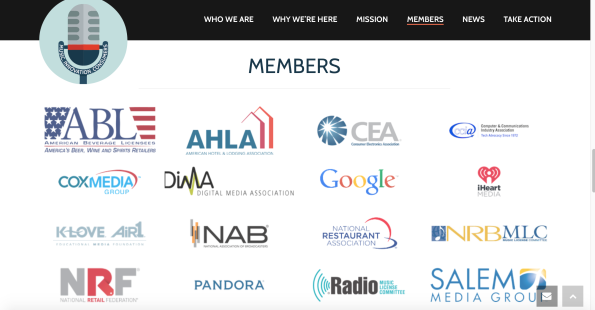
Related articles