

By Eric Zhigong Zhao
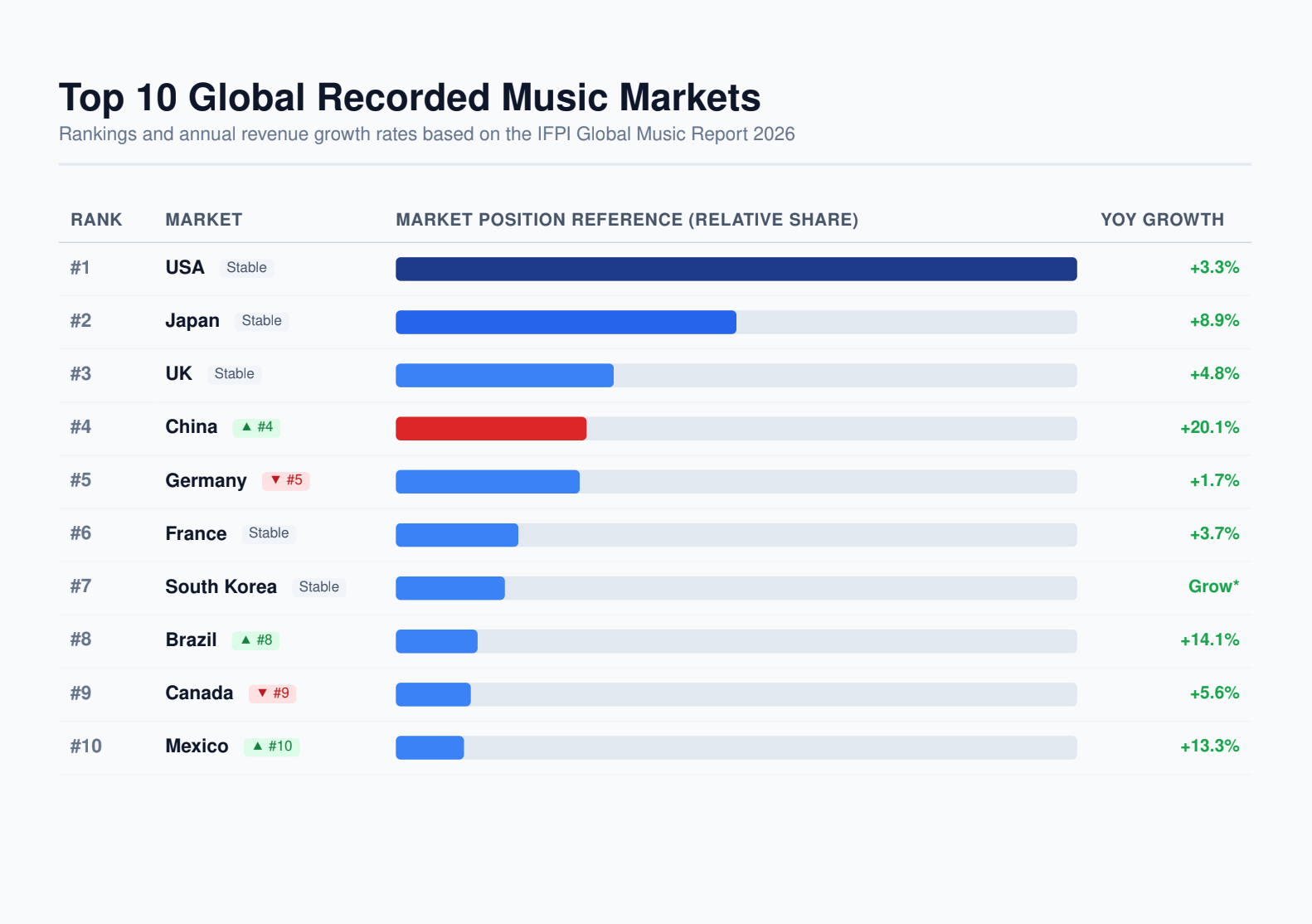
In March 2026, IFPI reported that China had passed Germany to become the world's fourth-largest recorded music market, after a single year of 20.1 percent growth, the fastest of any major market.1
To a foreign artist, manager or label, the math looks like an open door. More than a billion listeners. A market growing while North America slows. A paying audience still far from its ceiling.
That open door is where the trouble starts.
I work on the other side of it, as an intellectual property and entertainment lawyer in China, on the contracts, licenses and disputes that foreign acts and rights holders usually meet only after something has gone wrong. Most of them arrive with one core misunderstanding, and it is bigger than censorship or piracy, the two reasons Western coverage always reaches for.
They think that China is one market. It is not. It is a stack of separate markets that do not share customers, rules, or money, and a strategy that wins in one of them can be dead weight in the next. Here is the map.
1) You cannot enter the market by yourself.
In most Western countries a foreign artist can, in principle, promote a show, sign a distributor, and license a recording to a platform on their own. In China, each of those steps runs through a licensed domestic gatekeeper by law.
A commercial performance needs a permit from the local Culture and Tourism authority, and a foreign act cannot hold or apply for that permit itself. The application goes through a licensed performance agency. The setlist is filed for approval before a single ticket is sold. Approvals attach to one venue, one date, one lineup, and they can freeze during politically sensitive weeks that have nothing to do with the music.

The usual advice, "find a local partner," is correct and close to useless, because it treats that partner as a convenience. The partner is the entity that legally holds your permit, controls your approvals, and often sits inside the chain of your rights.
Having reviewed dozens of agency and sub-licensing agreements involving foreign rights holders, I can tell you the failure point is almost always the same three questions: who actually controls the performance permit, how your rights move down the sub-licensing chain, and who absorbs the loss when an approval is pulled at the last minute.
Get those wrong and your streaming numbers will not save you.
2) "Weak copyright" is the wrong frame.
The reflex belief that China has no real copyright protection is out of date. The Copyright Law amended in 2020 and in force since June 2021 introduced punitive damages for willful infringement, and through Article 45 gave sound recording producers a right to payment when their recordings are broadcast or publicly performed.
The comparison people assume, weak China against strong America, does not hold cleanly either. The United States has no public performance right for sound recordings on AM/FM radio at all. When a song plays on terrestrial radio in the US, the songwriter gets paid and the owner of the recording does not. The US does pay recording owners for digital and satellite play, collected by SoundExchange. China's Article 45 reaches further on paper, into traditional broadcast and public performances of sound recordings.
On paper, anyway. The real problem in China is collection. Walk into a shopping mall, a chain restaurant, or any of the millions of bubble-tea shops, and you will hear current hits, often a Billboard single within days of its release, exactly as you would in the US. Almost none of that throws off a public performance fee that reaches the rights holder. The right exists. The plumbing to collect it barely does.
Two bodies handle music collective licensing, and foreign rights holders should know which is which. The Music Copyright Society of China (MCSC), founded in 1992, is the only collective society for musical works, meaning composition and lyrics. The China Audio-Video Copyright Association (CAVCA), founded in 2008, is the only society for sound and video recordings.
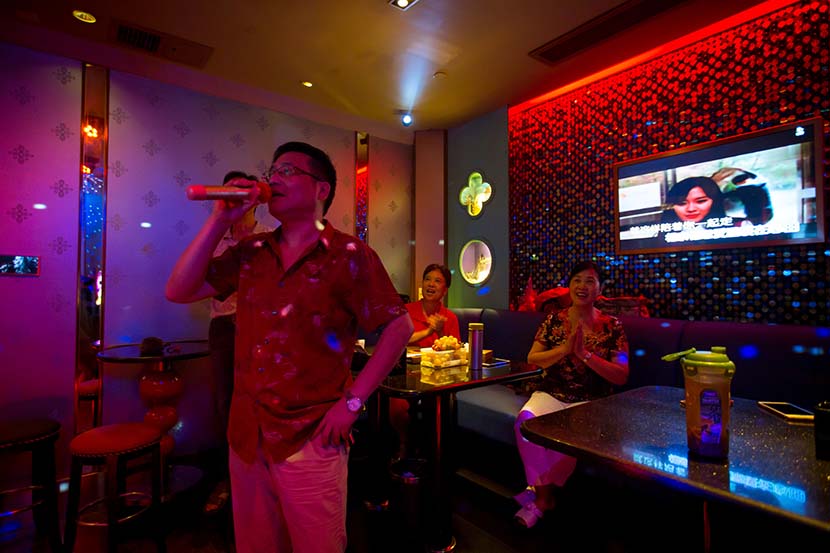
The framework dates back to China's WTO accession era. MCSC manages musical works, while CAVCA focuses primarily on recordings, particularly karaoke licensing. Before the smartphone, KTV was the country's default night out, and that licensing stream was substantial. There is no competitive layer of ASCAP, BMI, SESAC and GMR here for a publisher to play one off against the other. Registration among independent and foreign rights holders is thin, and the distance between a right you hold and money in your account is wide.
One contract warning while you are here. A large share of Chinese music deals default to a buyout, a single payment for a broad transfer of rights. Foreign songwriters routinely sign away more than they meant to, because the document assumes assignment where they assumed a license. Read the rights clause as if every word costs money, because it does.
+Read more: "What Is Tencent Music? And What Makes China’s Streaming So Unique?"
3) The platforms do not work the way yours do.
Spotify does not operate in mainland China. Tencent Music (TME) runs the market through QQ Music, Kugou and Kuwo, with NetEase Cloud Music as the main challenger.
The licensing rules changed in 2021, and the detail matters. China's market regulator did not ban exclusivity outright. It ordered TME to give up the long-term exclusive lock-ups it held with the global majors, after finding it controlled more than 80 percent of exclusive library rights following its 2016 merger with China Music Corporation.
What survived is narrower and still legal: exclusive deals with independent artists for up to three years, and an exclusive release window of up to 30 days for new songs. That 30-day window has become a competitive tool. When TF Entertainment, the company behind some of China's biggest idol groups, signed with both TME and NetEase, TME secured a first-release window.
For a foreign artist with real demand, that short exclusivity is a genuine point of leverage, the kind of thing a platform will pay a premium to lock down for a launch.
4) China is not one market.
This is the part nobody writes in English, and it is where most foreign money gets wasted.
China is not a single audience reached through a single channel. It is at least seven loosely connected markets: the music festival circuit, the brand and advertising market, the Douyin (TikTok's Chinese sibling) short-video economy, paid streaming, the idol industry, the indie and Livehouse scene, and the ACG (anime, comics and games) subculture market. Each has its own gatekeepers, economics and audience. Winning one does not transfer to the others.
A Douyin explosion does not sell concert tickets. A festival favorite is not a streaming winner. A streaming star is not the artist a brand wants for an endorsement. Even "live" is layered: the Livehouse and festival worlds barely overlap with the arena-tour market that established Hong Kong and Taiwan stars still fill.
The clearest recent example is the rapper Lan Lao (SKAI ISYOURGOD). His track "Ba Fang Lai Cai" came out in August 2024 and broke out in early 2025, almost entirely through Douyin, where a remix and a dance turned it into a meme with billions of views. The short-video boom was not the income.
As one producer explained to a Chinese business publication, that repetition works as a funnel, pushing listeners back to QQ Music and NetEase Cloud where royalties actually settle. From there the song spread into other markets on its own terms. He topped Spotify's Chinese-language artist chart, passing Jay Chou, booked sold-out shows in Singapore, Australia and Europe, and landed a brand tie-in, a Lunar New Year remix with Carlsberg.
One artist, moving across short video, streaming, live and brand, with different mechanics paying out at each stop.
The brand market deserves its own line, because it is large and nearly invisible to outsiders. For Lunar New Year 2025, lululemon commissioned the independent musician Ding Ke to write an original song, "Back to Spring," for a campaign film fronted by the singer Li Yuchun, and released it to streaming platforms.
Brands here often want original music or a local ambassador rather than a license to a foreign hit, which is one more reason foreign catalog struggles to convert.
And streaming is no longer the dead end it is often called. TME's 2025 results show subscription revenue of about 17.7 billion Yuan, roughly $2.5 billion USD, up 16 percent, with 127 million paying users. The catch is the unit economics. Monthly revenue per paying user sits near 12 yuan, under two dollars, against the ten-plus dollars a Western service charges. The fastest growth is in everything around the subscription, concerts, merchandise and advertising, up about 40 percent, which is the multi-market structure showing up inside one company's income statement.2
Underneath all of it is the fan economy. Organized fan groups buy digital albums in bulk and fund promotion as a coordinated activity, and that spending, rather than passive listening, drives a lot of what looks like popularity. Its scale went public in 2021, when an idol-show voting mechanic tied to a dairy sponsor led fans to buy bottled milk for the codes inside and pour the milk away.
Regulators moved fast and reined the format in, and two lessons stuck:
- Fan monetization here is industrial,
- and the demand side of this market sits under direct political supervision in a way the Western supply side does not.
5) Why a market this big stays local.
Stack these layers and the localization of the market stops looking like a wall and starts looking like the rational output of the system. Platform economics reward domestic traffic, because domestic idols and viral local acts generate the fan spending the platforms are built to capture.
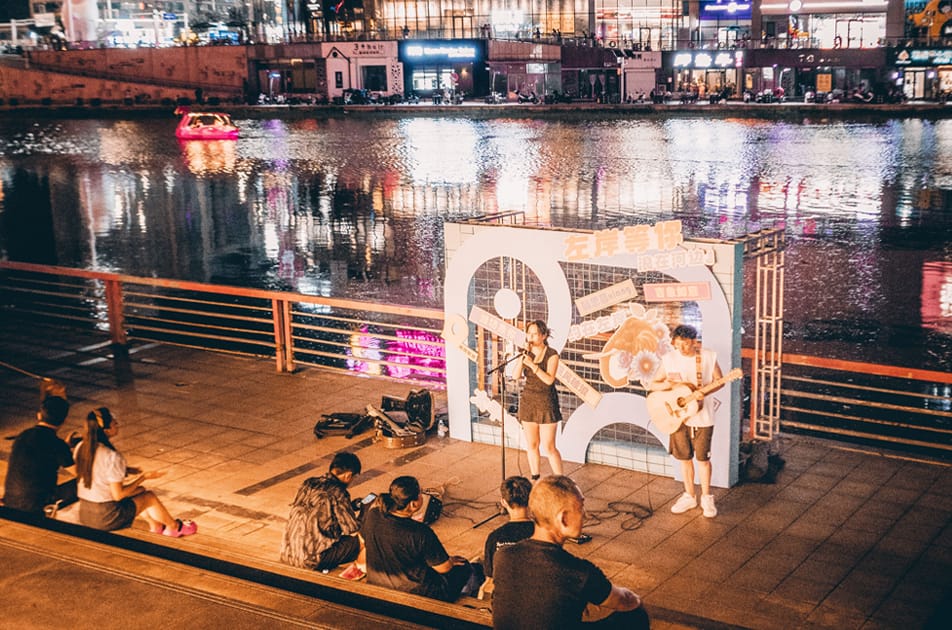
The approval regime adds cost, delay and cancellation risk to foreign content specifically. Algorithms and audience taste compound a home-grown catalog. Live touring across China's tiered cities rewards acts who can sustain a domestic circuit, which foreign artists rarely can. Even foreign brands tend to hire a local ambassador over licensing a foreign song, because it converts better.
None of this is sealed off. Foreign music circulates, foreign acts tour, deals close every week. The point is sharper and more useful than "China is hard." The market stays domestic because every layer of it, legal, platform, economic and administrative, is tuned for content that moves inside the system rather than across its edge.
China is not a market you enter once. It is a series of markets you enter separately.
Eric Zhigong Zhao is an IP and entertainment lawyer in China, working in Chinese and English. He came to the law from the other side of the studio glass. In college he made beats on an Akai MPC and played bass, and he still loses weekends to crate-digging and Discogs, with J Dilla as the bar everything gets measured against. Today he advises independent artists, labels, management companies and platforms on music copyright, performance licensing, trademarks, and cross-border deals between China and the West.
Footnotes
- IFPI, Global Music Report 2026. https://www.ifpi.org/global-music-report-2026-global-recorded-music-revenues-grow-6-4-as-record-companies-drive-innovation/
- Tencent Music Entertainment Group, Fourth Quarter and Full-Year 2025 Unaudited Financial Results (March 17, 2026). Full-year music subscription revenue RMB 17.66 billion (US$2.53 billion), up 16.0 percent; music services other than subscriptions RMB 9.07 billion, up 39.2 percent; 127.4 million paying users and monthly ARPPU of RMB 11.9 as of year-end 2025. https://ir.tencentmusic.com/2026-03-17-Tencent-Music-Entertainment-Group-Announces-Fourth-Quarter-and-Full-Year-2025-Unaudited-Financial-Results