

In recent years, a growing number of artists have chosen to step far outside traditional concert halls and festival stages in order to bring their music directly into some of the planet’s most fragile and awe-inspiring environments.
Sure, some of these are for the purpose of creating a spectacle. In many cases, that spectacle is meant to create mass awareness of the vulnerability of the natural environments that are situated just beyond the boundaries of our cities; cities which typically house cultural performances by artists such as these. Supported by organizations' fundraising efforts to protect these wild spaces, artists can often be seen in these videos reckoning with the bigness of their moment, the vastness of a landscape that both cradles and ignores the performer making a racket within.
By placing instruments and sounds where audiences cannot follow or do not belong, artists have an opportunity to both reframe our relationship with the wild world and what it means to our species, as well as our engagement with live music, in recognizing how crucial of a communication tool that is as well.
Here are a handful of our favorite live music moments which have occurred in faraway places on Planet Earth.
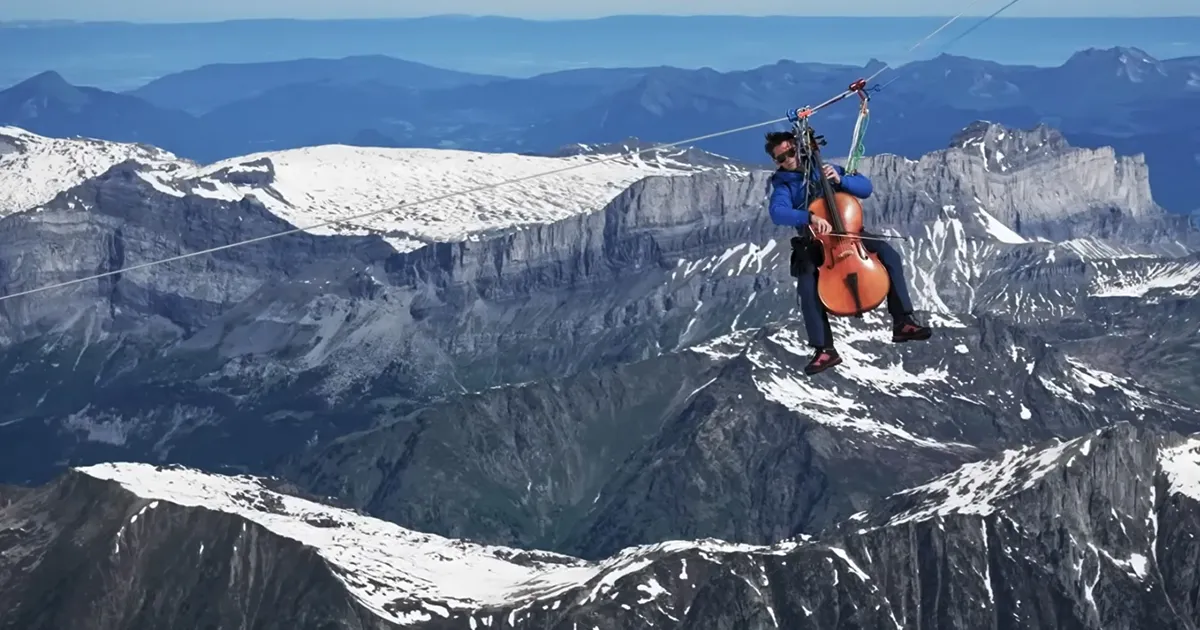
Gautier Capuçon — Cello on a Zipline in the French Alps (2025)
In one of the most visually arresting classical performances in recent memory, Gautier Capuçon played the cello while suspended from a zipline hundreds of feet above the French Alps. The performance accompanied the release of his album Gaïa, a project explicitly centered on humanity’s relationship with the natural world. As Capuçon glides across the snowy expanse, the image blurs the line between human vulnerability and environmental scale — a deliberate reminder of how small we are in landscapes increasingly affected by climate change.
Ludovico Einaudi — Piano on an Arctic Iceberg (2016)
Ludovico Einaudi’s now-iconic performance saw the composer playing a grand piano atop a floating iceberg in the Arctic Ocean, staged in collaboration with Greenpeace. Performed as glaciers cracked and drifted behind him, the piece transformed climate data into something emotionally tangible. The fragility of the ice beneath the piano became the message itself — a haunting visual metaphor for ecosystems on the brink.
Metallica — Concert in Antarctica (2013)
Metallica made history as the first band to perform on all seven continents when they staged a concert at Argentina’s Carlini Research Station in Antarctica. Playing inside a transparent dome without traditional amplification to protect the environment, the band performed to scientists and contest winners wearing headphones. The performance underscored that even the most extreme, seemingly untouched places on Earth are no longer disconnected from global culture — or global responsibility.
FKJ — Piano at Bolivia’s Salar de Uyuni (2019)
French musician FKJ (F***ing Jazzy Feel) recorded a serene piano performance at Salar de Uyuni, the world’s largest salt flat, where land and sky dissolve into one another. The minimalist performance relied almost entirely on natural acoustics and ambient sound, allowing the vastness of the environment to shape the music itself. The result felt less like a concert and more like a meditation on scale, silence, and balance.
Ólafur Arnalds — Live Set in Iceland’s Volcanic Highlands (2020)
Filmed in the remote highlands of his home country, Iceland, Ólafur Arnalds performed surrounded by volcanic rock, glaciers, and open tundra — landscapes that have defined much of his work. With no visible audience and minimal infrastructure, the performance emphasized solitude and environmental intimacy. Arnalds has frequently spoken about Iceland’s rapidly changing climate, making the location itself an unspoken part of the composition.
Ryuichi Sakamoto — Piano in Fukushima’s Exclusion Zone (2014)
In 2012, the late composer and pianist Ryuichi Sakamoto traveled to the Miyagi Prefecture to examine, and later purchase, a damaged piano recovered from the ruins of the tsunami spawned by the Great East Japan Earthquake in March 2011. The instrument, detuned and submerged in tidewaters, became an extension of the landscape itself — its broken sound reflecting environmental trauma rather than perfection. Filmed in near silence amid empty homes and overgrown land, the performance was less a concert than a quiet elegy for ecosystems permanently altered by human intervention.
In the end, what unites all of these moments isn’t novelty, but intent.
Allowing audiences globally to experience music that's been performed in, and shaped by, these vulnerable natural ecosystems we coexist amongst, puts content like this into perspective. They're whispered protests, signalling to live music audiences that culture isn't separate from our communal obligations as citizens of this planet, but enwrapped within them.