

________________________________________
Guest Post by Josh Messer on PressPlayOn Monday night, DJ, producer, and DJ Mag’s new Editor-At-Large Dani Deahl shared this text message, which a musician friend of hers received from a blogger.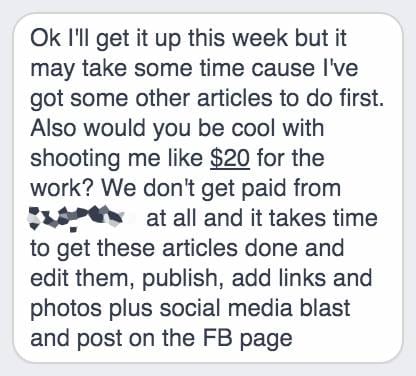 To clarify this situation if you don’t fully grasp: a blog writer is asking a recording artist for payment in exchange for posting a written review to their outlet. This is called payola, a common form of music-related bribery that’s as old as radio itself, but something that’s grown to exist in myriad forms.In the comment section of her Facebook post, Dani posted a link to The Society of Professional Journalists, who have a specific term for payola in our specific realm: “checkbook journalism.” They strongly admonish any professional writer who engages in it. “Checkbook journalism undermines journalistic independence and integrity and threatens the accuracy of the information that is purchased,” SPJ holds in their official position paper on the topic.Its current most-popular form falls short of false advertising, but not by much. The problem with payola is that when a party that stands to benefit from supposedly impartial coverage, is then forced to purchase said coverage, the credibility of both the purchaser and the source providing this coverage is completely nullified. The introduction of monetary incentive into journalistic process inherently diminishes the incentive to prioritize offering high-quality, or even just satisfactory coverage — period.Even when fair and impartially administered salaries are paid to writers by employer publications (as they honestly deserve), this still creates an incentive for writers to create content that benefits the interests of these publications. This goes double for those whose salaries are rooted from ad revenue, at which point the interests of those advertisers also comes into play.Non-profit journalism describes many music blogs as we know them, in that writers receive no profit from neither the publishing site nor the artist; PressPlay operates in this manner. Both of these scenarios, however, presume that writers do not accept under-the-table payment in addition to assuming either of these roles — a topic that was itself a pervasive issue in 2015, when Hype Machine removed several handfuls of notable blogs over mass payola allegations. (edit: Facebook commenters have noted that Discobelle and some other sites may have been removed in error. Discobelle and several other blogs initially implicated in this scheme had indexes reinstated by Hype Machine. Others, such as Dancing Astronaut, remain removed from indexing but dispute claims of payola.).Meanwhile, ask any handful of PR providers or unsigned producers in the music industry and you will assuredly hear of a noticeable and accelerating decline amongst electronic music press on a universal scale. I contributed to the Complex Media-owned music blog Do Androids Dance at the time of its cancellation in January. The writing staff knew that we were among a dwindling number of writers at major outlets that didn’t tolerate payola in any form. Complex abruptly cut our funding (which supported several writers as part-time jobs) seemingly at our zenith, and there was a consensus among the staff of “if it’s this bad for us, just imagine how bad it is for everyone else.” Complex graciously migrated all of DAD’s posts to their own site, but their dropping of the brand was otherwise unceremonious.Nearly a year on and we weren’t wrong. Almost any music that isn’t being pushed by a dedicated publicist or manager is nearly guaranteed to go undiscovered by just about everyone. Not only is it now considered suicide to upload uncleared remixed material to Soundcloud, but don’t even ask about uploading something without an arranged blog premiere unless you’ve got follower counts in the five figures. Payola thrives where hard work presents itself as too inconvenient. It thrives when conventional means no longer yield reasonable results, and they haven’t for a while.Discovering music on the internet has finally reached a saturation point where if someone hasn’t told you to listen to it — whether it’s a subscription streaming service, a DJ, a blogger, a publicist, or a friend — you are utterly unlikely to ever know it exists.It speaks volumes when this statement remains true for even our foremost music curators. It deafens when you consider the truth that an increasing number of these curators are being paid off secretly by the artists themselves to attain that traction. Personal agency in finding our own music has been systematically removed, usually because someone is benefitting monetarily by removing it. Payola (in the form of checkbook journalism) simply involves cutting in journalists on this list of undisclosed beneficiaries.I’m happy to say I’ve never accepted any pay to write about a track on a blog. I do receive pay to conduct a bunch of promotion-related services via my start-up PR and management company, The Subvert Agency, but all cases of this are clearly delineated as such. You’ll also never see a post on PressPlay or any other site about a Subvert-affiliated artist that’s authored by me — that’s also payola. Sometimes bloggers will plagiarize my written copy (from my mailers and pitches) and I’m hardly surprised because these are usually the same people that encourage this scam.By the way, when people benefit from a dishonest scheme, that is a scam. Checkbook journalism, by its definition, is a scam.