


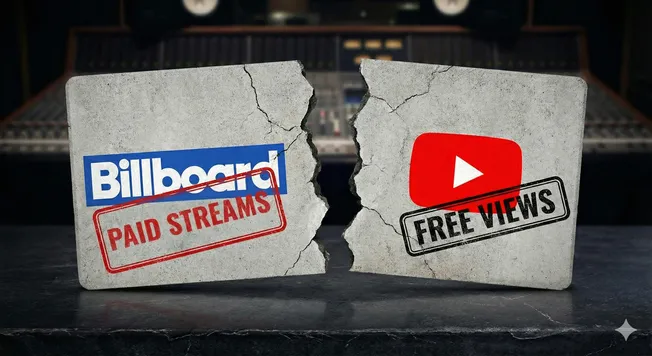
YouTube has officially pulled the plug on its decade-long data partnership with Billboard. As of January 16, 2026, views from the world’s largest video platform no longer factor into any U.S. Billboard charts.
Why: A Battle of Ratios
The data divorce stems from a fundamental disagreement over how a "fan" is valued. For years, Billboard has used a weighted system that favors paid subscription streams (Apple Music, Spotify Premium) over free, ad-supported ones.
- Billboard's Move: Billboard recently updated its formula to narrow the gap. Starting in early 2026, the ratio changed from 1:3 to 1:2.5. Under the new math, it takes 1,000 paid streams or 2,500 ad-supported streams to equal one album unit.
- YouTube's Stance: Lyor Cohen, YouTube’s Global Head of Music, argued that "every fan matters" and demanded a 1:1 ratio. When Billboard refused to treat a free YouTube view the same as a paid Spotify stream, YouTube decided to take its data and go home.
How to Pivot Your Marketing and Release Strategy
With YouTube data off the Billboard table, the "visual-first" marketing playbook just got a massive update. Here’s how to adjust:
- Prioritize DSP Pre-Saves and Paid Tiers: Since Billboard now weights paid streams even more heavily and YouTube views are out, focus your "launch week" energy on driving fans to Spotify, Apple Music, and Amazon. A single stream from a paid subscriber is now worth significantly more than any free stream or video view.
- Repurpose Music Video Budgets: If the primary goal is a chart position, consider shifting a portion of your music video budget into short-form content and influencer campaigns that drive audio streams. Long-form videos should now be viewed as brand builders rather than chart drivers.
- Lean Into YouTube-Only Milestones: Use YouTube’s internal charts and Google Trends data to prove reach to talent bookers and sponsors. Just because it isn't on Billboard doesn't mean it isn't a hit; you just have to present the data differently.
- Double Down on "Audio-First" Assets: Canvas for "visualizer" videos or lyric clips on YouTube to keep the platform’s community engaged, but save the heavy-hitting marketing spend for platforms that Luminate (Billboard’s data provider) still tracks. [More info on Billboard's data sources here.]
What This Means for Artists & Labels
This isn't just a backend data tweak; Billboard is trying to shift how success is defined.
- A Growing Visibility Gap: Artists who rely on visual storytelling, viral music videos, and global fanbases—K-Pop, Latin, Hip-Hop and more—,ay see a significant dip in chart positions. A song that is a "cultural moment" on YouTube may no longer look like a "hit" on the Billboard charts.
- The Rise of Alternative Metrics: Expect YouTube’s own internal charts to become more vital for booking agents and brands who need to see the full reach of an artist beyond Billboard’s filtered lens
Irving Azoff Says "Good Riddance"
Not everyone is mourning the loss of YouTube data.
In a scathing open letter released via Pollstar, music mogul Irving Azoff applauded Billboard for standing up to what he calls the "bully" of the tech world.
"I have been waiting to see who’s willing to stand up to the bully that is YouTube, and kudos to Billboard for doing just that... Until YouTube starts paying artists and songwriters more, I say good riddance—we’re all better off without them."
— Irving Azoff
Azoff’s argument is simple: YouTube pays significantly lower royalty rates than its competitors. By refusing to weight YouTube's free streams equally, Billboard is protecting the "value" of music that fans actually pay for.
Hypebot's Bottom Line
We are entering a fragmented era of measurement. There is now one chart for "revenue-generating popularity" (Billboard) and another for "raw cultural reach" (YouTube).
For the independent artist, the message is clear: don't chase the chart; chase the community.