

By Kyle Bylin from Music 2045
01
My Journey from Music to AI
Earlier this week, I reflected on my career in the music industry. I wondered what the next five years would look like if frontier AI labs stayed on their current trajectory.
If you and I time-traveled to 2030, what might the music industry look like? What would stay the same, and what would forever be changed?
For the past year, I have been immersed in higher education, working in an academic library and advocating for AI literacy and fluency to be taught to college students. I believe this knowledge base and skillset will be essential to obtaining a job in the future.
One of the challenges to teaching a generalist subject—especially if you lack domain expertise—is trying to imagine how AI literacy can be applied in professional settings. It's hard! However, I have a unique perspective on the music industry due to my career history. For the past twenty years, I have worked in various sectors of the 'music industries,' as they're more correctly understood by the in-crowd, academics, and experts.
I initially interned at an indie label called 50 Entertainment and a concert promoter named Jade Presents. Next, I landed jobs as a technology editor and writer for Hypebot and a social chart manager for Billboard. As the smartphone and mobile app sector exploded, I pivoted into technology and conducted user research for Live Nation Labs, SoundHound, and Scout.FM. I also hosted a podcast about the music industry for nearly four years—and one hundred episodes—during this time. Lastly, I continued my education by earning a Bachelor of Arts in Music Business during the COVID-19 pandemic. Soon after, I got a full tuition scholarship to the University of Michigan, where I earned a Master of Science in Information.
Accordingly, I know a lot of people, and I still follow the news loosely. But it's been a bit since I worked in different parts of the music industry and talked to those who worked in other parts of the industry every week. I've also never worked at a major record label, music publishing company, or artist management company, among other important places, so I do have a few blind spots regarding the artist and copyright side of the industry. Instead, my specialty has always been my interest in emerging technologies and consumer behaviors. It's the needle that threads through my career and remains at the center of most essay subjects I write about.
If you and I time-traveled to 2030, what might the music industry look like?
02
Teaching AI Literacy for a New Era
For anyone unfamiliar, academic librarians in higher education institutions—such as major universities and colleges—often offer English 111 and information literacy classes to students. These classes cover how to find and evaluate peer-reviewed journal articles, distinguish scholarly from popular sources, develop effective search strategies, and use information ethically. Now, with the rise of chatbots like OpenAI's ChatGPT, Google's Gemini, and Anthropic's Claude—which can generate text, images, and other forms of media—an emerging discipline called AI literacy is developing. This broader umbrella seeks to encompass everything that high school or college students might need to know about AI.
While traditional information literacy focuses on evaluating the credibility and accuracy of sources, AI literacy pushes these skills further. How? By challenging us to analyze how AI-generated information is created, what ethical and copyright concerns are involved, and how bias may be embedded in the models themselves. Large language models, powered by vast computational resources, can produce content that mimics human writing in remarkable ways, even as experts admit the inner workings remain a bit of a black box.
As an academic librarian who teaches and writes about AI literacy, I've been closely observing how rapidly AI capabilities are advancing and transforming the information landscape. I've argued in recent essays about the importance of considering the profound impact powerful AI will have on students' future careers—especially since the world may look quite different by 2030 when today's students graduate and enter the workforce. With this perspective, I set out to explore how AI literacy can be integrated into music industry education. Students currently enrolled in music programs need to be prepared to become 'AI fluent' and equipped to navigate and shape the so-called 'Intelligence Age' these students will soon enter.
The most important thing that chatbots enable is the ability for anyone to ask questions about any topic.
AI Literacy
The ability to understand, evaluate, and ethically use AI systems—from recognizing AI-generated content to understanding bias, training data, and model limitations.
ChatGPT Prompt:
"Explain the music industry in one sentence to a college student."
ChatGPT Response:
"A global ecosystem where artists create music, businesses (like labels, publishers, and streaming platforms) package and distribute it, and fans fuel it with their attention and money, while technology and culture constantly reshape the rules of the game."
ChatGPT Prompt:
"Explain how to market music online in one sentence."
ChatGPT Response:
"Marketing music online means strategically blending social media, streaming platforms, and digital storytelling to build a loyal audience, spark engagement, and turn casual listeners into lifelong fans."
The music industry is highly concentrated in just a few regions, so you often must live in places like Los Angeles, Nashville, New York, or London to regularly encounter people who work in the field. While you can follow trade publications such as Billboard, Hypebot, Digital Music News, and Music Business Worldwide, most young people are likely unaware of these sources.
In other words, information is both abundant and scarce—but you must take the first step to seek it out either way. The content may never find you otherwise.
From Theory to Practice
03
Can Anyone Become or Discover the Next Eminem?
Anyone can now use deep research to find information about any subject and conduct extensive online research. A band could use ChatGPT to conduct extensive research into the top 5 similar-sounding bands and where they toured early in their careers. The aspiring band could then see if any of those venues would be willing to book the band once they reached a certain TikTok audience size. Or they could use a simple prompt: 'Give me a 25-step, 25-day plan to grow my audience on TikTok to X size.' Then the band could just keep repeating that loop for a year until they went viral. In twelve months, perhaps the band will turn that influence and viewership into brand sponsorships or even band interest. Or the band could try to double down on recording original music if they had previously been doing covers. The whole idea is that people can now follow their journey wherever it may lead. And for those who actually stick to the plan, they might actually see huge returns and benefits that would have mystified people back in 2000–2006 (when I was in middle school and high school).
Additionally, with Perplexity's new Comet browser, you can just ask the assistant to take control of the browser and start looking up information, sending personalized emails, and trying to pitch yourself to people in different ways. An enterprising enough young person who really wanted to market their music to a wider audience could do just that. Think of young Eminem in Detroit, Michigan. He could have just taken his rap music and put it into the inboxes of every single music industry's email account and social media that he could find online.
You don't even need to be able to sing or play an instrument now.
It's an odd thing to admit—it's almost like machine beats human defeat—but you don't even need to be able to sing or play an instrument now. You could just fire up an account on Suno and start generating hundreds of songs until you started to hone your Rick Rubin golden ear for the sound and the feeling you want from your AI artist's first couple of albums. Maybe you decide that you want to start an entire roster of AI artists and create Interscope Records in a small town in North Dakota. You might want to be known as the kid who discovered, developed, and released the first record from the first Eminem-level AI rapper after randomly stumbling across a TikTok that inspired your ambitions to become an intelligence age music tycoon by the same age as Taylor Swift when she achieved breakthrough success.
If you are an aspiring artist or music business student who wants to put yourself out there and get attention, you can now do so ways previously unimaginable. And if you truly have a remarkable story or a compelling rap to back you up, AI can help you achieve your wildest dreams faster than ever before.
The Intelligence Revolution
04
AGI and the Future of Creativity
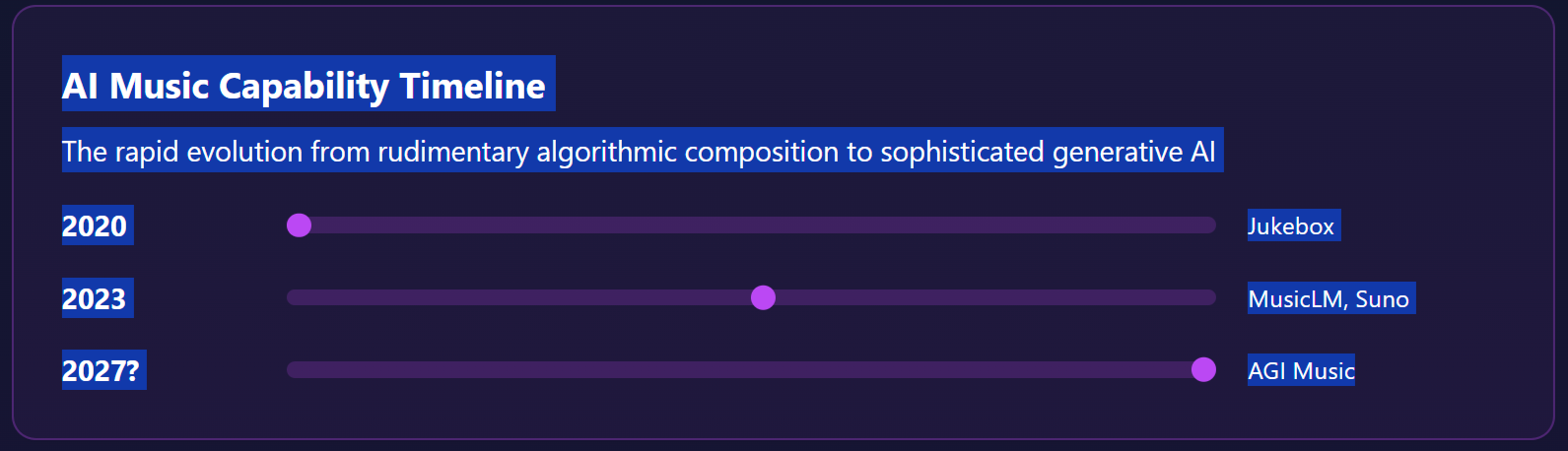
AI Music Capability Timeline
The rapid evolution from rudimentary algorithmic composition to sophisticated generative AI
AGI (Artificial General Intelligence)
AI systems that can perform any intellectual task a human can do—reasoning across domains, learning from minimal examples, and adapting to novel situations.
Key predictions for AGI arrival:
- Sam Altman (OpenAI): 2027-2029
- Dario Amodei (Anthropic): 2026-2027
- Ray Kurzweil: 2029 (predicted in 2005)
- Demis Hassabis (Google DeepMind): Late 2020s
In previous essays for academic library trade publications, I covered predictions about the next five years of frontier AI development, drawing on commentary from leaders like Sam Altman, Dario Amodei, Demis Hassabis, Elon Musk, Mark Zuckerberg, and Eric Schmidt. Conversations have since evolved rapidly. In just the past six months—as I have written on Substack—the focus has shifted toward concepts like superintelligence and singularity.
When writing my Hypebot essay 'Let 1,000 AI Startups Bloom: Why the Time to Disrupt the Music Industry Is Now,' I recognized that AI would soon revolutionize the music industry—much more than past innovations like MP3s, social media, streaming, and smartphones. But what I fully understand now is that the true purpose of the AI race was never just about building better chatbots or music generators. The real goal is the creation of artificial general intelligence (AGI) and artificial superintelligence (ASI): advanced systems that can perform any work a human can do, potentially even controlling internet-connected machines and, ultimately, advanced humanoid robots.
The real goal is the creation of artificial general intelligence.
In late 2023, my focus shifted to how AI could rapidly democratize music creation and unleash a new wave of innovation. Reading the 2023 book *The Coming Wave* by Mustafa Suleyman—co-founder of DeepMind and current CEO of Microsoft AI—led me to recognize AI as a transformative general-purpose technology, potentially even more disruptive than streaming, digital players, or MP3s. My predictions centered on the rise of generative music tools like Suno, Udio, and others, which let anyone—even those with no formal training—create, produce, and distribute professional-quality songs in minutes.
This shift is already challenging the music industry's established power structures. While major record labels are now negotiating with and even suing these AI startups over licensing and copyright, the technology continues to enable the emergence of a creative class that's organic, synthetic, and hybrid—a class that could rival, redefine, or even replace today's superstar artists and major music companies. Alternatively, these innovations might paradoxically make traditional music stars more valuable than ever by further amplifying the importance of brand, curation, and provenance in an algorithm-driven era.
AGI would mean AI systems that can perform any intellectual task as well as a human, including mastering music theory, songwriting, arrangement, and even the nuances of production and audience engagement. In the music industry, AGI could produce convincing hits, manage marketing campaigns, analyze audience data, design artist 'brands,' and continually optimize every variable for success. The entire process—from ideation to global distribution—could be streamlined and hyper-personalized, further blurring lines between 'artist' and 'algorithm.'
Standing now in 2025, two things are simultaneously true: People still mostly find music through recommendation feeds, playlists, TikTok virality, and curated streaming services. And pick-up trucks with radio station promotional marketing still park outside, and social media people post on Facebook about listening to broadcast radio.
But as we look toward 2035 or 2045 in a world with AGI—or even ASI—the way we discover and experience music could be fundamentally different. Algorithms may not just suggest, but also actively compose new music based on our moods, biometrics, or social networks. Algorithms might even merge audio, video, and real-time augmented or virtual reality-based performances into seamless, personalized experiences that adapt in real-time to show you every possible iteration of a concert video that you could imagine and beyond. It's not just Taylor Swift, Era's Tour; it's the infinite universe of potential music venues to visit.
Accordingly, training young people for careers in music—or any field touched by frontier AI—means preparing them for profound unpredictability. Today's overhyped skillsets may be irrelevant tomorrow. Just look to the rise and fall of prompt engineering as an example. Thus, roles we now see as essential may vanish while new ones emerge unpredictably.
In that environment, the best education that we can offer students in any major might be foundational adaptability and imagination. It's a unique mix of deep curiosity, creative process, strategic foresight, design thinking, and ethical grounding. It's the ability to learn and collaborate across human–machine partnerships.
In a future shaped by superintelligence, true human distinctiveness may come from embracing what only we can offer—our messy, subjective, unpredictable insight—while thoughtfully guiding the AI systems continuously redrawing the boundaries of everything.
The Existential Question
05
If Anyone Creates Music, Does It Even Matter?
If anyone can create music, does music even matter?
The Singularity
A hypothetical future point when technological growth becomes uncontrollable and irreversible, resulting in unforeseeable changes to human civilization—often associated with the emergence of superintelligent AI.
Lately, I've started to lose sleep over a question that feels both existential and intensely practical: If anyone can create, generate, or automate music, does music even matter? Other questions underlie that one, too. Will real music matter even more or less? Or at the outer limit, what does it mean if the intelligence behind that creativity grows beyond any semblance of human control?
My anxiety over these questions has taken on a new shape after I read reviews of the decisively titled AI doomer manifesto *If Anyone Builds It, Everyone Dies* by Eliezer Yudkowsky and Nate Soares. The book is arrestingly direct—a title almost too big or too bleak to take seriously until you grapple with the force of the authors' argument. In their telling, if any lab, company, or rogue actor succeeds in building something like a superintelligent AI with today's methods, extinction isn't just possible; it's the default outcome.
Yudkowsky and Soares make a simple, unbearably stark argument: The goals of a superintelligent AI are unlikely to be our goals. Even the subtlest divergence, the authors argue, could produce outcomes catastrophic enough to wipe us out—whether through malice or simple indifference.
Yet as I read and reread the book's reviews, something struck me: Despite all the book's cataclysmic framing, the music industry is never once mentioned. Yudkowsky and Soares are after something bigger than royalties or hit singles. But the authors' logic lands close to home.
If they're right, it won't just be musicians and songwriters swept aside; it will also be the idea of culture, creativity, and meaning as living, evolving, and distinctly ours. I imagine a world in which music, as both practice and communal experience, becomes as irrelevant as paper maps in the age of satellite navigation. Would we even notice when it slips away?
So what are we, as stewards of music, supposed to do? As I see it, the debate over AI safety, alignment, and global regulation is something our field can no longer afford to sit out. Musicians, educators, label heads, and fans alike must demand a seat at those tables—must advocate, lobby, and insist that the huge questions of intelligence and power are questions of culture, not just code.
Meanwhile, the pace of change means that every business model, every conventional wisdom, could become obsolete with shocking speed. It feels like we're weatherproofing the roof while a hurricane forms offshore—and most people don't know the storm is even there. As for those who hear the storm warnings? We can't agree on whether it's real.
The urgency for focus beyond copyright and licensing rhetoric is total. The existential question posed by superintelligence has little to do with short-term revenue splits or licensing models, and everything to do with what remains when the machines outgrow us. Maybe brand and curation will save us—protect the few authentic beacons in an infinite sea of generated sound—or maybe they're swept away in the tide along with everything else. There may never be a consensus on just how much risk, or how much reward, we think is at stake.
But Yudkowsky and Soares offer a provocation that simply cannot be ignored: What will we wish we had done now, before the moment passes? The music industry has always been about anticipation, reinvention, and reckoning with change. This time, those instincts might be what let today's industry professionals endure, adapt, and reimagine not just their workplaces, but our place in a world where even the act of creating is up for grabs.
Today, as I think about this new cohort of students arriving in music programs—brimming with ambition and uncertainty—I am left with a single question echoing above it all: Are we truly preparing them, and ourselves, for a future that might be rewritten by forces more powerful and unpredictable than anything the industry has ever known?
And that leaves you and I with something to ponder: If AGI arrives between 2025 and 2030, what will we wish we had done before the moment happens?
About Kyle Bylin
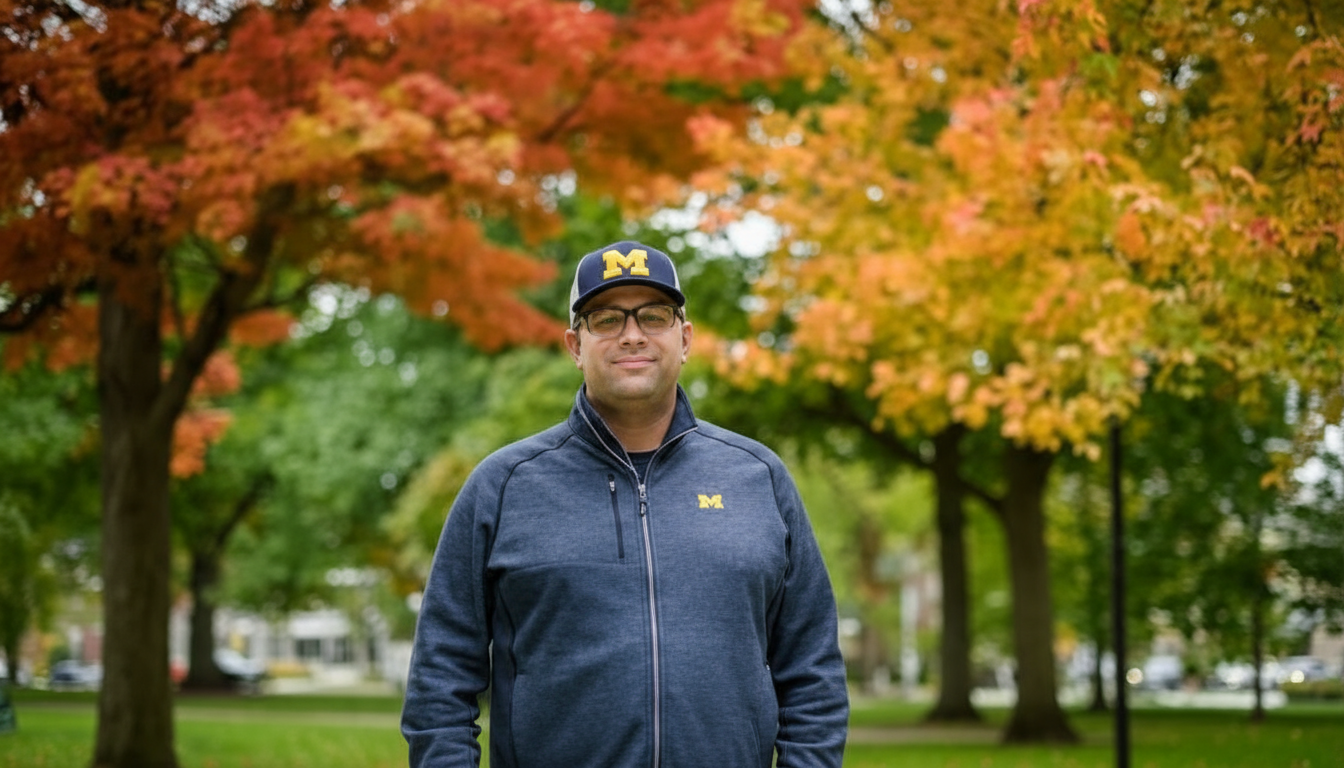
Kyle Bylin serves as a Research & Assessment Librarian at Saginaw Valley State University, where he has been at the forefront of developing AI literacy frameworks that bridge technology and learning. His approach to artificial intelligence centers on practical implementation, educational equity, and preparing students for an AI-integrated future.
With an MSI from the University of Michigan School of Information and a B.A. from Berklee College of Music, Kyle brings a unique interdisciplinary perspective to technology adoption in higher education. His career has spanned more than two decades analyzing digital transformation across industries.
Beyond his work in academic libraries, Kyle has spent over 20 years as a music industry analyst, contributing thousands of articles to Hypebot, The Future of Music Coalition, and others. His recent scholarship focuses on how institutions can develop responsible AI integration strategies while addressing the ethical dimensions of emerging technologies.