

______________________________
Guest post by Bas Grasmayer of Music Tech FutureAn emerging void signals new opportunity for innovation in digital music.The benefit of writing thoughts down is that you get to revisit them. Six years ago, I penned a piece for Hypebot called The Next MySpace. At that time, people in the music business were desperate to for another MySpace to emerge: the site had been a ray of hope, but as it collapsed, online music was scattered across an immature ecosystem of rapidly growing startups like Soundcloud, Bandcamp, Facebook, Spotify, and many others that were eventually acquired or perished and forgotten. I argued:The closest we will ever get to a “next MySpace” will be either a music network or a social network that manages to gather, organise and integrate the fragments in spectacular fashion.DEFINING THE MYSPACE MOMENT
THE NEW MYSPACE MOMENT
There are two main factors contributing to a new emerging void for entrepreneurs to leap in. One has to do with product adoption life cycles, which I’ll explain below. The other has to do with the important position Soundcloud claimed in the online music ecosystem.Soundcloud came closer to being the ‘next MySpace’ than any startup has. And let’s be blunt: the company is not doing well. After years of legal pressure to tackle the problem of works being uploaded to the service without rights holders’ permission, they were forced to adopt a service model that does not make sense for Soundcloud. The typical $10 a month subscription doesn’t make sense. People are on Soundcloud for the fresh content, the mixtapes, remixes, unreleased stuff: the things that will not be on Spotify for weeks or months (or ever!). Why inject the catalogue with music of long deceased people?There have been reports that Soundcloud would consider any bids higher than the total amount of money invested into the company to date. That’s not a good sign. The road they’ve been forced into is a dead-end street, and the only end game is a quick acquisition.I don’t think Soundcloud will die, but it is hard for the company to focus on what they’ve always been good at. Now that they’ve been forced into the Spotify model, those are the types of metrics that are going to matter. Subscriber numbers, conversion, retention. So it may struggle to do as good a job serving the audience they’ve traditionally serviced so well. (small note: I love Soundcloud, and the people there: prove me wrong!)This leaves a vacuum.Adding to that vacuum, is the fact that Spotify (and other streaming services) are looking beyond early adopters. To understand the phenomenon, have a look at the below graph: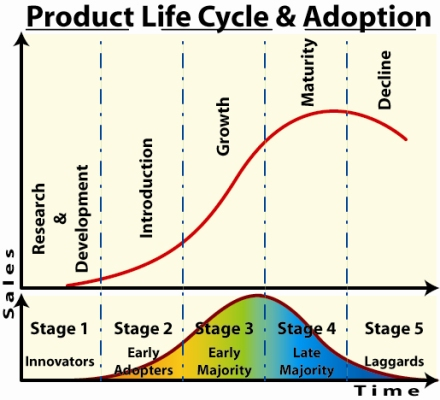
FILLING THE NEW VOID
What happens then? Well, we’re going to get to the next phase of the digital music ecosystem – which is mobile-driven, and flirting with augmented reality, VR, and artificial intelligence. Early adopters are likely to keep paying for their Spotify subscriptions – it’s too big a convenience to give up… So entrepreneurs will have to figure out ways to monetize new behaviours.Now is a great time to look at very specific problems in music. Don’t try to build the next Spotify or the next Soundcloud. For a while, everyone was trying to build the next MySpace — all those startups are dead now. Instead, take a specific problem, research it, build a solution for someone, test it, try it again for a broader group, and if it works: double down and scale up.Personally, I’m very curious to see where startup accelerator Techstars Music’s current batch will be five years from now.Related articles