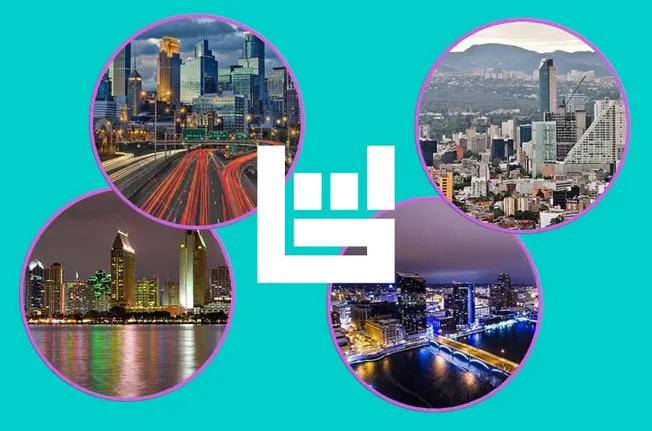
This week, Touring Radar turns its attention away from individual artists to four live music cities that are growing and investing, attracting attention, or wrestling with the economics beneath their busy calendars. Touring Radar is supported by Bandsintown tour data.
We identified four cities whose venue ecosystems are changing in particularly revealing ways. Publicly viewable data from Bandsintown’s follower and upcoming-event totals don't reflect ticket sales or attendance figures, but they can be vital in tracking change and growth across the total activities occurring in a market.
It's a useful snapshot of where audiences are paying attention and where live music is happening consistently. Let's dive in.
1. Grand Rapids Built the Top of Its Venue Ladder
Grand Rapids, Michigan made a substantial bet on its future as a touring destination when the 12,000-capacity Acrisure Amphitheater opened in May. The riverfront venue represents a $184 million public-private investment and is projected to welcome more than 300,000 visitors each season. The venue's 18 upcoming events represent an impressive opening calendar of touring talent.
But Grand Rapids is not attempting to create a live music market from scratch. It's already a popular destination for artists on the move.
The Intersection has 96 upcoming events listed on Bandsintown, while The Pyramid Scheme has 59. GLC Live at 20 Monroe has 23, and Van Andel Arena provides another established option at the upper end of the market. What changes now is that a gap has been filled with this newly-built rung on the local artist development ladder. Artists can build through clubs, graduate into theaters and larger concert halls, reach the arena level, and now consider a major outdoor play without ever leaving Grand Rapids.
+Read more: "Huntsville Ain't Nashville — But It Sure Is on the Rise"
2. Minneapolis' Challenge Ahead Is to Make Sure Its Healthy Live Economy Stays Intact
Minneapolis–St. Paul has one of the strongest live music identities in North America. New economic data shows that identity also produces an enormous amount of tangible value. A recently released local analysis found that independent live entertainment generates $2.2 billion in economic output, supports more than 15,000 jobs and contributes $114.2 million in annual state and local tax revenue.
Those figures describe a powerful local industry. Its profitability numbers describe something more alarming. Only 20% of Minneapolis’ independent stages reported turning a profit. But it's not due to inactivity. The Dakota lists 84 upcoming events, 67 at Fine Line, 55 at First Avenue, and Armory has 42.
A crowded calendar can look like a healthy market from the outside while the venues creating that activity struggle with staffing, insurance, rent, production costs and thin margins. Minneapolis certainly does not need to prove that live music contributes to its economy; but the challenge ahead lies in ensuring that the businesses generating that contribution can survive long enough to share in it.
3. San Diego Wants to Open Its Bottleneck
In August, Live Nation detailed plans to transform San Diego, California’s historic Wonder Bread Building into a purpose-built, 4,000-capacity concert venue. The company described that capacity as a specific hole in the city’s touring infrastructure: too large for its club network but below its major arenas and outdoor venues. The new venue is expected to open in 2028 and could eventually welcome 316,000 fans annually.
Bandsintown's own city listings help illustrate the market surrounding that gap. House of Blues San Diego has 62 upcoming events, Music Box has 58, The Observatory North Park has 53 and SOMA has 40. Meanwhile, Pechanga Arena, Petco Park, Viejas Arena, and North Island Credit Union Amphitheatre all serve significantly larger productions.
San Diego does not lack live music. It may lack an appropriate next step for artists who have outgrown its smaller rooms but cannot yet justify an arena. That is why the Wonder Bread Building proposition is based on widening its career-development bottleneck.
+Read more: "Touring Economics: Why Concert Tickets Cost $150 in Austin But $68 in Cleveland"
4. Mexico City Is No International Afterthought
Mexico City, Mexico has become too large, too active and too structurally important to be treated as a bonus date attached to a primarily American tour. Its rising star venue, Palacio de los Deportes, has more than 123,000 followers, followed by Estadio GNP Seguros with nearly 89,000, Autódromo Hermanos Rodríguez with more than 56,000, Auditorio Nacional with more than 54,000 and Arena CDMX with more than 47,000.
Below those major buildings is another substantial layer that includes Pepsi Center WTC, Auditorio BB, Teatro Metropólitan, Circo Volador, Foro Indie Rocks! and Lunario del Auditorio Nacional, and the festival season calendar is just as magnificent. Mexico City hosts events such as Pitchfork CDMX, Corona Capital, Coca-Cola Flow Fest, Vans Warped Tour Mexico City, Knotfest Mexico, and numerous independent festivals.
Mexico City has leveled up its presence on the international touring circuit so thoroughly that it's no longer considered by many to be a "nice bonus" destination. No, it's a guaranteed tour anchor now.
The Market We’ll Be Watching: Minneapolis
Every Touring Radar edition ends with one last thought with regards to one of the entries profiled above. This week, Minneapolis presents the most urgent industry question:
What does it mean for a live music market to generate billions of dollars, support thousands of jobs, attract millions of fans and still leave most of its independent stages without a profit?
Touring markets cannot be judged only by the number of events appearing on their calendars. The next step is determining whether the venues creating that activity are being paid enough to remain part of the system. A city can have demand, cultural importance and a busy calendar while still losing the rooms that made it a music city in the first place.
This could be a phase of the economic standing of the region, or country, but it could also precede a reckoning with the city's vibrant cultural sector, and where gentrification-assisted capital ends up when it trickles down to the creative class.