

By Garrett Hall
*This article is for informational purposes only and does not constitute legal advice. You should consult an attorney before applying to register your performer name as a trademark.
Trademark registration applications for music artists face unique challenges, from local artists to pop superstars alike. The law regarding trademarks is not always the most approachable in the abstract, so it can be helpful to understand relevant concepts with concrete examples.
We can look to the trademark applications submitted by a notable pop artist, Sabrina Carpenter, to illustrate many of the trademark registration issues facing performers in the music industry today.
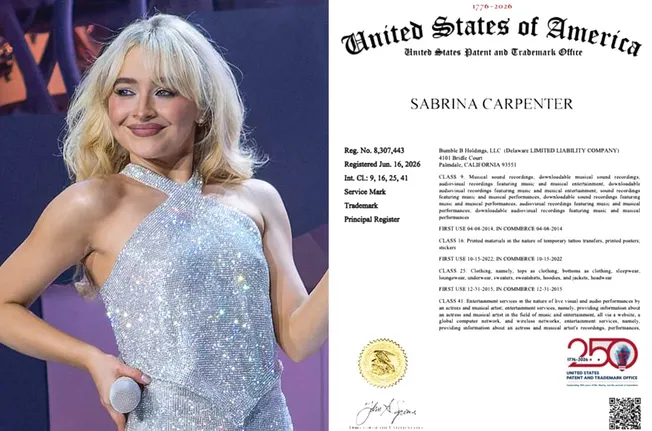
On May 15, 2024, a trademark application for “SABRINA CARPENTER” was filed by her company Bumble B Holdings, LLC, to register the name in connection with four different ‘groups’ of goods and services, known as ‘Classes.’ Specifically, the application sought to register SABRINA CARPENTER in connection with sound recordings (Class 009), posters, stickers, notebooks, and calendars (Class 016), clothing and footwear (Class 025), and live music entertainment services (Class 041).
Bumble B Holdings, LLC has since filed for two additional trademark registration applications:
- THAT’S THAT ME ESPRESSO for clothing and coffee (Classes 025 & 030) filed on May 20, 2024;
- SHORT N’ SWEET for sound recordings, temporary tattoos, tote bags & handbags, pillows, mugs, clothing, playing cards, and entertainment services (Classes 009, 016, 018, 020, 021, 025, 028, 041) filed on May 13, 2025.
These three applications have faced many of the hurdles that are common to musician applications, making them fantastic examples through which we can introduce and explore these issues.
1) "Likelihood of Confusion"
For all trademark applications, the United States Patent and Trademark Office (“USPTO”) will refuse to register any new mark that is likely to confuse consumers with an existing registered mark.
For example, if you started a soft drink company and attempted to register “COCA-COLAH” as a trademark for your goods, the USPTO would issue a refusal letter, known as an Office Action, explaining its concern that consumers would be likely to confuse your goods with existing registered trademark COCA-COLA.
In making a likelihood-of-confusion decision, the USPTO examines several factors, but the two major considerations are:
- How similar the marks are to one another; and
- How similar the applied-for goods and services are.
In our COCA-COLA example, the marks COCA-COLAH and COCA-COLA are only a one-letter difference and pronounced the same. Additionally, both sell soft drink beverages — identical goods. These factors combine to indicate that consumer confusion is likely.
Likelihood-of-confusion is one of the most common refusals faced by trademark applicants. Artists that want to register their name as a trademark should always check to see if there are any existing, registered trademarks that could make their application difficult.
The SABRINA CARPENTER application received an Office Action for likelihood of confusion. The Office Action noted the possibility of confusion with an existing registration — SWEET TOOTH BY SABRINA CARPENTER, a trademark for fragrances owned by Scent Beauty, Inc. which had a preexisting licensing deal in place to use Sabrina’s name in their branding and marketing.
To demonstrate that no likelihood of confusion existed, Carpenter’s attorneys submitted a “consent agreement” signed by both Bumble B and Scent Beauty, demonstrating that the new trademark application mark and the registered mark were capable of co-existing in the market without causing conflict.
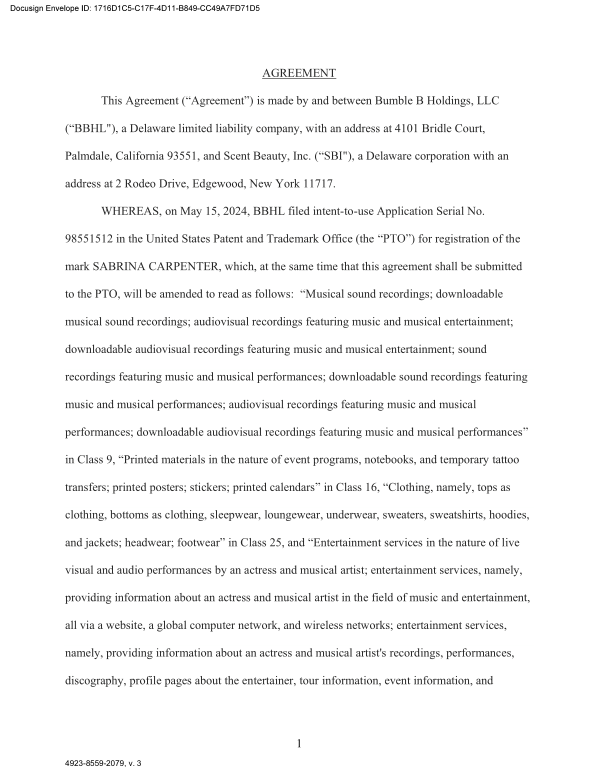
Consent agreements are extremely effective in overcoming likelihood-of-confusion refusals. The Examining Attorney evaluating the application is tasked with serving the interests of all of the already-existing registered marks, so they often issue Office Actions in situations where confusion is likely. But if an owner of a registration signs a document saying that they are not concerned about confusion, this is normally sufficient to quell an Examiner’s concerns.
A consent agreement is one of several ways to solve a likelihood-of-confusion refusal. Whether it makes sense to reach out to the owner of the registered mark to seek their consent must be determined on a case-by-case basis, as doing so is not without its risks. For example, if the owner is unlikely to agree to a consent agreement, reaching out to them may alert them to challenge your application (if your application reaches the publication phase).
Here, at least, a consent agreement strategy worked for Sabrina.
For an artist seeking to protect their performer name as a trademark, the best course of action is to conduct a clearance search prior to filing. Because the likelihood-of-confusion analysis considers both identical and similar marks, it is important for an artist to do more than simply “check if their name is available;” doing so often leaves a ‘blind spot’ to similar names that could cause issues with the application. A clearance search will help artists get a much clearer picture of the landscape of marks that could result in their refusal.
2) "Name Consent of Living Individual"
When a trademark contains a person’s name (ie, GEORGE FOREMAN for electric grills; CALVIN KLEIN for clothing), the USPTO requires that the applicant also submit a signed document demonstrating that the person consents to the registration. It is quite common for musicians to forget to provide this extra documentation along with their applications.
The application for SABRINA CARPENTER was submitted by her company, Bumble B Holdings, LLC, and the application was signed by the Principal of the company, Elizabeth Carpenter (Sabrina’s mother). Sabrina herself was not a signatory to the application. Because of this, the initial application record did not contain Sabrina Carpenter’s explicit consent to the registration of her name as a trademark.
To correct this, Bumble B Holdings amended the application to include a consent statement, signed by Sabrina Carpenter on May 17, 2024.
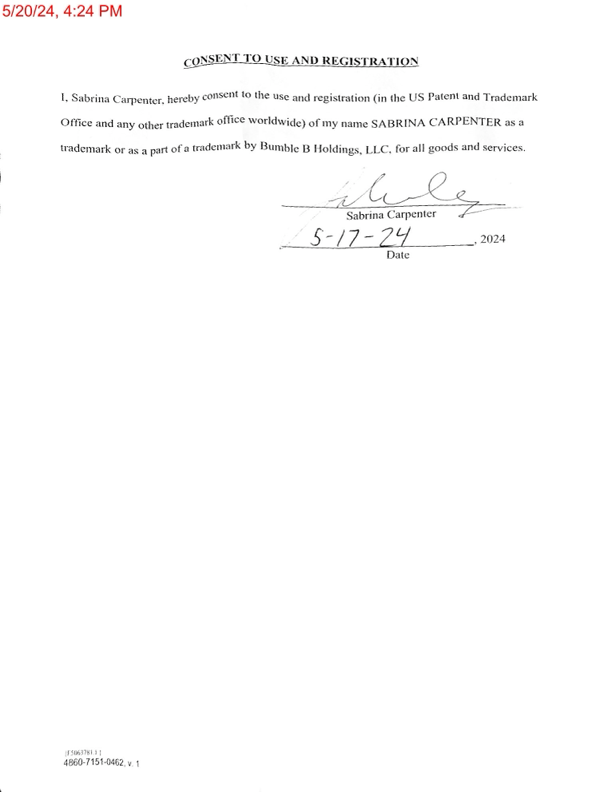
This simple document resolved this name consent issue, but there is an additional requirement for music artists seeking to register their name as a trademark in connection with sound recordings; see below: NAME OF A PERFORMING ARTIST.
3) "Improper Specimen"
At some point in the trademark application process, the applicant has to demonstrate that they are using the trademark in commerce with the applied-for goods and services. An applicant has the option of submitting this evidence with the initial application filing (use-based application) or at a later stage (intent-to-use application). An intent-to-use application requires an additional fee, but it can provide the applicant extra time to begin production and sales of their goods and services.
This evidence of use of the mark comes in the form of a ‘specimen’ which shows the trademark as it is used in context of the goods or services provided. The applicant has to submit at least one specimen for each class of goods/services that they are applying to register for.
Many specimens take the form of screen-captures of internet webpages where goods and services are available to consumers, such as online marketplaces for tickets, merchandise, or mp3 downloads. Other specimens could include images of the trademark appearing on product packaging, such as on CDs or vinyl covers.
To convince the Examining Attorney that the goods and services are in fact being provided to consumers, internet webpage specimens typically need to include the URL and date accessed, as well as a clear depiction of a way to order (ie, ‘Add to Cart’ or ‘Buy Now’ button), in addition to showing the trademark on the goods or packaging. For services, a decent specimen may be advertising materials, again with a means of obtaining the services (ie, a phone number to call).
All of this information has to be included in the screenshot specimen provided — it is not the Examiner’s responsibility to go to the website and track down information. If the connection between the trademark and the product is not clear enough to the Examiner, they will issue an Office Action refusal.
For example, the application for SABRINA CARPENTER included the following specimen to demonstrate that clothing is sold in connection with that mark.
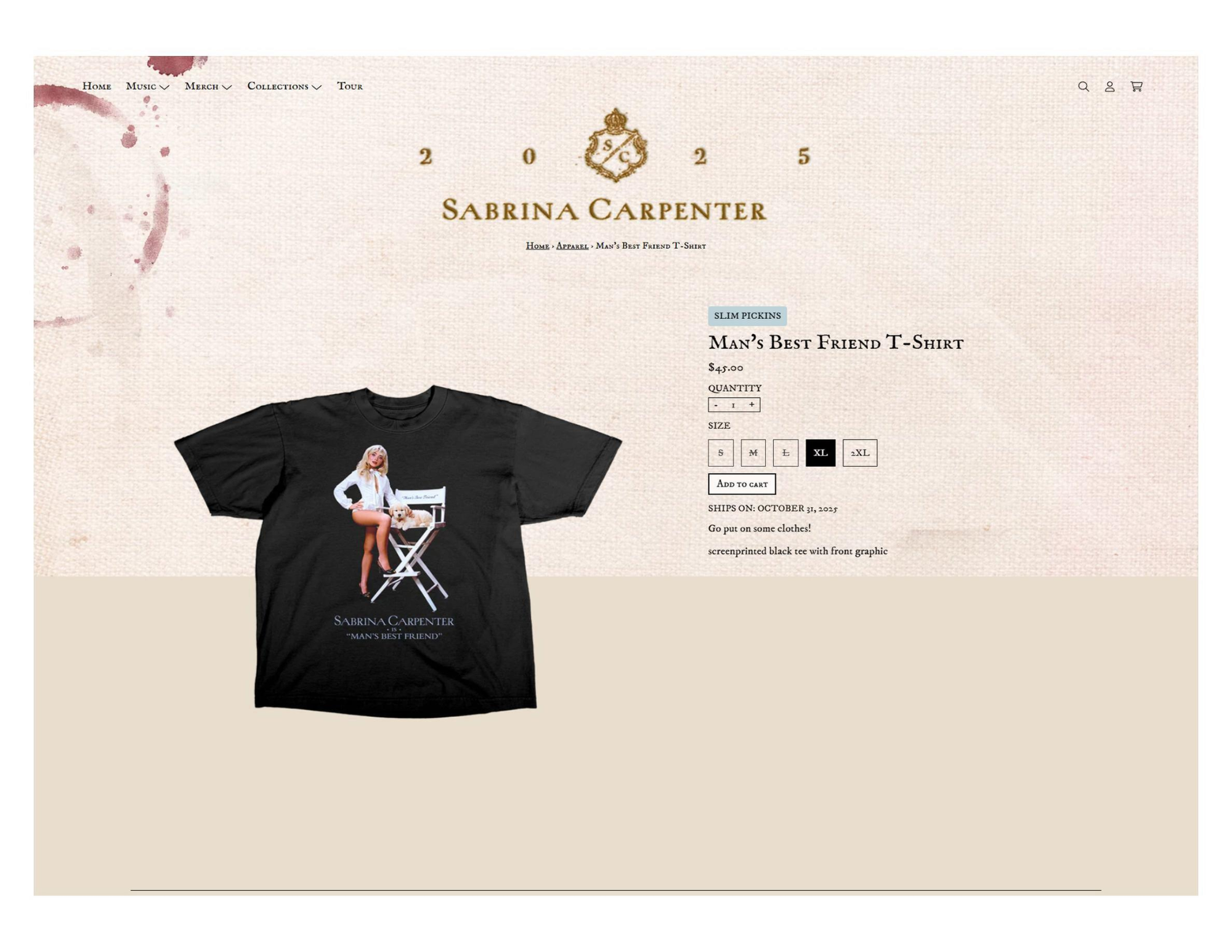
This webpage screenshot makes for a good specimen. The website URL and date accessed appear at the bottom. Several articles of clothing are shown as available with prices listed, and the selected item has a clear ‘Add to Cart’ button. A traditional ‘checkout’ icon appears in the top right of the image. The mark SABRINA CARPENTER appears prominently at the top of the online storefront, and “Sabrina Carpenter Official Store” appears in the website footer. Artists who sell branded merchandise including clothing should follow this example.
As an additional consideration, when an applicant applies for downloadable goods, such as downloadable sound recordings (Class 009), the specimen must show that consumers have the ability to download the goods. If the specimen does not clearly show a download feature (ie, a ‘Download’ button), then the Examiner may refuse the application and issue an Office Action for Improper Specimen.
It is not uncommon for musicians to submit their Spotify page as a specimen — caution: a Spotify page can be a good specimen for services in Class 041, but because Spotify is streaming-only, it would fail to demonstrate that the musician sells downloadable songs.
4) "Failure to Function: Name of a Performing Artist"
Trademarks function as an indicator of source. If a consumer sees ‘NIKE’ branding on a sweatshirt they like, that consumer is able to locate goods of the same or similar quality by locating the business that they know sells clothing under that branding. On the other hand, if Nike only sold a single sweatshirt, and the sweatshirt that the consumer liked was a custom 1-of-1, the branding ‘NIKE’ serves little function — it does not tell the consumer where they find similar-quality goods.
As such, names do not function as trademarks if used in connection with one-off products. If a name or logo does not indicate the source of similar-quality goods or services, then it ‘fails to function’ as a trademark.
This logic is crucial to performers. If a singer only has one release available on Spotify or iTunes, the singer’s name functions only as the name of a performing artist — it provides the listeners with no information about where they can find similar-quality songs under the same name.
Because of this shortcoming in trademark function, the USPTO will refuse to register applications for trademarks that are merely the name of a performing artist. In order for a performer’s name to be considered a trademark, the applicant has to demonstrate that their name is in use in connection with multiple releases (or, in the language that the Examiners use, “a series of creative works”). In addition, the applicant also has to demonstrate that they have some control over the production and quality of the releases.
The most common way of submitting this evidence is to provide a specimen that shows numerous releases under the trademark, as well as submitting a sworn declaration statement “Applicant [name] produces the goods and controls their quality,” signed by the applicant.
While this issue is most commonly associated with an artist’s musical sound recordings (which are considered goods), the same considerations apply to the live music performance services they provide. If a performer markets a one-time-only concert, then the performer’s name does not function as a trademark — it is merely the name of the artist to be performing.
For a name to function as a trademark for services, it may be preferable to submit a specimen that shows multiple gig dates and locations; for instance, a flyer with tour dates or a website where tickets can be bought for upcoming shows.
5) "Failure to Function: Title of a Single Workd Refusal"
Similar to a ‘Name of a Performing Artist’ refusal, the USPTO will refuse to register an application for a trademark if the trademark is merely the name of a single work, such as a single song or album. The reasoning for this is the same as above — finding an album under one name does not function as a trademark unless it can indicate source, serving to show consumers where they can find similar releases under the same name.
On September 27, 2025, the application for SHORT N’ SWEET was refused on this basis, with the Examining Attorney issuing an Office Action explaining the refusal. Carpenter’s company responded on November 13, 2025 by submitting a new specimen and explaining that:
“[t]he substitute specimen submitted herewith shows that the subject mark is being used for a series of musical works, namely, each of the songs on an album. Those songs are available for purchase as separate musical works under the mark.”
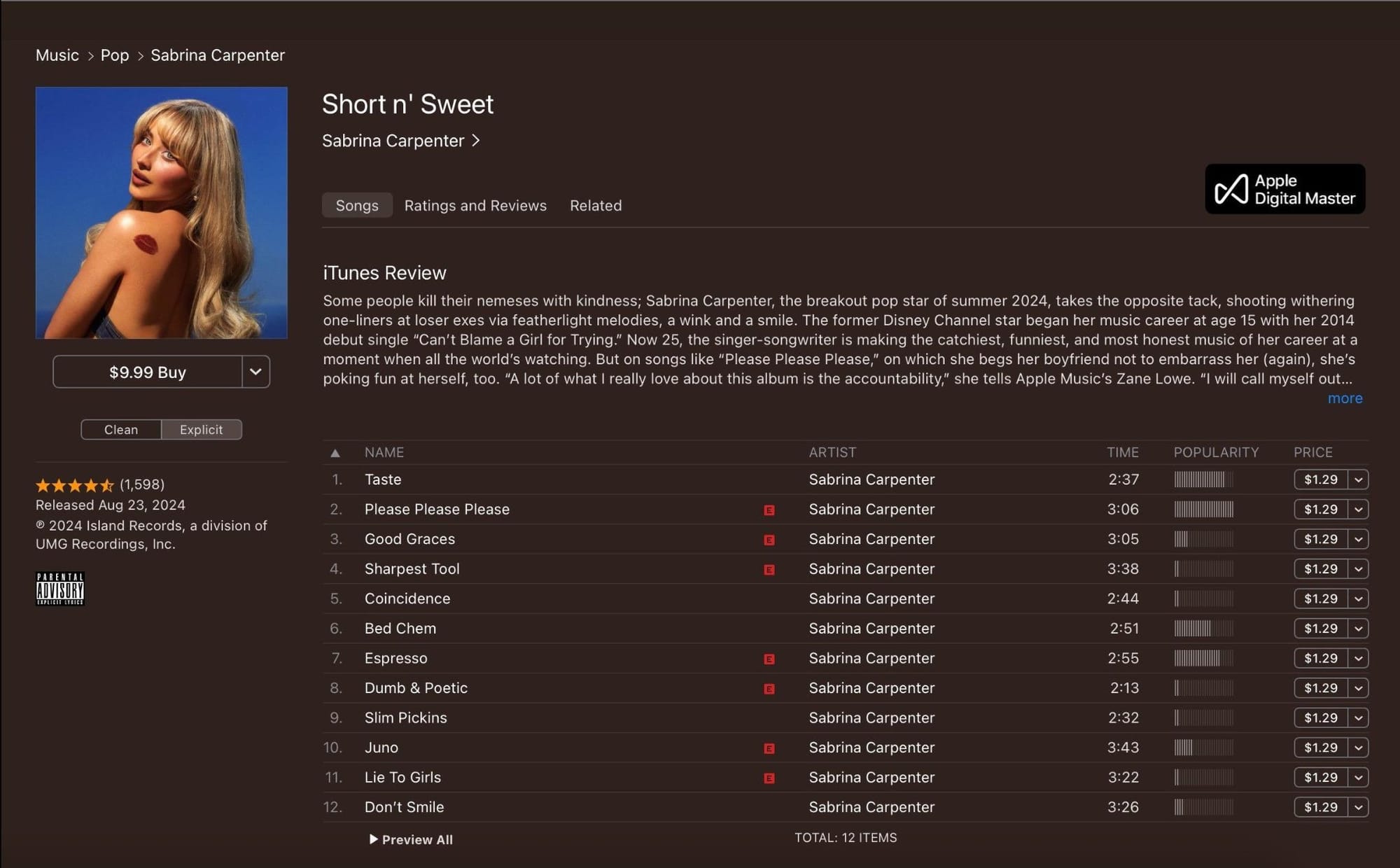
Predictably, the Examining Attorney was not persuaded by Bumble B’s submission. The individual songs are not marketed as SHORT N’ SWEET, but rather, the album itself is. This led the Examiner to conclude that there was no evidence Bumble B provided:
“showing proper trademark use of the applied-for mark for the identified goods.”
A proper response would show several releases under the branding SHORT N’ SWEET — for example a deluxe album version or a later album in a series of albums in that name.
For example, Lil Wayne’s THA CARTER could meet trademark registration requirements because he has released six albums in that name, and because of that, the name serves a trademark purpose by indicating source of similar-quality releases under the THA CARTER branding. If you were to come across an album titled THA CARTER VIII, you would have trademark-facilitated assumptions about who released it.
For another example of an album series that could serve a trademark function, see Meat Loaf’s BAT OUT OF HELL, which has seen three releases.
If Bumble B does not successfully overcome the Final Action, Class 009, which covers ‘musical sound recordings,’ will be deleted from the application. On June 22, 2026, Bumble B submitted a Request for Reconsideration after this Final Action, attaching new specimens and arguing that the:
“demonstrate use of the mark for a series of musical works since the two albums shown do not contain the same content.”
Here is one of the included specimens:
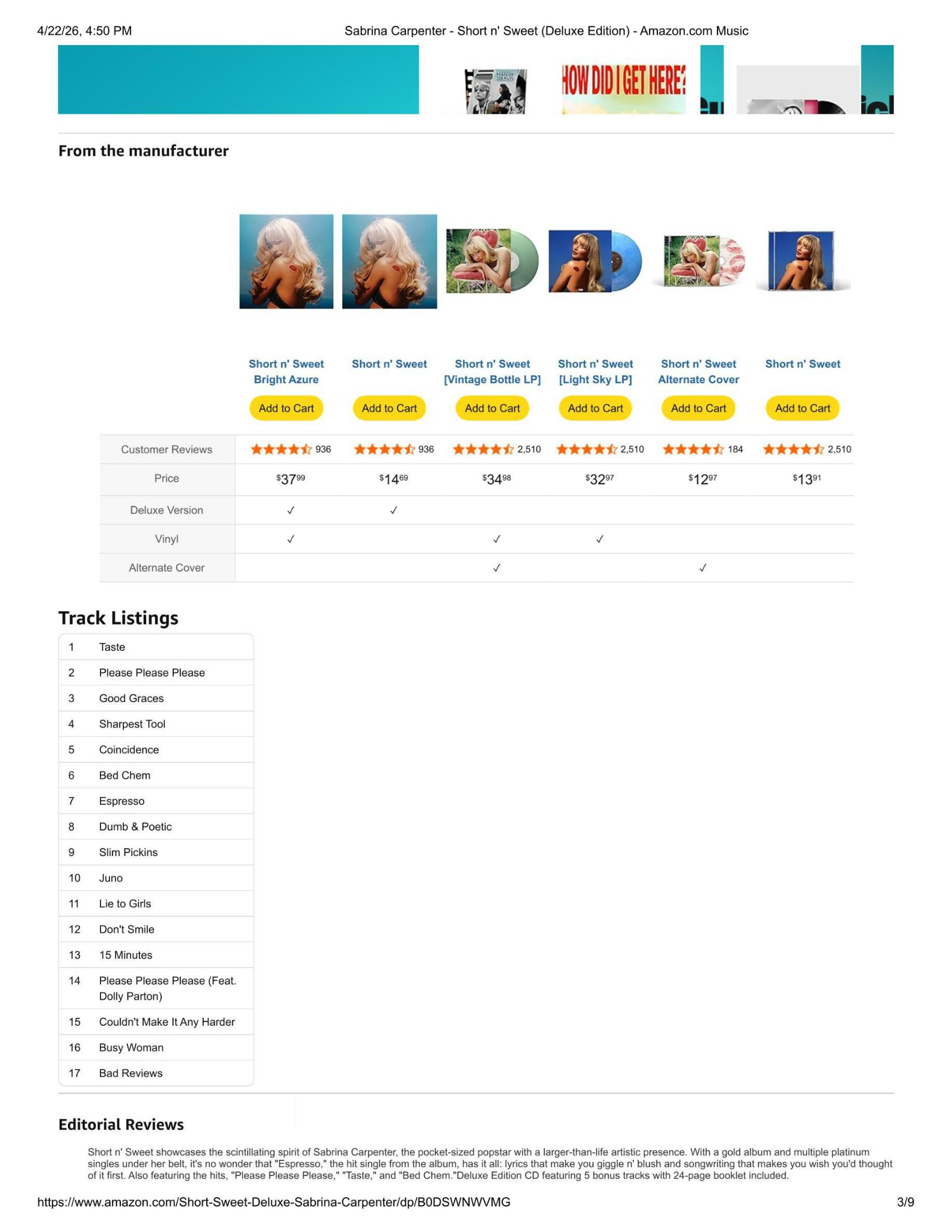
This submission will improve Carpenter’s chances of securing the SHORT N’ SWEET trademark. Deluxe additions and variants of the main album are (arguably) different products in the way that is meaningful to trademarks — it permits the listener to find other, similar offerings under the same branding.
Carpenter’s attorneys should have known to submit evidence like this from the start, to give her the best chance at avoiding this failure-to-function refusal. Even with the effort that has gone into Carpenter’s four trademark applications, there is still work to be done if they are to result in registrations. It can certainly pay dividends for musicians to be aware of – and prepare for – some of the above issues from the very beginning of the application process.
Garrett Hall is a Boston-based intellectual property attorney and the founder of Hall, Esq., PLLC, where he operates BALLAD IP, a program providing specialized, music industry trademark and copyright services. His work focuses on helping clients navigate the trademark registration process, protecting their brands, and securing federal registrations. He writes about intellectual property law and music industry IP issues.