

By Kevin Mills, Head of TREBEL Fan Intelligence,
A manager I know recently told me what it costs him to tell his artist's fans about a new release. He has about 13,000 contacts, all people who signed up to hear from the artist through a popular fan-messaging tool. Each message to that list costs him between $500 and $600, depending on its length and whether it carries a link.
That is roughly four cents per fan, every time he hits send. He did the work to earn those fans, and reaching them is still a line item. So he does what most teams do: he sends less, and saves messages for the moments that can justify the bill.
Since October, my team at TREBEL has been testing a different model, called WaloPass, with artists and labels. Fans add a digital fan card to the wallet on their phone, with no app to download, and the artist's updates arrive on the lock screen. Teams pay a flat subscription with no charge per message.
Four early campaigns, from a Banda single to a Hip-Hop festival contest, have shown us what works, and what we still have to prove. I wanted to share case studies that exemplify what independent artists and teams should be considering with direct-to-fan messaging.
Start with the fans who are already listening
The first came from RB Music, which wanted traffic for “¿A Poco Te Decepcioné?”, the new single from La Inolvidable Banda Agua de la Llave. In early October, in-app messages and push notifications on TREBEL sent more than 110,000 clicks to the official YouTube video in under 48 hours.
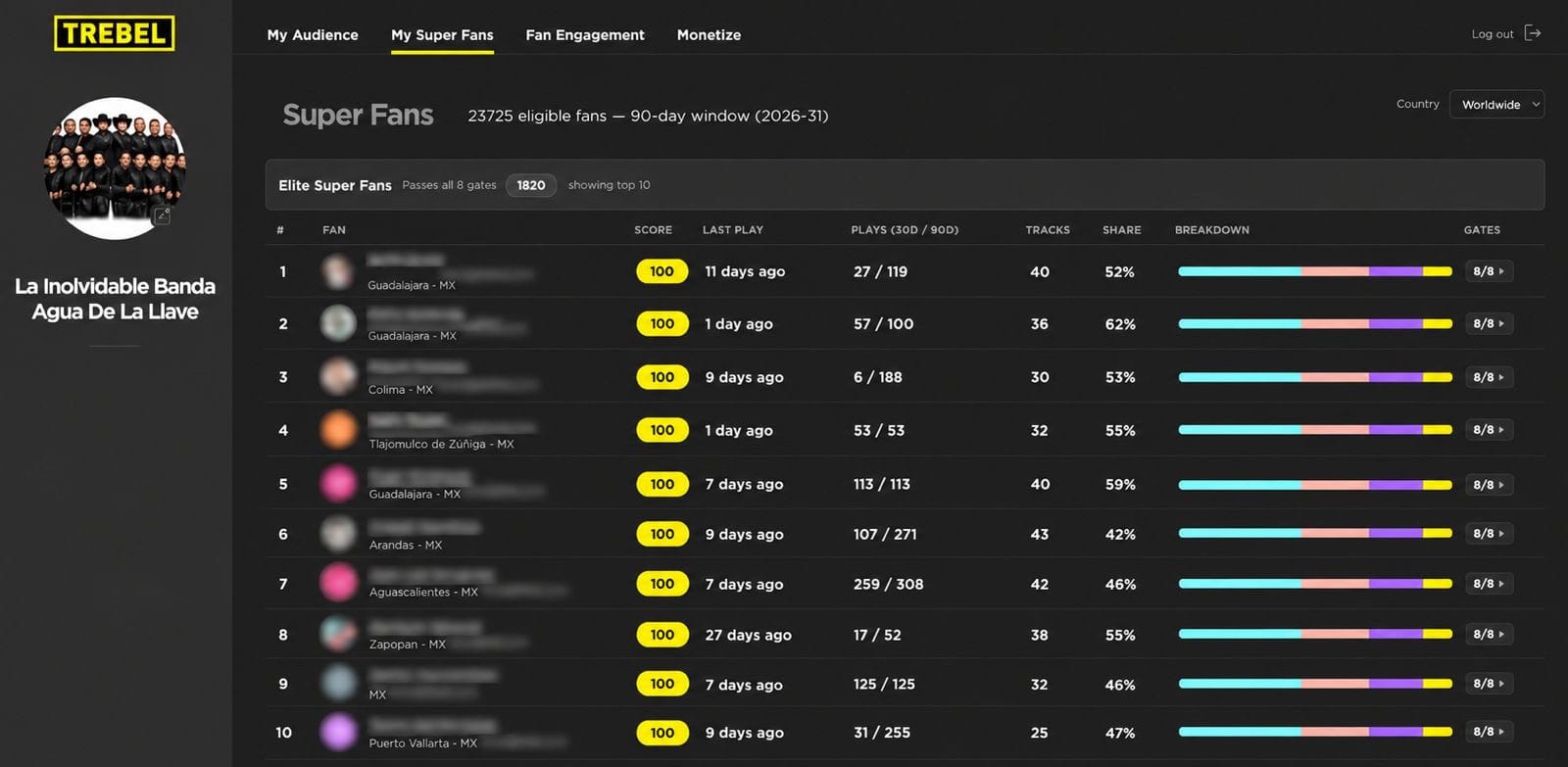
A campaign usually ends there, with a spike on a dashboard and no record of who those people were. This time we looked at which listeners kept returning to the band's music and exploring its catalog, and invited them to join the band's community, with the promise of exclusive surprises.
About 11,000 people saw the invitation. More than a third added the card, and roughly 4,500 fans now hold it.
A small ask can travel a long way
The second campaign started with an artist's own fans instead of TREBEL listeners. A major label in Italy launched a card for one of its artists and promoted it only to his core audience, not his full following. Nearly 40,000 fans added it to their phones in the first week.
Within days, the label told us, more fans had added the card than had clicked through its first promotion, a sign that fans were sharing it with each other. The label then featured a preorder link on the back of the card and told us daily physical sales doubled, before it had sent a single notification.
+Read more: "Running the Numbers on '1,000 True Fans'"
The card can fill a room
Those first two campaigns got fans to watch and to buy. The next two asked them to show up.
The team behind 008 Racca wanted 40 fans at a live video shoot but worried too few would sign up. They sent cardholders a notification with a registration link. More than 80 signed up, and the fans who were admitted got their confirmation through the card. We then built a page where attendees could upload what they filmed that night. So far, 25 fans have sent in 49 videos that the artist can share with credit.
Chelo Hop is taking the same idea to the festival stage. She has built a contest around her Dec. 6 set at the Festival de Hip Hop de Zipaquirá in Colombia. Fans earn points by watching her videos on a listening-party page we made for her. The top fan wins a full day at her side: the studio, the ride to the festival, soundcheck, backstage and the show. Every reminder goes out through the card.
In both cases, the card was only one piece. We also built the upload page for 008 Racca and the listening-party page for Chelo Hop. That is how we work with teams that want more than the card: they bring the idea, and we design and build the experience around it.
+Read more: "On the Fence About EPKs? Here's Why They Still Matter."
What we would tell any team
1- Start with your most engaged fans.
The best response came from listeners who had already shown they cared, and from artists who asked their closest community first. We have not yet seen an artist promote the card to a large following, and we expect that to work just as well.
2- Plan the first messages before you send the first invitation.
La Inolvidable Banda Agua de la Llave now has thousands of fans one notification away, and its next release will be the first real test of that channel. A list only has value once it is used.
3- Give fans something to do.
A link, a seat at a shoot and a chance to spend a day with the artist were each opportunities for fans to act, and they did.
These campaigns are still in their early days. What we do not know yet is whether fans respond to the tenth message the way they respond to the first. That is what we are measuring now: whether cardholders keep the card, and whether they act on the next release, ticket offer or merchandise drop.
The manager with 13,000 contacts rations his messages because each one has a price. These teams are finding out what happens when the next message costs nothing extra.
Kevin Mills is head of TREBEL Fan Intelligence, the team that builds WaloPass and the custom fan experiences around it. TREBEL is a licensed music app that offers on-demand listening and offline playback at no cost to consumers in the United States and Mexico. Artists can share their WaloPass digital fan cards with fans worldwide.