

By Dr. Daniel J. Carucci, CEO of Tipify
The bond between fans and artists is older than streaming, older than radio, older than recording itself.
You can see it everywhere. Fans line up at the merch table to buy a shirt in a color they already own. They see the same act for the third time in 18 months, then linger after the encore hoping for thirty seconds near the stage door. They overpay for vinyl or a CD they may never play, purely out of love and loyalty.
They are trying to say something to one specific, singular person that a stream count was never built to convey:
"I see what you’re doing, and I want you to keep doing it."
That impulse is not one AI can compete for. There is no one on the other end of a generated track to thank.
That is why The Velvet Sundown stung. The “band,” whose music, photos and backstory all turned out to be AI-generated, climbed past a million monthly Spotify listeners in the summer of 2025 before its creators admitted what it was.
The backlash wasn’t really about the quality of the music. It was about betrayal: the discovery that a relationship people believed was human had never been one to begin with.
Here is the striking part: most listeners could never have caught it on their own.
In a Deezer/Ipsos survey of 9,000 people in eight countries last fall, 97% could not reliably tell fully AI-generated tracks from human-made ones in a blind listening test. That sounds like a defeat for the idea that human-made music matters: if nobody can hear the difference, why would anyone care? But the same survey found that 80 percent want fully AI-generated music clearly labeled, and more than half were uncomfortable that they couldn’t tell.

+Read more: "'Human-First' Needs More Than Just a Checkbox"
Academic studies point the same way: label the identical piece of music “human” instead of “AI,” and listeners tend to value it more and engage with it more deeply. And look at what people actually play. Despite flooding Deezer’s uploads, fully AI-generated music accounts for only one to three percent of listening there, and
the company says most of those streams are fraudulent. Listeners cannot hear authenticity, but they still want it. That gap, between what people can perceive and the human being they are reaching for, is the real story of this moment.
I don’t come to this as a skeptic of technology. I’m a physician and scientist, I was an early adopter of artificial intelligence, and I’m in awe of how it has transformed the way we approach hard scientific questions. By the labeling standard the music industry adopted this summer, this very article is “AI-assisted.”
But I come to music as an outsider, and from the outside it looks like an industry in the middle of a problem it has been treating as a technical nuisance rather than calling it what it is: a contest over whether the human being behind the music still matters.
Most major streaming platforms currently hold two positions at once. Publicly, they are alarmed, and some taken action. Deezer detects and tags AI-generated tracks, keeps them out of its recommendations, and has begun removing those tied to fraud. Tidal stopped paying royalties on fully AI-generated songs in July.
That same month, the RIAA and IFPI, joined by the Recording Academy, SAG-AFTRA and the independent label community, launched a voluntary framework to label music “AI-generated” or “AI assisted.”
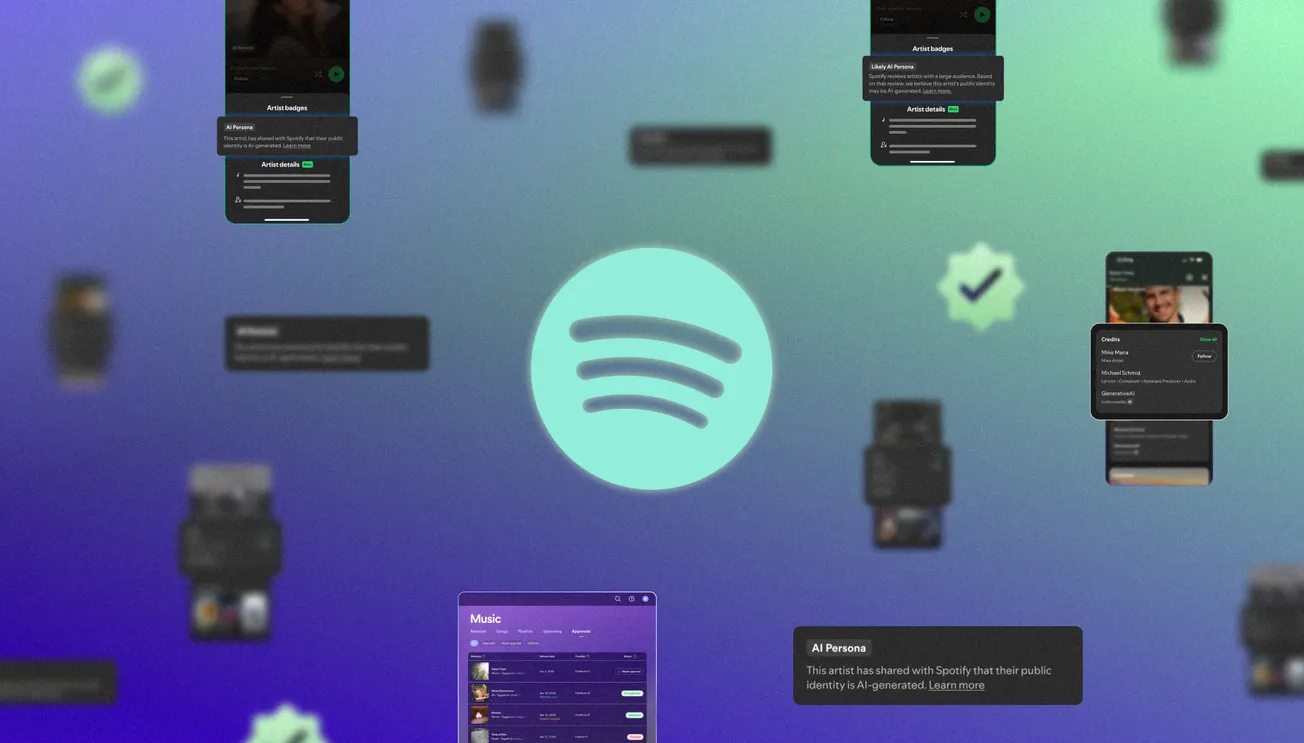
In August, Spotify went further, announcing an “AI Persona” badge for artist profiles whose identities appear to be AI-generated, and saying it will keep those profiles out of its editorial and algorithmic recommendations by default. Its stated reason is telling: listeners told Spotify they don’t like discovering that an artist who seemed human was never a person at all.
The world’s largest streaming service is, in effect, acknowledging the premise of this essay: whether there is a real person behind the music matters. These are meaningful moves. Yet most of the world’s listening still happens on services that have not, as a rule, stopped paying royalties on fully AI generated tracks.
Meanwhile, the volume keeps climbing. One AI tool, Suno, reportedly generates about seven million songs a day. On Deezer, fully AI-generated tracks went from roughly a third of daily uploads in late 2025 to more than half by June of this year, about 90,000 tracks every day. And the platforms are not only policing the technology; they are building with it. Spotify, for one, has launched a generative AI research lab and is developing AI music products with the three major labels.
+Read more: "15 Must-Have Tools to Market Music and Grow a Fan Base"
That is the position the platforms are in: policing AI with one hand while investing in it with the other. I don’t think this is hypocrisy, exactly. It’s closer to what any organization does when it can’t yet tell whether a new technology is a threat or an opportunity, and when its customers’ values may point one way while its incentives point another. It tries to keep every option open for as long as possible and postpones the final decision.
There’s a second cost buried in those upload numbers.
Every AI-generated stream that earns even a fraction of a cent draws from the same shared royalty pool that human artists split. But for the overwhelming majority of independent artists, the dilution of that pool is close to a non-issue. Not because it doesn’t matter, but because the pool was never real money for most working musicians to begin with. By the math of the congressional sponsors of the Living Wage for Musicians Act, an artist needs more than 800,000 streams a month on Spotify just to earn the equivalent of a $15-an-hour job.
For many of these independent artists, half of nothing is not much worse than nothing. The pro-rata argument matters enormously to the handful of artists (and their labels) with enough volume for a percentage point to mean real dollars. For everyone else, the pool was already an abstraction, and diluting an abstraction further doesn’t change what an artist takes home at the end of the month.
What independent artists need isn’t a slightly larger slice of an abstraction. It’s a direct line to the people who already care about them. I should disclose my bias here: I founded Tipify, a company built around direct fan-to-artist support, because I believe this relationship has real economic value.
One number makes the case better than I can: the average tip on our platform is $17.50, roughly what an artist would earn from nearly 6,000 Spotify streams. Fans will pay for connection when they know there is a real person on the other end to receive it.
This is a humanization moment. It’s not a retreat into nostalgia, and not a rejection of technology for its own sake. It’s an audience recognizing, in real time, what it actually wants from music, now that it finally has to ask who is actually making the music it loves.
And the humanization moment is already producing something. Artists and fans are finding their way back to each other through the noise, and increasingly, artists are backing one another directly too, all of them insisting that the relationship was the point all along. Out of the current drama playing out among the titans of the music industry, something more honest is taking shape: an industry that will eventually have to build for the bond it spent two decades engineering around, rather than managing the fallout from having ignored it.
The platforms are betting that concern and growth can coexist indefinitely without anyone noticing the contradiction. I suspect the fans, and the artists standing in front of them, already have.
Daniel J. Carucci, MD, MSc, PhD is the Founder and CEO of Tipify, a direct fan-to-artist patronage platform at tipify.music.