


Spotify has issued a one-year progress update detailing its campaign against AI music, revealing that it has pulled over 50 million "slop and spam" tracks out of its recommendation algorithms so far this year.
The action builds on Spotify's ongoing crackdown against artificial intelligence abuse, which has already led to the removal of over 75 million tracks in the last year,
Rather than a blanket ban on music created by or with the help of artificial intelligence, Spotify is focusing on efforts to protect real artists, preventing royalty siphon scams, and maintaining the integrity of personalized user feeds.
Some of Spotify competitors have taken a different approach.
How Spotify Is Trying To Tame the AI Wave
Spotify’s multi-layered strategy attempts to differentiate between generative "slop" designed to game the system and legitimate creators using technology responsibly.
1. Algorithmic Quarantine for "Slop"
The 50 million flagged tracks haven't all been deleted from the catalog, but they have been purged from personalized recommendations like Discover Weekly and Release Radar as well as editorial playlists. By analyzing user skip rates and listener flags, Spotify starves low-effort bot tracks of algorithmic reach.
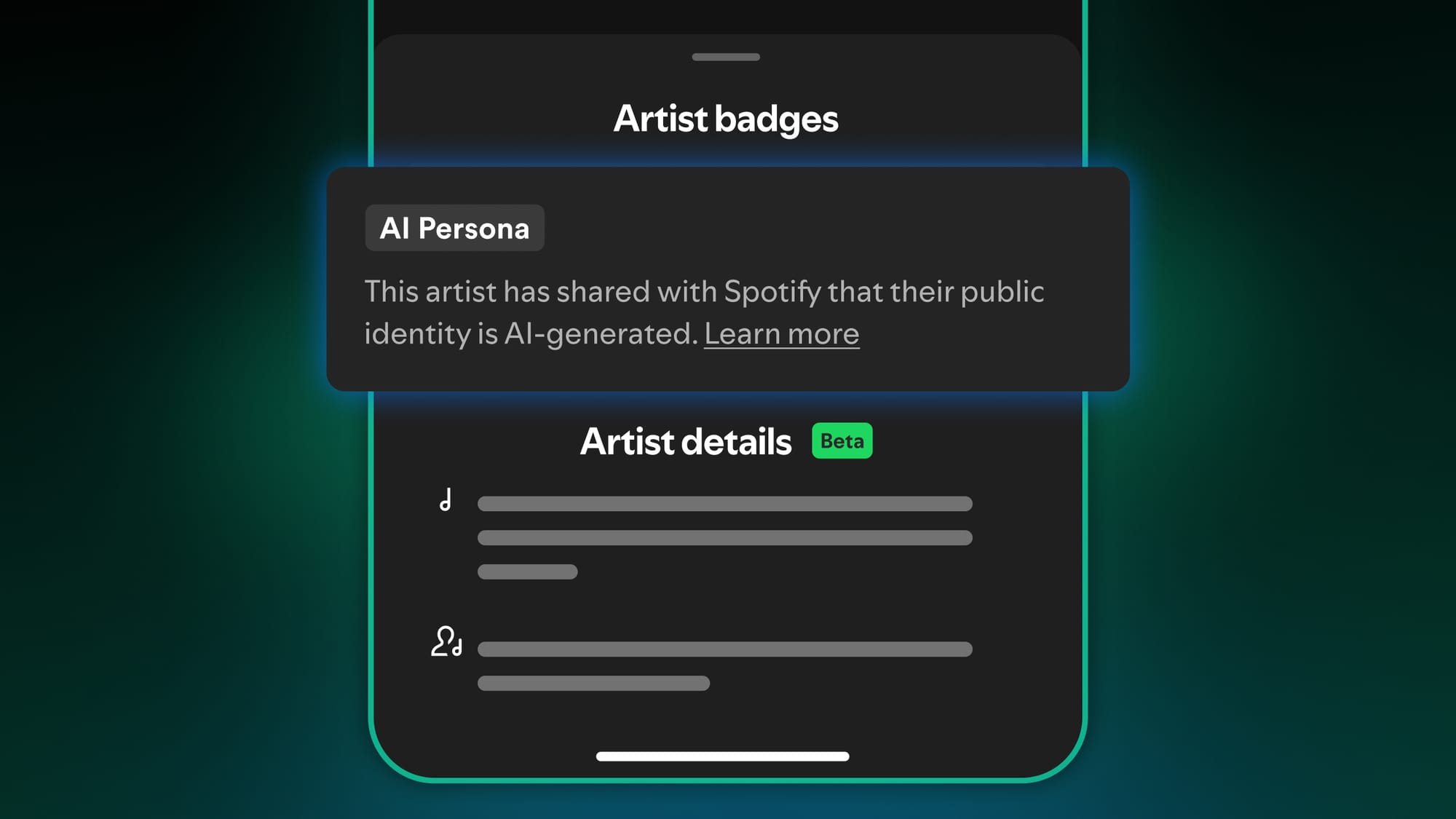
2. "AI Persona" Labels and Profile Badging
Spotify introduced explicit "AI Persona" and "Likely AI Persona" labels for artist profiles that do not represent a real human being. Profiles tagged with this status are automatically blocked from algorithmic recommendation channels, preventing bot-generated personas from taking exposure away from emerging human musicians.
3. Protecting Human Verification
Through its Verified by Spotify standards, human artists who utilize AI as a tool in their creative production process can still retain verified status as long as they present themselves authentically. Synthetic-only personas are disqualified from receiving the blue checkmark.
4. Opt-In AI Credits
Listeners can view AI Credits in the mobile app's song details. Submitted via participating music distributors, this system allows creators to disclose AI contributions such as AI-assisted lyric writing, voice models, or instrumentals without mislabeling whole songs outright.
"As AI makes music more abundant, we believe listeners will value human artistry even more. Our job is to make Spotify the place they find it."— Spotify
Spotify's AI Efforts Compared To Apple, Amazon, Deezer and Tidal
Spotify is focusing on anti-fraud rather than anti-AI, allowing synthetic tracks but purging unauthorized voice clones, mass-generated "slop," and bot streaming. It uses uploader self-disclosure to tag AI artist profiles and excludes fully synthetic tracks from editorial playlists, while still paying standard royalties on legitimate streams.
It's competitors are taking different and sometimes strictor technical and financial, approaches:
- Apple Music and Amazon Music: Focus mostly on distributor-level gates, requiring strict metadata tags and legal proof of training-data consent to prevent copyright infringement before tracks enter their catalogs.
- Deezer: Uses proprietary detection software- not just self-reporting - to actively filter out synthetic tracks, exclude them from recommendations, and offer users a toggle to hide AI songs entirely. Deezer has offered their software free to other DSPs.
- Tidal: Also uses detection software and holds the most aggressive financial policy, completely demonetizing 100% AI-generated tracks.
Hypebot's Bottom Line
Spotify is working to protect the integrity of artist payouts and the sanctity of fan discovery by separating creative AI tools from synthetic AI slop. That approach has already led to the removal of 75 million tracks and labeling and downgrading 50 million more.
In the coming months, we should learn if Spotify needs to add additional technical and financial restrictions like those being used by Deezer and Tidal to keep the AI tidal wave at bay.