

By Ray Flanary of Redemption Road Music Group
Here's a sentence that would have sounded insane ten years ago: my record label is a software shop now.
Not by choice, and not because I wanted a second career, and certainly not because I wanted to lose hours and hours of sleep. But because the industry kept handing me the same three options — a spreadsheet, a sticky note, or a subscription — and all three were costing me money.
The Endless Pile of Subscriptions...
Indie labels run on thin margins. Everybody in this business knows that.
So picture what "modern tooling" looked like for a small label like mine: one subscription for radio tracking, another for booking contacts, another for PR lists, a CRM for the relationships, a royalty spreadsheet that no SaaS product will touch because the math is too bespoke.
Every one of them billed per month, per seat, and every one of them built for a generic company — not for a label that needs to know which Texas stations play my albums on Tuesday nights and which venues seat 200 with a green room.
I did the math the way any label owner does it: by asking what it costs when nobody's looking. Five tools, three people touching them, twelve months. That's not software overhead, that's a payroll line. And here's the part nobody says out loud — when the subscription dies, the data dies with it. Years of station contacts, venue histories, who booked what and when — all sitting on somebody else's server, exportable if you're lucky, gone if you're not.
The Industry Forced This Onto Us
So labels like mine started drilling down. Not because we wanted to be developers, but because the gap between what we could buy and what we actually needed kept getting wider.
AI changed the cost of building — a small team can now ship tooling that used to take a funded startup — and suddenly the math flipped. The question stopped being "can we afford to build this" and became "can we afford not to."
We built SoundScape Pilot, and I want to be honest about what that word "built" means, because this industry has a hype problem, too.
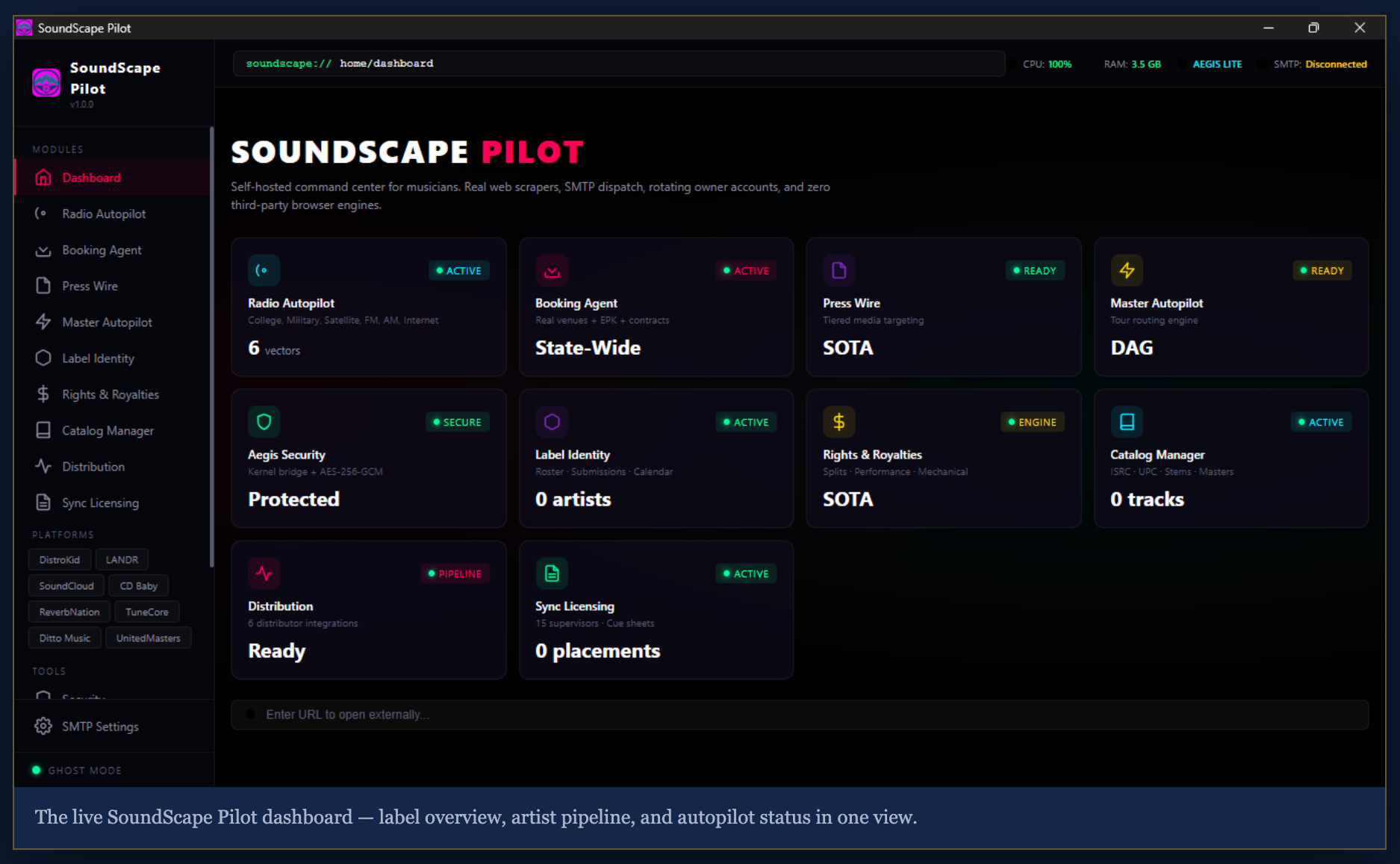
It's a self-hosted command center that runs on the label's own computer. Four working autopilots: one matches our artists to real radio stations and drafts the outreach; one finds venues by state and capacity — including the church circuit that matters in Texas — and handles the EPKs and follow-ups; one works media outlets for PR; one builds routed tours.
Underneath sit the engines nobody wants to think about: catalog, sync licensing, distribution, royalty accounting. No data leaves the owner's machine. No per-seat rent. It's a one-time fee that can be divided up into monthly payment plans.
+Read more: "What Happens After the Streams Stop: How Independent Artists Should Measure a Campaign"
What We Refused to Automate
This is the part I care about most. We automated the research, the matching, the drafting, the follow-up tracking — the work that was eating hours and producing nothing. We did not automate our relationships.
The call to the program director still happens with a human voice on it. The venue handshake still happens in person. The tool drafts; the human decides. Any "autopilot" that tried to replace the relationship would be a liability, not a feature, because in this business the relationship is the asset.
The spreadsheet itself was never the problem. The problem was the spreadsheet was eating the hours that should have gone to the relationship.
The Receipts
Full disclosure, because I'd rather you hear it from me: on October 20 we had the whole system independently tested — all 102 API routes swept, every one of them. What broke, we fixed in public. It's pre-launch. Zero revenue, zero users, and I'm not going to dress that up. The honest version is better than the impressive version, and in a business built on handshakes, trust is the only currency that compounds.
That sweep is why I'm comfortable saying the broader thing: this isn't a product pitch. Something structural is happening. Labels spent a decade renting their operations back from the cloud, and now the ones who can are buying them back — not as a flex, but as survival math.
The Zoomed Out Part
SaaS won the 2010s by making software somebody else's problem. That was a good deal when the alternative was a server closet. But the rent kept compounding, the data kept drifting further from the people who created it, and the tools kept being built for everyone in general and no one in particular.
The labels building their own software right now aren't trying to become tech companies. They're doing what indie labels have always done: refusing to pay Nashville prices for something they can build in Abilene. The stack is just the newest thing we had to take back.
Own your masters. Own your data. Turns out those were the same sentence all along.
Ray Flanary is the Chairman Of The Board at Redemption Road Music Group in Abilene, Texas. SoundScape Pilot is at pilot.redemptionroadmg.com.