

By Tommy Funderburk, Founder of Muzit
The US Supreme Court’s unanimous decision in Cox Communications, Inc. v. Sony Music Entertainment marks a turning point for the music industry that has been decades in the making.
By limiting the ability to hold internet service providers liable for user activity, the ruling rejects the industry’s favorite litigious-happy copyright ‘enforcement’ practices. For years, the industry relied on a heavy-handed, increasingly strained playbook: identify infringers, issue takedowns, and, when necessary, escalate to legal action. That model is now under pressure in ways that are difficult to ignore.
To me, this raises a bigger question: if enforcement is no longer the primary lever, is there a better way for copyright owners to respond to the daily consumption of their content on the open internet? This moment arrives amid a broader transformation across media and entertainment. The way content is created, distributed, and consumed has fundamentally changed, driven by a more participatory, global, and decentralized digital ecosystem.
File sharing, once framed almost exclusively as a threat, is also a reflection of how audiences discover, engage with, and value content.
So, the industry now stands at a crossroads. It can continue conjuring enforcement mechanisms in a more constrained environment or it can begin to rethink the underlying assumption that file-sharing audiences are a problem to be confronted, rather than a signal to be understood.

From Enforcement to Engagement
For artists, managers, and rights holders, the pain points are familiar.
Streaming platforms provide scale, but limited visibility into who is driving demand beyond their ecosystems. Walled gardens like Spotify, Apple and other streaming platforms offer limited access to rich catalogs and content creators continue to decry the opaque accounting and de minimis payment models employed by the industry. Marketing costs continue to rise, while conversion remains unpredictable. And perhaps most importantly, the industry still struggles to identify and meaningfully engage with its most passionate fans.
Yet those fans are not invisible.
They exist beyond streaming dashboards and social media metrics; in forums, file-sharing networks, and other off-platform environments where intent is often stronger, not weaker. They are not casual spectators. In many cases, they are highly engaged consumers actively seeking out content, sharing it, and amplifying it.
In other words, they are what the industry has recently recognized as “superfans.” They actively seek out content and demonstrate deliberate engagement. They are taking action, often going out of their way to access music. As Co-Founding Editor of WIRED, Kevin Kelly puts it:
"1,000 of these active participants can be more valuable to an artist’s touring and merchandise business than 100,000 passive streams. They are pre-qualified, high-intent audiences. The kind of fans who don’t just listen, but show up, purchase, and advocate."
The challenge is not their existence. It is the industry’s historical lack of tools and data to engage with them in a constructive way.
For decades, labels, publishers, and studios attempted to curb this behavior through force. This included sending cease-and-desist notices, pursuing litigation, and, at times, pushing for users to be disconnected from the internet altogether. But the reality is that these efforts were often aimed at the very people who cared most and did little to stem unauthorized downloading.
In hindsight, it’s a difficult strategy to defend. What marketing team would choose to treat millions of potential customers as adversaries?
The industry now has an opportunity to shift from a mindset of restriction to one of conversion. Instead of asking how to stop behavior, the question becomes: what does that behavior tell us about demand, and how can it be activated?
This shift aligns with broader trends shaping the future of entertainment. Advances in data analytics and AI are enabling more precise audience segmentation, while direct-to-fan strategies are becoming central to how artists build sustainable careers. In this context, understanding off-platform behavior is increasingly a necessity.
+Read more: "How to Find and Stop Unlicensed Commercial Music Uses on Social Media"
Reframing the Signal
I came to this perspective not as a technologist, but as an artist and copyright owner. As a recording artist, I own over 300 copyrights. As founder of the artist-friendly music label Sovereign Artists, I represented the copyrights of Grammy-winning artists, including Heart The Crickets, Dave Grusin and others. File sharing crippled our label. We learned quickly it’s impossible to compete with "free."
But file sharing fans from around the world began to reach out to me. First with negative hate mail: “I’ve traveled from Spain to Norway to see you perform, bought all your records and merch but I downloaded the one song that was not available on iTunes and I get a $150,000 lawsuit? F you!” Great. Just what every artist wants to hear.
Then, some who claimed to be the world’s greatest hackers emailed saying, “We’re fans but we see your new music online and it’s so easy to download. Does this make us bad people?” I began to debate the obvious: these people were consuming, they were passionate, some even bleeding edge fans, who just can’t get enough. True, they didn’t whip out a credit card and pay, but was it really a great idea to send $750,000 in fines to some poor soul who downloaded 5 of my songs the industry claimed were only worth 99 cents?
Someone had to come up with a way to keep the fans happy and compensate copyright owners for their work. Unfortunately, the industry’s response punished those who were often the same people most invested in the music. Their downloading, sharing, searching behaviors were intentional. That realization led to a simple question: what if, instead of treating these interactions as violations, we treated them as signals?
This idea became the foundation for Muzit and the TRACE platform.

TRACE was built to monitor and monetize global sharing activity. Rather than punish file sharers, Muzit uses our AI driven platform to open windows for music executives, artists and stakeholders to finally identify, engage and monetize the largest fanbase in the world. By analyzing entertainment data across the broader internet, stakeholders are able to identify patterns of behavior that indicate interest, intent, and affinity.
Knowing that a household listens to these songs, watches these movies and plays these video games signals a profile not realized from traditional data. For artists, labels, and marketers, that information can be predictive and can be used to reach audiences who are already primed to respond. The results have been eye-opening.
But while that data is powerful, owners need more than just information - they need a service that can actually engage these new fans. Because our global audience shares their explicit consumer behavior through TRACE, we are able to communicate directly with them. At Muzit we don’t sue p2p fans, we monetize them by sending fan and artist-friendly marketing campaigns directly to their household computers or mobile phones!
Two Examples
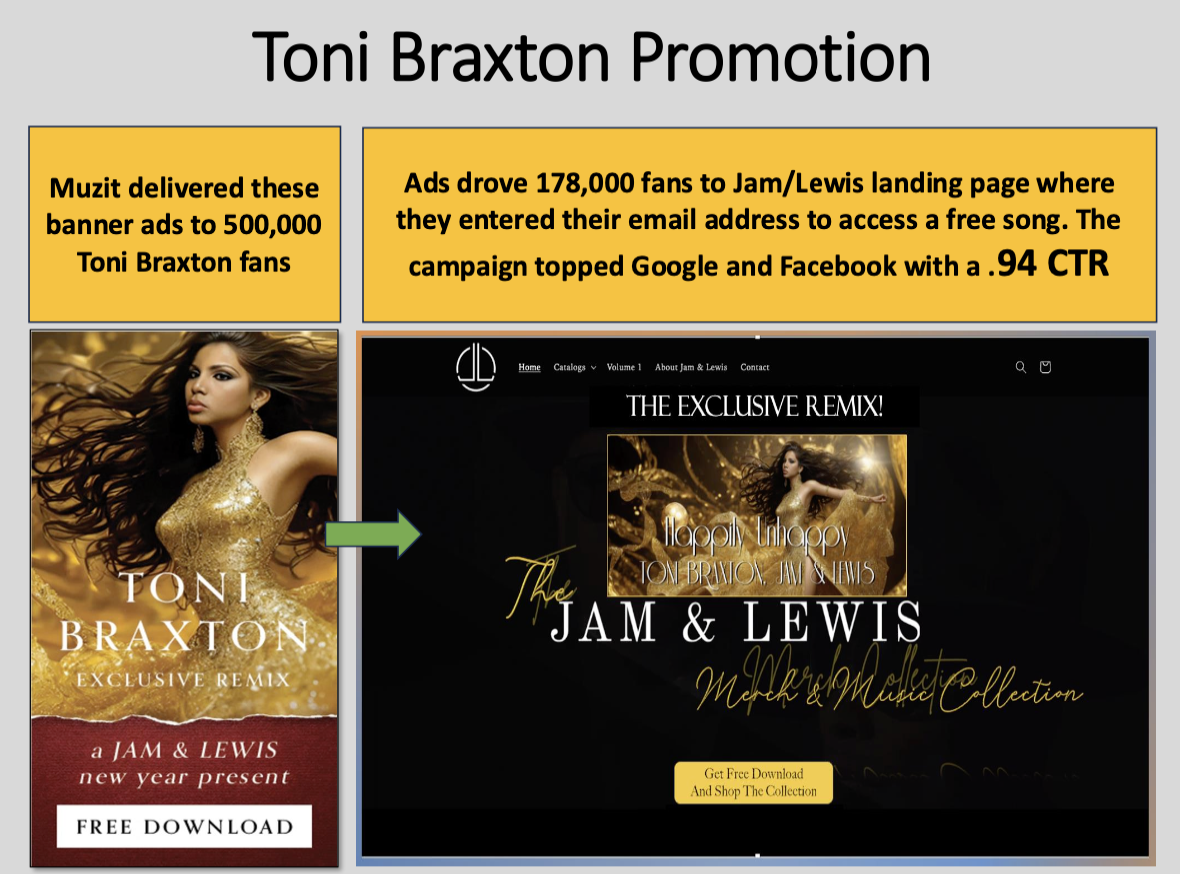
Hall Of Fame Songwriters Jimmy Jam & Terry Lewis used Muzit to promote their new single featuring Toni Braxton. Muzit selected 500,000 Toni Braxton fans from our TRACE database of over 850 Million IP addresses. Rather than issuing takedowns or a lawsuit, we sent banner ads to them all offering a free download - yes I said it - of the new Jimmy Jam and Terry Lewis single featuring Braxton.
In two weeks,178,000 fans clicked through to the official landing page, where they entered their email address to download the song and access Jimmy and Terry’s Merch & Music Collection.
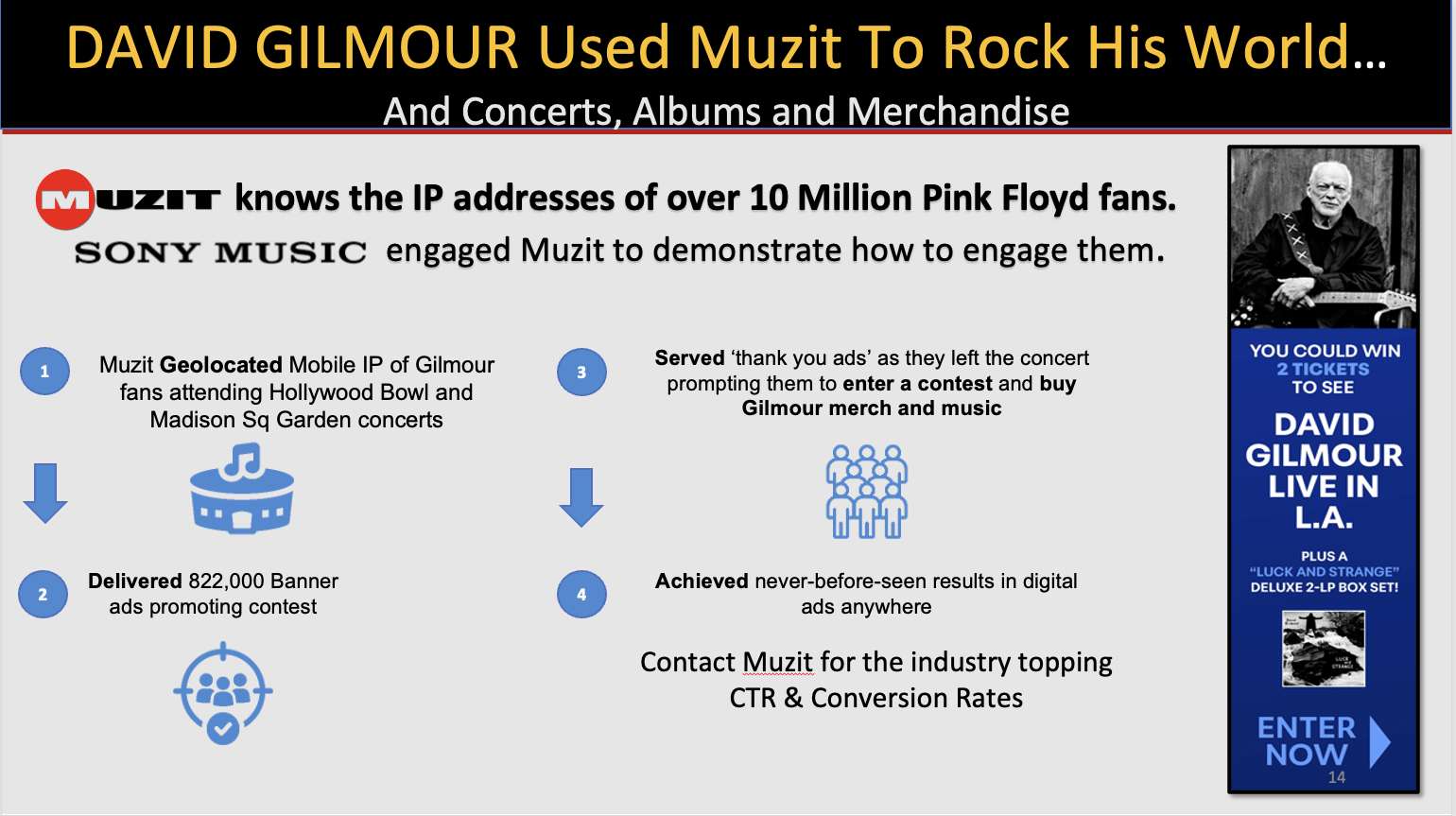
Our most successful campaign to date has been promoting the new release of Sony artist, David Gilmour. David was to perform at The Hollywood Bowl, The Sphere and Madison Square Gardens. Muzit identified 800,000 Pink Floyd fans within 100 miles of these venues and delivered banner ads offering free tickets and exclusive new music and merchandise from TicketMaster and Sony.
The results were off the charts, besting Facebook or Google CTR and conversion rates by 20+%.
These outcomes point to a broader insight: the same behaviors that once triggered enforcement actions can, when properly understood, drive meaningful engagement and revenue. Not only that, but shows that entertainment-based insights perform exceedingly well beyond a single industry as peer-to-peer activity offers a more complete view of consumer interest spanning film, television, games, publishing, and software.
For rights holders, this opens the door to new strategies around marketing, distribution, and monetization. For artists and creators, it creates new pathways to connect with audiences on their own terms.
+Read more: "How Come Nobody Ever Talks About 'Casual Fans?'"
Choosing the Next Chapter
None of this suggests that infringement should be ignored, or that rights should not be protected. But it does suggest that the industry’s 20th-Century playbook has an opportunity to evolve into the modern digital era, moving beyond a binary framework of compliance versus violation and one towards a more nuanced understanding of audience behavior.
The tools and assumptions that defined the past three decades are as outdated as 8-track cassettes. Today, AI platforms like TRACE and its “pristine” data pool open up new capabilities to understand and engage with fans in a more meaningful and mutually productive way.
The Supreme Court didn't just change the rules for ISPs, it gave the music industry permission to stop playing cops and robbers and start being a partner that's assigned to its fans again. The question is, who will be brave enough to break from the past, pick up the data and engage this giant untapped fanbase?
Tommy Funderburk is founder and chairman of Muzit, an online entertainment analytics platform that employs proprietary technology and an artist-to-fan-focused business model to help owners of copyrighted digital content identify, engage and monetize the global peer-to-peer audience. You can reach tommy at tommy@muzit.com