

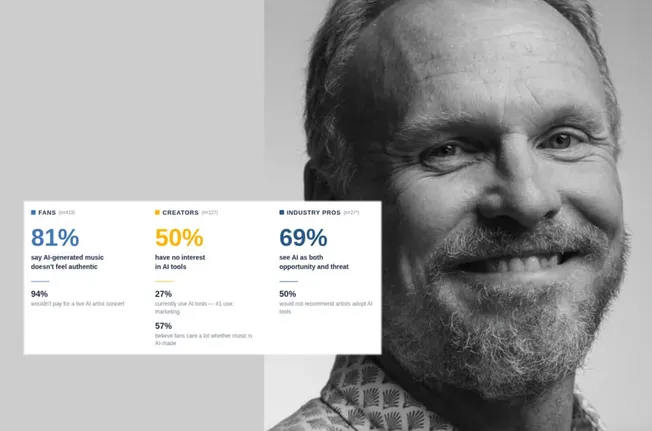
By Jason English, host of Curious Goldfish
Independent creators using AI tools are convinced their fans don't care about AI in music. The fans, including the ones who've actually heard AI music, say they do. We named the gap between those two reads the "AI Optimism Blind Spot."
Here’s quick context on where that conclusion and assessment come from: I conducted a survey earlier this year, distributed through the Curious Goldfish podcast audience, music communities, and word of mouth. I believe it’s the first-ever grassroots, independent survey about AI and Streaming conducted by an independent podcast.
I had 573 people respond across three personas: 419 fans, 127 creators (94% of them independent), and 27 industry professionals. No major label paid for it. No streaming platform shaped the questions. In the spirit of Curious Goldfish, I was curious and wanted to know what fans, creators, and industry pros were actually saying about the state of music in 2026 when nobody was selling them anything.
Among creators in our sample who don't use AI tools, 67% say fans care a lot about whether the music they love was made by a person. Among creators who use AI frequently, only 14% say the same. That's a 4.7x drop. The fans aren't divided about this. 81% say AI music isn't authentic, and 75% of the fans who've actually heard AI-generated music still reject it. The closer a creator gets to the tools, the more confident they get that fans don't mind.
The data argues the opposite.
The blind spot is real. The reason it exists isn't really about AI. It's about how creators read their own audience right now, and the conditions that distort what they're hearing back.
Start with the obvious one.
If you're an independent creator in 2026, the case for using AI tools is hard to argue with. 88% of creators in our survey earn less than 10% of their income from streaming. Content demand is constant. The tools scale work you can't scale on your own. Once you've decided to use them, your brain does what brains do when faced with a forced choice: It reduces the friction. I think it comes down to the fact it’s difficult to keep using AI in your workflow and also believe your fans hate it. So you adjust the estimate of how much fans care, just enough to make the choice livable.
That's not specific to creators. Plenty of fields run on it. Music is where we happened to ask the question.
The second piece has to do with where creators are getting their feedback. The platforms that reward content volume, such as TikTok, Reels, Shorts, playlist algorithms, are built for distribution, not relationships. Creators using AI most heavily are largely creators trying to keep up with that demand. The further you optimize for the platforms, the less direct signal or feedback you get from the actual people listening. You start reading and respecting the algorithm instead of reading the room.
The fans tell you why that matters.
+Read more: "Music & AI: What Happens When Quality Is No Longer a Differentiator?"
The most engaged fans in our survey, the ones spending $500 a year or more on live music, find new artists through word of mouth, trusted curators, and live shows. They're not on the platforms where AI content velocity wins. So the creators leaning hardest on AI are getting feedback from a tier of fans that's already disengaging, while the fans whose opinion would change their business never make it into the loop.
The third piece is the word "tool." Once you call AI a tool, the question becomes whether the tool works.
- Does it cut your editing time?
- Does it speed up your social content creation?
- Does it produce an acceptable demo mix?
Those are fair questions. They aren't the question fans are asking. Fans aren't reading craft. They're reading whether a person made what they listen to Creators end up answering one question while their audience is asking another, and that's most of what the blind spot is.
You can see it word for word in the survey itself. A fan in our sample wrote:
"People tend to love musicians because they feel like that musician connects to them and their experiences. I don't think you can get that from AI."
A creator who uses AI tools, in the same survey, wrote:
"I think the whole 'AI music getting on charts and playlists' is the exception, not the rule. Like in most fields, AI will be used as a tool by music creators but never 'replace' them."
Same survey. Two completely different conversations.
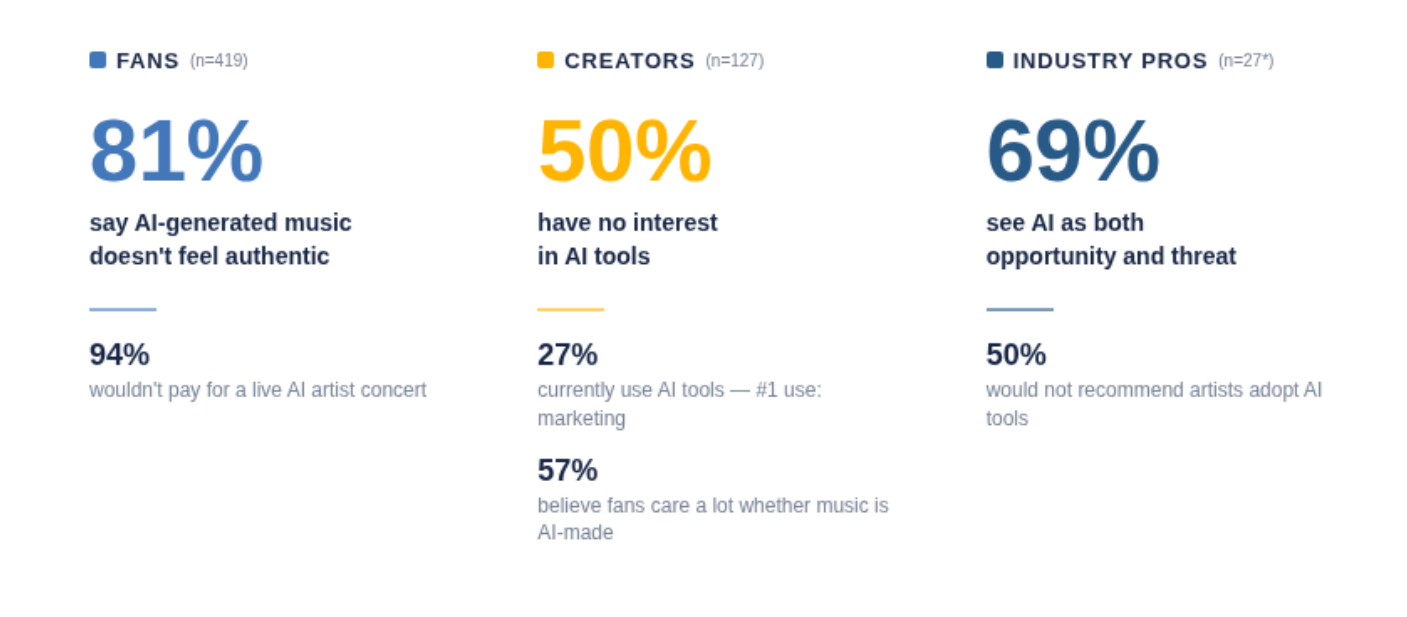
The most useful check on all this is a small cohort in our data, the creators who told us it's gotten easier to make a living from music. The sample is small, 23 respondents, so this is a signal, not a verdict. But within that group, 70% say fans care a lot about AI authenticity, against 57% in the cohort that says it's gotten harder. The thriving creators are reading fans more accurately than the struggling ones.
That tracks for me. Survival narrows perception and when you're not under economic pressure, you have the bandwidth to keep listening. When you are, you commit, and the commitment is what produces the blind spot. Whatever else those thriving creators are doing, they're still hearing what their fans actually think.
I'll admit I'm sympathetic to the creators on the other side of this finding. I started Curious Goldfish at 50. I don't have a personal brand that drives listeners on its own. The same advice every other independent voice gets: post more, feed the algorithm, be everywhere, has been thrown at me too. Most days, despite hundreds of posts, it feels like nobody cares. The case for grabbing every tool that lets you keep up is obvious from the inside. I get it.
What the data is telling us is that those tools come with a cost the people using them can't see clearly from inside the work. It’s an important call-out, especially for managers, labels, and anyone helping artists make these calls.
Two practical things if you're in that role.
First, ask the question your survey answers don't give you. What would your most committed fans actually say about your tool stack if you laid it out for them. Most artists have never asked. Most managers haven't either. And would fans actually care?
Second, treat the human authorship as a brand asset, not as marketing copy. The "Human-First" label that's showing up among independent artists and labels is a market response to the blind spot working in reverse. The audience is paying attention. The artists who say plainly that the songs were written, performed, and sung by real people are gaining ground their AI-heavy peers think is being given away.
The technology will keep moving. Knowing what your audience actually thinks is a separate skill, and it might be the one worth growing.
The free summary of The State of Music in the Age of AI & Streaming is available at curiousgoldfish.com. The full 106-page report, with deeper findings on streaming economics, The Content Trap, The Superfan Profile, and the rest of the AI authenticity data, is available there for $24.
Jason English hosts Curious Goldfish, an independent music podcast focused on singer-songwriters and bands across Americana, folk, roots, bluegrass, and country. The State of Music in the Age of AI & Streaming is his independent research report, available at curiousgoldfish.com.