

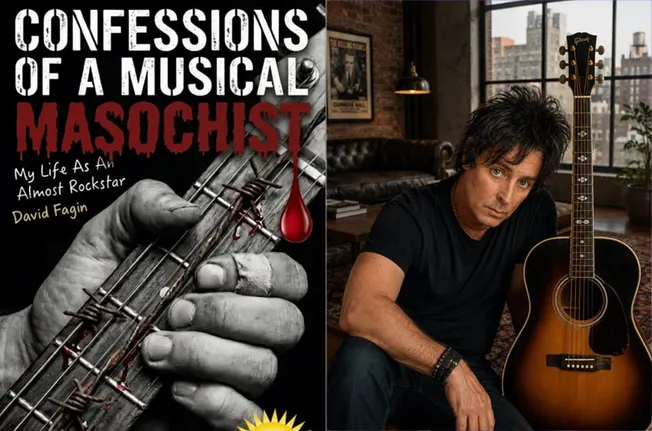
David Fagin is a musician, songwriter, producer, and artist-rights advocate best known as the founder, lead singer, and principal songwriter of the power-pop band The Rosenbergs.
The band became a case study in artist leverage in 2000, when Fagin publicly refused a slot on Universal-affiliated Farmclub over a 23-page, six-album contract that would have handed the label the band's website and publishing in exchange for roughly two minutes of airtime. His refusal circulated widely (now called "going viral"), garnering coverage from CNN, CNBC, the LA Times, Spin, Wired and the Denver Post. The Rosenbergs instead signed with Robert Fripp's Discipline Global Mobile on a revenue-share deal that let the band retain its own masters and partner with Napster on record sales and tour promotion.
In his new book, Confessions of a Musical Masochist, Fagin tells the story of a career spent chasing a dream that stayed permanently just out of reach — from viral notoriety, national tours, and a deal with British rock royalty to empty clubs, floor-sleeping, disastrous road trips, tribute bands, and stints with The Muppets, Neil Diamond, and Sheryl Crow.
Hypebot is proud to offer this complete chapter excerpt. Enjoy.
Embracing the Dark Side
It’s not that we wanted to give our music away, we liked being compensated for our art the same as anyone else, but besides not having the budget to compete on a traditional playing field, we had just found out the field was off limits to us. Members only. So we started our own game in the sandlot. Hoping that menacing dog wouldn’t steal our ball.
To our surprise, Napster was interested.
Milt Olin, the new CEO, liked us. Called us “scrappy” (thankfully with an s). Napster was in the midst of fighting its own, exponentially larger war with the major labels, and so they saw us as kindred spirits—a band that told the system to go screw itself and was in need of a new path forward.
Even Adrian, Mr. Slow-and-Steady himself, was on board. Maybe he realized we had very little steady left, and slow was feeling more like stuck. Or maybe he was more than a little embarrassed by how badly the McClusky thing had flopped and figured we had nothing to lose. In his defense, we might never have gotten anywhere if we spent $50,000 on a record that was blacklisted, anyway. Still, it would’ve been cool to take the shot.
In any case, in true Rosenbergs fashion, we decided to try something no one had ever done: With Napster behind us, we released a two-for-the-price-of-one bundle of Mission: You.
Napster would pay to manufacture and distribute 10,000 copies of the CD with a second, full-length “Napster copy.” One CD would have the booklet, lyrics, and liner notes; the Napster one would just be the disc with the Napster logo and a heartfelt liner note from us: “Before we become drug-addicted rock stars and isolate ourselves from our fans, we can think of no better way to get our music to the public than with the help of Napster. If 20,000 people have the record, that’s potentially 40,000 people at our shows. Here’s a copy for you and a copy for a friend.” File sharing, Amish-style.
(Somewhere, a Sony marketing exec is spitting out his latte, reading that. I know this for a fact, because years later, Sony would steal this exact idea and offer two-for-one deals with some of their own artists. Which either meant we were visionaries or they were desperate. Probably a bit of both.)
Part of the deal included Napster putting us on their front page. Keep in mind, this was like being added to Spotify’s front page today. Of course the internet was nowhere near what it is now, but back then it still meant hundreds of thousands of views. Daily. We finally found it: a back door into the mainstream.
The morning after we went live on Napster’s front page, Evan and I were holed up in a motel (for the moment, the desire to kill each other taking a back seat to the business at hand). Evan opened his laptop and lost his mind. Sitting in his underwear, belly out like a proud toddler, he shrieked: “Jesus Christ, David! We got over a thousand requests to be added to the mailing list just since last night!”
Giddy, like sixth graders watching a Donkey Kong machine tip over and the coins come flying out, we ran to get the Joes in the other room.
In 2001, MP3s and file sharing were the Wild West. As Napster and The Rosenbergs rode into town, the entire music industry stood on its front porch, screaming for the sheriff to “DO SOMETHING!” Meanwhile, we were feeling like the Dalton Gang.
The first week of the insane Napster rush, we collected over ten thousand addresses. Poor Evan. What was once a rush of rocket fuel had turned to a nightmare, as he had the glamorous job of manually entering every single email into our database. This was way before Mailchimp or Constant Contact. As we drove between gigs, Evan sat in the back of the van, typing away for hours on end. How he didn’t get carpal tunnel is beyond me.
The other part of the Napster deal includes tour sponsorship. For us, it was perfect timing, since the record had just come out. The nice folks at Napster threw us $5,000 in cash and several six-foot-long magnetic Napster logos to slap on the sides of our van. They also gave us boxes and boxes of T-shirts, stickers, hats, and other swag. I still have most of those dusty boxes in my garage, looking very much like the room with all the classified docs in Mar-a-Lago.
All the magnetic logos were stolen within a week. (There’s simply no way to stop someone who wants to take a magnet off your van. They’re probably collector’s items now.) As we cruised down the highway, people honked at us—either in support of Napster or to let us know they hated us. Either way, we were getting noticed.
But the real question was: Without radio promo, would anyone come to the shows? We could barely draw fifty people in NYC, and now we were booked as headliners in 500-capacity venues in New Mexico and Sacramento. Would Napster’s exposure—and the thousands of new fans on our mailing list—translate into breathing bodies in the rooms?
It actually did.
Sort of.
Having thousands of new fans was absolutely amazing. But there was just one small problem no one had thought of. All the kids who found us on Napster were under eighteen. Which meant, legally, they weren’t allowed inside 90 percent of the venues on the tour.
Every town we rolled into, we found a few hundred high schoolers standing outside the venue…and, one by one, we watched them all get turned away. It was a cruel twist worthy of a John Hughes movie, with no happy ending. Like Samantha getting dumped by Jake. I’m not sure how to explain the special kind of heartbreak that comes from driving across the country, from Tucson to Tallahassee, promoting your first full-length record, with thousands of fans—thousands—who want to see you, yet only playing to the bartender and the sound guy.
Doing our best to see the humor in this fucking catastrophe, we called our jaunt the No Fans Allowed tour. Almost everywhere we played was a graveyard. Seeing all those kids locked out was so frustrating. We actually tried jamming on the sidewalk a few times, but it never really worked. We didn’t have any acoustic guitars with us, so you could barely hear us.
There was one exception in the nightmare that was the Napster tour: The show we did at the Cow Haus in Tallahassee with Hank Williams III. The place was packed.
Seeing all the people led us to believe, for once, we’d make out okay, financially, as the split saw Hank getting a $5,000 guarantee and us splitting the rest with the other band. To our good fortune, the third band on the bill pulled a no-show, which left just us and Hank. Now, come settlement time, we were expecting an even bigger windfall. Stupid.
We’d heard Hank had a thing for punk and thrash metal, and sure enough, after about an hour of boring, country-western heartbreak, he addressed the crowd in full Southern drawl: “Ladies and gentlemen, those of you who’ve seen us before know what’s gonna happen next. Those of you who haven’t might wanna head for the exits. Or stick around. It’s your choice. But It’s gonna get loud.”
Half the room bolted.
Hank peeled off his jacket, revealing a skull-and-crossbones shirt and tons of tattoos, and launched into a speed metal cover of Stormtroopers of Death. One minute it’s “Your Cheatin’ Heart,” the next it’s “MUTHAFUCKA!! MUTHAFUCKA!!”
Hilarious. Surreal. And awesome.
After everyone cleared out of “Bob’s Country Bunker,” we went to the office to settle up. By all logic, we figure we’re due at least $3,000–$4,000.
But the guys from Deliverance put a stop to that.
The “promoters” of this shit-kicker—three good ole boys who look like they’re cast for a regional production of Hee Haw: The Apocalypse—ushered us into the back room. Did I mention they were quite large? And drunk? And they had guns? Somehow, we managed to find ourselves smack-dab in the middle of a scene from the movie Porky’s. And, as it turned out, these drunken hillbillies with guns had zero interest in paying us what we were actually owed.
One of them whipped out a calculator, pretending to go through the motions. Reading the room, I already knew how this would turn out. After a minute of overly-exaggerated tapping and sighing, he looked up and said, with full, drunken Southern sincerity: “I dun tole Mary y’all were gettin’ sebenty-fibe bucks for the night and she agreed.”
I’m sorry, what?
Mary would never have agreed to a laughable sum like sebenty-fibe dollars. Unfortunately, she had the contract. We’d just spoken to her, but, of course, we didn’t have a fax on us, and these guys weren’t going to let us see their copy. God, how I wish there were cell phones that could send PDFs.
We called Mary. She didn’t pick up. We argued with the hicks for a bit, but it was no use. I wanted to tell them to keep their seventy-five dollars but was overruled. We took our sad little payout and left to pack up the van.
To add insult to this redneck injury, as we were loading out, two of the Deliverance Brothers come trotting out. Naturally, to help us pack.
“You boys dun took our microphones.”
“I’m sorry, what?”
Captain Kangaroo repeated himself.
“You’re accusing us of stealing your mics?”
The sound system at this place was made of rust, duct tape, and pubic hair. We told them we didn’t have their microphones, but that just upset them more.
“Open the van,” he said. The third stooge was now there, too.
To say we were scared shitless is understatement. These guys were the type to blow your heads off, then bury you in a ditch behind the bar.
Yet, as petrified as we were, we weren’t gonna let them in the van. Fuck that shit. Screwing us out of our money was one thing. Accusing us of theft? No thanks.
Lucky for us, a small crowd had gathered, watching the standoff between the city boys and the moonshine trio. Probably hoping for a remake of Road House. Then, just as we thought we were about to be shot, Calculator Guy gave us one long, guilty look and said: “Ah, forget ’em, boys. Let ’em go.”
Guess he realized stealing three grand from us was better than life in state prison for the quadruple murder of northerners.
Our underwear freshly soiled, we drove off—underpaid, falsely accused, and reeking of beer, sweat, and mid-level trauma.
In El Paso, we played an Air Force base exactly like the one in Spinal Tap. Actually, Spinal Tap had more people at their show. And we didn’t even get to meet Fred Willard.
A few fans actually showed up, thanks to a handful of pop-loving airmen, but it was beyond surreal playing in an actual airplane hangar. The drums sounded like they were in the Grand Canyon. Every song sounded like Dokken.
As much fun as it was being on a tour through the nation’s armpits, playing to no one, and constantly fighting with your tragically immature band member, for some reason, I was not in a great headspace. Maybe it was that Paula and I had been broken up for three months by then, and I’d decided to live in a full-blown, deluxe pity party. Somewhere in the middle of New Mexico, I woke to an email from Paula. It was a GIF of a teddy bear rolling over in bed with no one next to him. The caption said: “I miss you.” I let the thing play like fifty times, that stupid bear rolling over, then rolling back. Rolling over, rolling back.
After three months of nothing, she ambushes me with an emotionally manipulative Build-A-Bear? Thanks.
In my fog of heartbreak over the tour, and now heartbreak over my heartbreak, I loaded my gear into the van, forgetting to bend my knees… and… SNAP! A pain shot through my lower back like I’d just been tased by the LAPD.
As I was doubled over in pain, I saw the bag was only halfway in, so, like a true genius, I gave it one last push and—SNAP! Another, even-more-crippling pain. Nearly immobile, I hobbled back to the motel, bent over like a hunchback, and called Dr. Ron, who offered his usual groundbreaking advice: “Heat it, then ice it.” Or was it the reverse? Whatever, neither worked. I could barely walk.
I ended up playing the next two shows sitting on a stool like some sad lounge act in a bad 70s movie. Not like there was an audience to give me their sympathy, anyway. When I got home, my high school buddy, Chip, who was now a chiropractor, gave me one good crack and knocked the pain clean out of my spine. To this day, I still get sore standing for too long, which isn’t great if you’re a musician on your feet for four to five hours at a clip. But, thanks to Chip, the pain is nowhere near what it once was. Outside of a Napster hat, my back injury was the only lasting souvenir I would bring home from the tragedy that was the Napster tour.
In LA, we were at the House of Blues, an amazing, iconic venue. They told us we could have one bottle of anything we wanted in our trailer. Without hesitation, I said: “Tequila!” Big mistake. I wound up drinking three-quarters of the bottle myself, crashing the set of poor Page Hamilton of Helmet, the act on after us—and doing a Wayne’s World (bowing in front of him) at his feet, ’til I was dragged off by security. At which point, I began vomiting uncontrollably. It would’ve helped if I’d eaten something, but c’est la vie.
The next morning, we had a four-hour drive to San Francisco, and I had a nasty case of alcohol poisoning. I couldn’t even get off the bed, let alone get into a moving van, but I had no choice. Not only did we have a show that night, we were supposed to meet up with Jerry Harrison for dinner. The guys basically carry me to the van and throw me in the back, in pretty much my underwear.
Every five minutes or so, I was like “Pull over.” BLLLLEEEEEEECCCCHHH. I puked out the door. This constant stopping—and the fact Joe couldn’t drive over 30 mph for fear of me vomiting inside the van, added about three hours to our trip. When we hit the desert near those giant wind turbines, I made Joe pull over again. This time, when Zeckle slid the door open, a swarm of horseflies flew in the van. For the remainder of the trip, the van swerved left to right as Mahoney tried to avoid being bitten. Of course, that movement made me projectile vomit into a Big Gulp cup—until finally, I passed out.
Incidentally, we made it to San Fran with about a half hour to spare, and, somehow, I managed to put on one of my best shows of the tour. Maybe I should do this more often? The next day, Jer—that’s what I call Jerry now ’cuz we’re BFFs—took us up to his house in the redwoods and we toured the giant tree forest.
Silver lining—somehow, we actually managed to sell all ten thousand copies of the Napster-sponsored CD.
And now for the bad news.
Adrian told us that record stores were apparently buying the two-for-one bundles, opening them up, and selling the two CDs separately, in order to double their profit. So instead of promoting file sharing, we were actually promoting capitalism.
Evan was the first to say what we we’re all thinking: “Fuck that shit! Call Chidekel! We’re suing!”
When I told Chidekel what was going on, he said: “As long as they pay for them, they’re allowed to do whatever they want.” Naturally, that crushed us.
“What?! That can’t be right.”
“It’s right.”
We were boned. Even the indie stores—especially the indie stores—were ripping open our two-for-ones and selling the second disc separately. Then came gut punch #2: Adrian told us our upcoming in-store tour of indie record stores—about twenty dates—was canceled.
We were already blacklisted from mainstream radio. Now the indie stores were blacklisting us?
Adrian sighed. “Yep. Don Van Cleave—the president of the Coalition of Indie Record Stores—is furious you guys partnered with Napster. Says they’re stealing from artists.”
I was not having this. “Exactly how much of a royalty does an indie store pay Depeche Mode when they sell one of their used CDs for five bucks?”
“Good point, mate. I’ll ring him up,” he said.
Ten minutes later: “No luck. They won’t support any artist doing business with Napster.”
This would turn out to be complete bullshit.
I told Angus, our business manager, the situation. Without missing a beat, he said: “You know Dave Matthews is doing a Napster promo right now.”
Our collective jaws hit the floor. We piled in the van and headed to the nearest record store. And there it was. The new Dave Matthews single “I Did It,” with a prominent placing next to the register, like a tip jar.
We called Adrian. “What the fuck, Adrian?! We do a deal with Napster and get blacklisted, but Dave Matthews does the same thing and gets prime product placement?”
“I’ll call you back, mate.”
CUT TO: Adrian returning with a line so stupid it could’ve come right out of Spinal Tap. “The problem,” he said, “is that you guys have the Napster logo on the front of your CD. Dave doesn’t.”
I stared into the void. The indie store association was giving us the real-life On your record, she’s the victim. On Dave’s, he’s the victim. For real? That was the excuse? A tiny, half-inch-wide kitty-cat logo was keeping us out of thousands of stores? And cancelling our tour?
The real reason, of course, was that Dave Matthews was a platinum-selling rock star and The Rosenbergs were not.
On top of all the Napster nonsense, my arguments with Evan were reaching a fever pitch. Riding in a van with us was like watching a cobra and a mongoose. Part of it was the obvious: too many months crammed into a van like human luggage. And into a studio situation that saw everything take five times longer than we thought. And would wind up costing us five times more than we thought. Thanks to our friends, blame and frustration, we were fast becoming corrosively allergic to each other.
On the road, Evan became the walking embodiment of the anti–anything Dave guy. No matter what the topic—women, politics, songwriting, the proper way to eat an orange—it didn’t matter. My way wasn’t just bad—it was now evil. Conversely, Evan’s way wasn’t just good, it was godly. One would think becoming a Buddhist would bring enlightenment and peace to any situation. But not with Evan. He joined the Milarepa Fund, the organization founded by The Beastie Boys’ Adam Yauch and activist Erin Potts to help free Tibet from Chinese rule, and was immediately an authority on everything. Peace and tranquility in the wrong hands can be just as powerful a weapon as hate and fear.
Just a few years ago, I was teaching Evan how to be in a band. Now he had made it his mission to teach me how to be a perfect person. Professor Silverman’s syllabus? Judging and despising everything I do. It was like I enrolled in a community college class of Enlightenment 101, taught by a bitter, hypocritical, low-calorie version of the Dalai Lama.
The arguments continued wherever we went; a particularly embarrassing one was in a family picnic area in the middle of Utah—screaming expletives in front of children eating Lunchables. It got so loud, a park ranger had to ask us to leave. Think about that; we were asked to leave a massive sprawling national park in the middle of the Utah desert. You could test the atomic bomb there, and no one would ask you to leave. Days later, in a strip mall parking lot in Indiana, or someplace with a lot of tanning salons, our fight was so nasty, we nearly broke up the band. Unsure what to do, Zeckle and Mahoney just kept their heads down and prayed we could at least sell a few more records before we broke up.
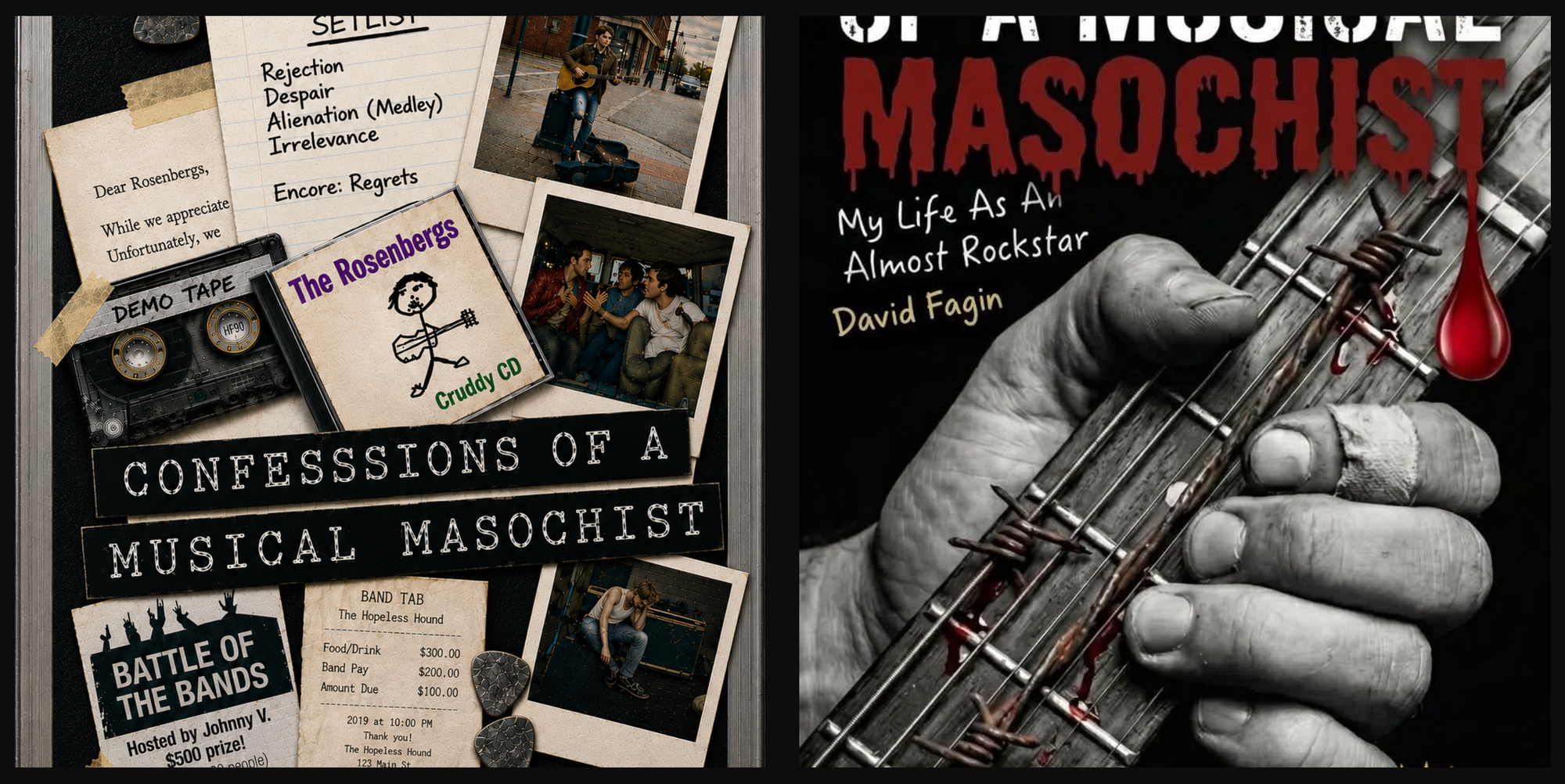
Order David Fagin's Confessions of a Musical Masochist: My Life As An Almost Rockstar, out today in print and audio via Scout Media and Noshpit Entertainment.
For more information visit David Fagin's website.
David Fagin is a musician, songwriter, and artist-rights advocate. As frontman of The Rosenbergs, the first band credited with going viral, he famously refused a Universal-affiliated TV slot over its contract terms, signed with Robert Fripp's label, partnered with Napster, appeared on Howard Stern with Gene Simmons, and testified at the C.A.R.P. hearings on Capitol Hill alongside Alanis Morrisette. His song "Birds of a Feather" was the theme to the CBS sitcom Accidentally on Purpose.
He even worked with The Muppets.