

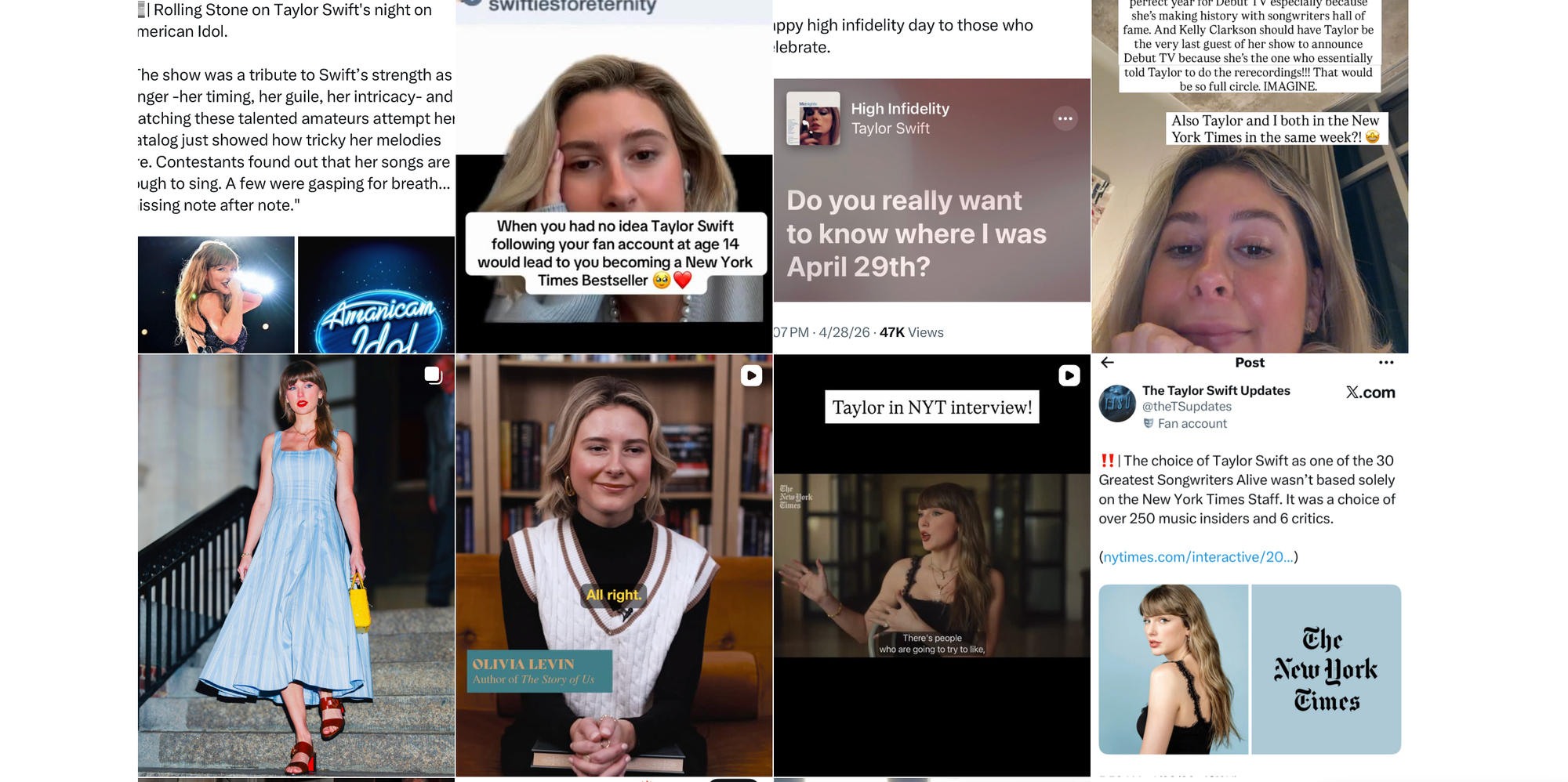
A superfan supporter of Taylor Swift has turned their fan page into a full-time career — earning income through brand partnerships, media opportunities, and a rapidly growing audience built entirely around fandom.
The recently reported story follows 26-year old Olivia Levin, who started the SwiftiesForEternity fan account on Tumblr and Instagram originally, and who now has amassed hundreds of thousands of followers by posting updates, insights, and commentary on Swift’s music and activities.
What began as a passion project has evolved into a sustainable business — one that doesn’t rely on direct access to the artist, official affiliation, or even participation from Swift’s team. In the wake of superfan subscriptions dwindling, as analyzed by Water & Music, this is a unique outlook on how fan communities are becoming reliant on themselves to continue fuelling their activities.
Fans Are Becoming Businesses
For years, fan communities lived on the margins: Tumblr blogs, Reddit threads, and unofficial Twitter accounts. But today, those same spaces are evolving into fully monetizable creator platforms. The difference now is scale — and structure.
Fan operators are:
- Building large, engaged audiences
- Acting as curators, commentators, and community leaders
- Monetizing through brand deals, content partnerships, and media visibility
In other words, they’re no longer just participating in culture in a top-down manner — they’re operating businesses inside it from the ground up, and supporting one another.
+Read more: "Fred again..’s Dropbox Photo Dump Understands the Moment"
A New Layer of the Music Economy
What makes this trend especially notable is that it runs parallel to the traditional artist economy — not in competition with it. Unlike direct-to-fan models (subscriptions, VIP packages, fan clubs), this emerging “fan economy” does not require or request artist buy-in, draw revenue away from the artist, or thrive on access.
Instead, it expands the ecosystem of content for participants seeking to make and/or consume that content. Fans also create value by helping other fans — explaining lore, tracking news, offering ticket guidance, and shaping the narrative around an artist in real time.
That’s labor the music industry has historically overlooked — or struggled to monetize. Now, fans are monetizing it themselves.
From Audience to Infrastructure
At scale, these fan-led operations start to look less like hobby pages and more like building new support structures. Especially as:
- Discovery engines for new listeners
- Real-time news sources for fast-moving fanbases
- Community hubs that deepen engagement
They also reflect a broader shift already reshaping music: fans want to participate, not just consume.
We’ve seen this play out in everything from remix culture to fan-led content ecosystems. This is simply the next step—where participation turns into ownership, and ownership turns into income.
+Read more: "Fanbase API: 'Artists Aren't Just Musicians, They're World-Builders'"
Why This Matters for Independent Artists
For indie artists, the takeaway isn’t to replicate this model — it’s to recognize and enable it. Because increasingly, your most valuable asset isn’t just your audience — it’s what your audience builds around you.
That means:
1. Your fans can extend your reach in ways you can’t
Fan operators often move faster, speak more directly to the community, and create content that resonates more organically than official channels.
2. You don’t have to do everything yourself
Promotion, storytelling, and community-building are no longer solely artist responsibilities. Fans are stepping in—and building their own platforms in the process.
3. Participation is the new loyalty
The fans who invest time, creativity, and identity into your world are the ones most likely to drive sustained growth—for themselves and for you.
4. Even small fanbases can support micro-economies
This isn’t just a megastar phenomenon. Highly engaged niche communities can support fan creators at much smaller scales.
Zoom out, and this isn’t just a feel-good story about one fan’s success. Although it's totally that too! It’s a message that the music business is continuing to unbundle into dozens of interconnected micro-economies — and fans are now claiming a role within that system.
Artists make the music. Platforms distribute it. But increasingly, fans are active participants in transmitting it.
+Read more: "UGC Strategy Guide: How Fans Market Your Music for You"