

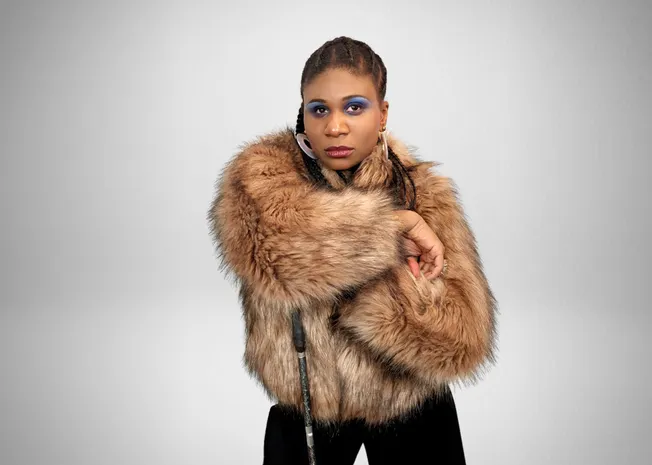
"Navigating a world not built for me with my 6-inch heels and matching glammed out cane has jacked up my problem-solving skills, my drive, my adaptability, my determination, and my creativity. I call this Big DIS Energy."
Lachi is a force of nature.
She's a legally blind singer/songwriter, producer, and performer, who is on tour more than most artists out there. Her music communicates both the traumas and triumphs of her individual life as well as being, simply, so much fun. Both of which are reasons why the connective properties of the live performance environment suits her personality and her mission.
She's also a writer and interviewer. She's a fashion entrepreneur having founded Glam Canes, which transforms mobility aids into statements of style and empowerment. And above all of that, selflessly, Lachi founded the UN-recognized non-profit organization, RAMPD (Recording Artists and Music Professionals with Disabilities), which advances accessibility at the highest levels of the industry.
Through this she's spoken at the White House, the UN, the headquarters of Google, Amazon, and several major universities in North America, and been able to collaborate with artists like Snoop Dogg and Coldplay to amplify and accelerate the voices of her community to global recognition.
She does it all with a smile, but also with a focused energy and attitude that expresses how she'll stop at nothing to actionize positive change in this world.
Here's our essential conversation. Follow Lachi on Bandsintown and catch her live on tour in 2026.
Hypebot: Hey Lachi, thanks for taking the time to answer some questions. It means a lot! Let’s dive right in! Do you feel like when you write music you’re writing your story or trying to tell the stories of those without a voice or a microphone of their own?
Lachi: "Thank you, I'm so glad to be here! Both. I start from my lived experience as a blind, neurodivergent artist. As I say in my book I Identify As Blind, I’m an expert in one thing: me! I write from my perspective, pull from my experiences, and tell the stories gifted to me by my ancestors. That being said, I’m always writing toward a bigger 'we.'"
Music lets me translate access, identity, and joy into something soulful and communal. A perfect example is the first single off of my upcoming album Magnificient, called 'Fidget,' a pop/trap bop celebrating how I process things differently. If someone hears themselves in it, or feels seen for the first time, then I’m doing my job."
H: It’s no secret your work has touched millions, but is there a weight on your shoulders? Or do you feel lifted by the communities you represent?
L: "I feel truly honored to do what I do. I think to myself, what would the eight-year-old me need to have found liberation so much earlier. What songs would she have needed to hear? What stories would she have needed to read? What heroes would she have needed to know? And if her white cane was bejeweled with pink rhinestones would she have used it with pride back then?"
There’s responsibility, sure, but it doesn’t feel like a burden. I feel lifted, filled. Community turns pressure into purpose. I’m not carrying something alone, I’m part of a movement that’s loud, creative, and very much here. I stand on the shoulders of my ancestors. My Black ancestors, my disabled ancestors, and my Black disabled ancestors. I hope to become that for those who come after me."
H: Have there been moments in your life when you felt disability was not being properly addressed and approached? How did you respond?
L: "All the time, from unaccommodating spaces to underestimated talent due to stigmas and tropes. For so long, and still today, many people do all they can to minimize or erase the experience of disability, neurodivergence, and other chronic conditions. The fear of being seen as too much, too different, not competitive enough (i.e. internalized ableism), is why folks mask or camouflage their difference or downplay them."
I respond by being who I want to see, building what’s missing, and bringing others with me."
That’s how RAMPD.org came to be, bringing accessibility to the industry, opportunity and community to creatives with disabilities, and turning frustration into infrastructure. My Glam Canes, my bejeweled cane line, allows cane users to navigate the world with pride in their difference, declaring they believe they are worth it and that they will no longer contribute to their own erasure. So often, folks view disability as something to pity or cure. Not Lachi."
Navigating a world not built for me with my 6-inch heels and matching glammed out cane has jacked up my problem-solving skills, my drive, my adaptability, my determination, and my creativity. I call this Big DIS Energy."
"When people recognize themselves in the music, the humor, the banter, it is physically electrifying, like the audience becomes part of the band, a harmonic of the sound wave, an echo of the prayer. That exchange of joy and power is why I live."
H: One thing I LOVE about your videos is that they’re always introduced by a voiceover narration to tell the listener what they’re about to hear. This signals to me that you’re taking care of the blind community by orienting them, but that you’re also perhaps aiming to educate sighted folks as to the lived reality of disabled listeners, and bring everyone onto the same level. Why is this meaningful to you?
L: "Thanks for noticing! Access can be integrated into high-quality art, and our Mad Different series and other content celebrating ASL, self-description, and more, highlight this. Audio intros and descriptions (especially if done by public figures or celebrities like Ali Stroker, Imani Barbarin, or Molly Burke) invite listeners with vision loss in from the first second, while showing sighted audiences what artistic inclusive design can look like."
It’s essentially just good storytelling that includes more people."
H: And what are some other ways that performers reach across community lines to bridge those gaps?
L: "First and foremost, just creating art that incorporates or reflects one’s true lived experience, goes a long way. My tracks 'Fidget' and 'Moves' as well as my upcoming album, Magnificent, all celebrate my lived experience as a disabled baddie front and center."
Some other ways I work to bridge these gaps are by hiring majority disabled, neurodivergent, and LGBTQ+ staff or crew on my teams and productions, designing content this is accessible to blind and Deaf audiences, and folks with sensory differences with multiple ways to engage, working through RAMPD to remain in community with the latest on Disability Culture."
When touring, I perform with an ASL artist as part of the band, Indi Robinson. She joins on stage at shows and in social content. We’re a living example of how both a Deaf and a blind performer can collaborate, elevate access, and amplify Disability Culture. Inclusion is a creative choice, not a constraint."
H: Tell me about RAMPD! How did that project gain UN recognition?
L: "RAMPD.org (Recording Artists and Music Professionals with Disabilities) is a network coalition of creatives, executives, educators, and techies with disabilities, neurodivergence, and other conditions working across music, media, and technology to make the industry more accessible and disability inclusive. Our partnerships, research, and consultancy helped land recognition at the UN as a model for disability inclusion in music and culture."
As the founder and CEO of RAMPD, it has been an honor to watch it grow from a simple necessity I felt I needed into an industry staple, connecting the music and live entertainment industries to the tools and programming needed to empower music creatives with disabilities. RAMPD has since worked with the GRAMMYs, Netflix, CMAs, TIDAL and more."
H: What are some unique preparations you and your team have to make before performing live gigs?
L: "We gotta plan access like we plan sound. Once a show or speaking engagement is booked, it starts with creating a setlist. My ASL artist and I translate all lyrics for ASL then rehearse. Ours includes an access rider for accommodating attendees and our crew. We advance with venues, stage layout for navigation, and access check-ins with crew (inclusive of safety-check, visual descriptions, and access need checks) before every show."
I occasionally get to invite a collaborator to join me on stage. I also work with my stylist and makeup artist Arthur to get my look — Glam Cane and all — perfected for the big day. Now, we’re a smaller outfit doing what we can to make every night accessible through and through. Our good friends at Team Coldplay also work some great magic to ensure accessibility is front and center at shows."
"The world was not built for anyone to thrive perfectly. And it is in overcoming an adversity here or a barrier or stigma there, large and small, that make us the power houses we are."
H: Are there ways in which venues could be more accessible to disabled communities of both artists and audiences, beyond the common things like wheelchair ramps and lifts?
L: "There is no checklist that can capture every single accessibility measure, so my go-to for venues is to lean on Wheaton’s Law, 'Don’t be a dick.' Every guest deserves to be treated with dignity, autonomy, and respect, so it’s all just a matter of hospitality and accommodation to a patron who wants to give you their money."
Beyond that, think full experience: clear wayfinding, trained staff, accessible ticketing, sensory-friendly options, and a website that says, 'Hey here’s all that info and a contact.' Access is about dignity and ease, not just entry. We help venues and events get it right at RAMPD. We host Disability Culture trainings, venue walkthroughs, policy consultations, market research and offer ways venues and organizations can connect with their local disability community."
The more people understand about disability and their own disability identity, the more inclusive and accommodating they will be to disabled artists and audiences naturally."
H: Like Mr. Stevie Wonder, I find your songs to be so much fun. So strong, powerful, rejoicing, uplifting. Can you feel the energy in a live space change while you’re performing?
L: "I can feel right when the room locks in. It’s palpable. It’s loud when I’m rocking and snorts when dad-joking. It’s pin drop when I’m storytelling. It’s word-for-word when I’m giving them one of my viral songs. When people recognize themselves in the music, the humor, the banter, it is physically electrifying, like the audience becomes part of the band, a harmonic of the sound wave, an echo of the prayer. That exchange of joy and power is why I live."
H: What’s the most beautiful thing in the world?
L: "Often, when we are kids, we are at our most liberated, and that’s why my upcoming album Magnificent embracing disability is kid-friendly. The most beautiful thing in the world is liberation, being liberated — when people embrace their full, authentic self. When we dig in and not only accept but celebrate the deepest parts of ourselves society has made us believe is unworthy, that is when we find true power, true liberation, true beauty."
The world was not built for anyone to thrive perfectly. And it is in overcoming an adversity here or a barrier or stigma there, large and small, that make us the power houses we are. My book is all about getting people to unmask the parts of themselves society trains them to hide. What’s more beautiful than that?!"
H: What’s your guilty pleasure food to eat after a gig?
L: "When I get asked what I want in my dressing room at a gig, I always request nuts and cheese to nibble on."
And if I’m feeling celebratory after the show, a little mezcal with lime. :)"
H: In that case, next one's on me!
Lachi 2026 Tour Dates
JUN 21 — Brooklyn, NY @ Tone Shift Collective Presents: Daddies & Baddies
JUN 26 — Boston, MA @ Keynote: Partners for Youth with Disabilities
JUL 03-05 — New Orleans, LA @ ESSENCE 2026
JUL 08 — Austin, TX @ National Federation of the Blind Convention
JUL 19 — New York, NY @ SqueakyFest 2026: A Disabled Night of Musical Comedy
JUL 22 — Fort Collins, CO @ Modern Band Summit
SEP 10 — Berkeley, CA @ Disability Rights Education & Defense Fund I Keynote
SEP 29 — Woodbridge Township, NJ @ Merck 2026 Economic Impact Summit