

By Meg Adams of Synchtank
Every conversation about the future of music rights eventually arrives at the same problem.
The data is wrong, incomplete, or locked in a system that can't talk to anything else. Royalties go unpaid. Licences stall. Deals that should close in hours take days. And somewhere in the chain, a spreadsheet is doing a job that no spreadsheet was ever designed to do…
The music industry has spent years debating how to modernize rights management. The conversation has focused heavily on AI, blockchain and new licensing models, right. But what has consistently been underinvested in is the layer that makes all of those things possible: metadata!
The Foundation That Isn't There
Metadata is the connective tissue of music rights. It tells the system who owns what, in what territory, under what terms, registered with which society. Without it, nothing downstream works reliably. Not royalty calculation, not licence generation, not distribution reporting, and not sync clearance.
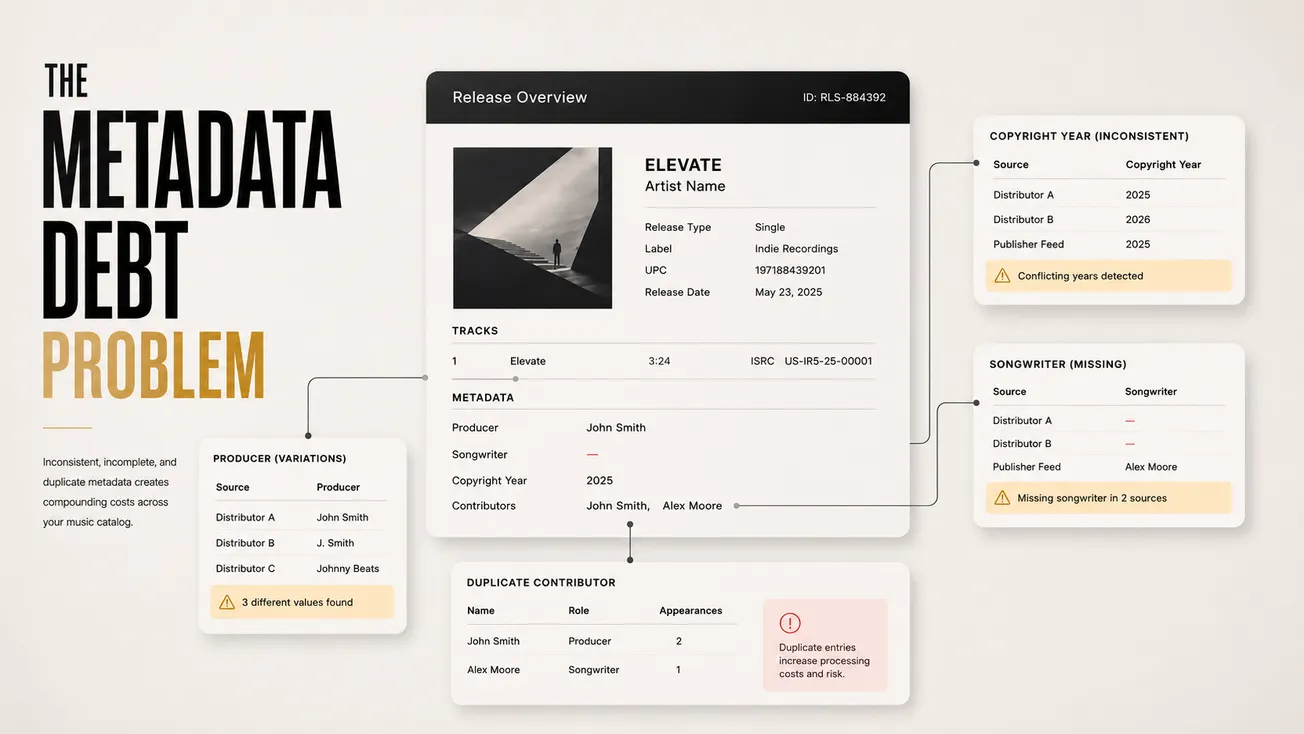
The problem isn't that metadata doesn't exist, because we all know that it does. But it exists in fragments, spread across incompatible systems, maintained inconsistently, and rarely structured to meet the requirements of the platforms and societies that need it.
A single track can have ownership data in a publisher's internal catalog, registration data at ICE, delivery metadata at a DSP, and monitoring data with no guarantee that any of these records agree with each other. When they don't, the consequences range from delayed royalty payments to licensing disputes to works that simply fall through the cracks.
Why This Has Been Allowed to Persist
The music industry is structurally fragmented. Publishers, libraries, broadcasters, PROs, DSPs, and collection societies each operate their own systems, maintained to their own standards, updated on their own timelines. Interoperability has always been an afterthought.
Legacy technology has made this worse. Many rights holders are still running operations on systems built before streaming existed, before DDEX was a standard, before CWR became the default language of society registration, and before the volume and velocity of sync licensing created the data demands that now exist. Those systems were not built to handle what the market now requires. Speed to sync and all that!
The cultural dimension matters too. Rights management has historically been relationship-driven, with significant institutional knowledge held by individuals rather than encoded in systems. That knowledge doesn't get lost when someone leaves, it does get lost when the organization has no infrastructure to capture it.

+Read more: "Why Duplicate Data is Costing Musicians & The Industry Millions"
What a Functioning Metadata Layer Looks Like
The shift required isn't just technical. It's architectural.
A functioning metadata layer starts with structured works data — compositions and sound recordings — in a format that supports CWR registration, DDEX delivery, and ICE matching from the outset, not as an afterthought. It means splits and ownership records that are maintained centrally and version controlled, so that when a deal changes, the change propagates correctly rather than creating a new fork in an already inconsistent dataset.
It means integration with the external systems that the industry actually runs on, not fragile one-off connections, but reliable delivery and ingestion pipelines that treat data exchange as a core infrastructure requirement rather than a project.
This means licensing workflows that are built on top of this data layer rather than running parallel to it, so that when a licence is issued, the relevant metadata is already structured, the rate has already been validated, and the reporting obligation is already understood by the system.
Companies like Synchtank have been building toward this model. Purpose-built infrastructure that treats metadata not as a filing system but as the operational core of rights management. The results, for the organizations that have made the shift, are measurable: faster licence turnaround, cleaner PRO reporting, and a significant reduction in the manual effort that currently absorbs so much of the industry's capacity.
The Cost of Inaction
Every year the industry delays addressing the metadata problem, the cost compounds. Streaming has driven catalog values to historic highs. Sync demand is growing across gaming, advertising, social, and emerging formats. The volume of transactions the rights infrastructure needs to support is increasing and the tolerance for the errors and delays that bad metadata produces is decreasing.
The platforms and societies that consume music rights data are raising their standards. DSPs are becoming less forgiving of incomplete or inconsistent metadata. PROs are processing more claims against more complex catalogs. Licensees increasingly expect self-service, the ability to find, clear, and pay for music without a manual process in the middle.
Rights-holders who are still managing this on legacy systems and spreadsheets will find the gap between what they can do and what the market expects growing wider. Not dramatically, not all at once, but steadily, and in ways that are difficult to reverse.
A Solvable Problem
The good news is that this is not a novel engineering challenge. The standards exist. The integration pathways are established. The technology to build a functioning metadata layer is available and proven.
What's required is the willingness to treat metadata infrastructure as a strategic investment rather than an operational overhead, and to recognize that the organizations getting this right today are building a durable advantage over those that aren't.
Music rights infrastructure is broken. Metadata is the missing layer. And fixing it is less a question of capability than of priority.
+Read more: "The Unsung: Why Songwriters Still Live in the Shadows of Streaming"

Meg Adams is the marketing manager at Synchtank, specializing in music rights, licensing, and the role of technology in catalog and rights management. Through her work with Synchblog, she explores emerging trends and industry developments affecting rights holders worldwide. She is also actively involved in the live music sector, giving her a unique perspective across both the business and creative sides of the industry.