


By Dominick Stragapede, Founder of DataWav
Most metadata mistakes look harmless when they happen.
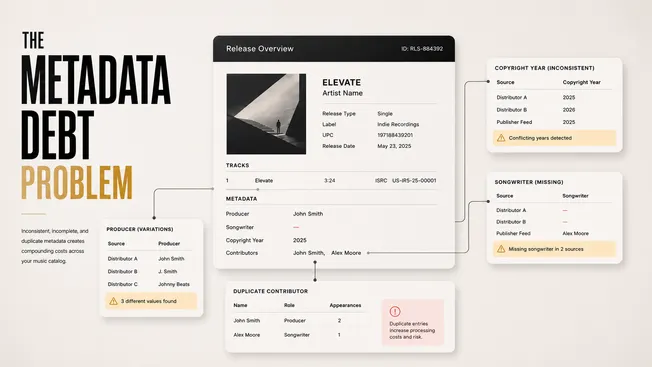
A producer is credited under a nickname on one release and a legal name on the next. A songwriter’s suffix is missing. A featured artist’s name is styled differently across platforms. The copyright line on the packaging does not match the information delivered to the distributor.
The song still comes out, though. There is no emergency meeting. No one delays the campaign. The team moves on to the next release, and the inconsistency quietly becomes part of the catalog.
That is how "metadata debt" begins. Metadata debt is the backlog of incomplete, conflicting, or unverified information attached to a label’s releases. One error is usually manageable. The problem appears when small errors accumulate across dozens (or hundreds) of tracks.
Eventually, someone needs a clear answer. That is when a two-minute confirmation turns into an afternoon of searching through old emails, spreadsheets, agreements, and messages.
Going live does not mean the information is right
Music teams are understandably focused on the music. They spend weeks adjusting mixes, approving artwork, planning content, scheduling announcements, and coordinating the rollout. Credits and metadata can feel like administrative work to handle near the end.
But the information behind a release is being created from the moment the song begins. A producer joins the session. A songwriter contributes a line. An engineer records vocals. A featured artist is added. The title changes. Ownership is discussed. Another version of the track is created.
If those details are not documented as they happen, somebody has to reconstruct them later. That becomes especially difficult on smaller teams, where one person may be handling management, distribution, marketing, budgets, creative approvals, and artist communication at the same time.
The information often exists, but in pieces.
The artist has the lyrics. The producer knows the session credits. The manager has the rollout information. The attorney has the agreement. The distributor has the version that was delivered. Each person knows part of the release. Few people can see the full record.
The hardest part is deciding what to trust
In label copy and release-planning work, the issue is not always missing information.
Sometimes there is too much information. A spreadsheet lists one credit. An email includes a later correction. The artwork reflects the update, but the delivery sheet does not. A contributor’s name appears differently in the label copy and the public credits.
Every document looks official. Only one can be current.
This is where labels lose time. Instead of entering information, someone has to investigate how the information changed and determine which version was actually approved. For one release, that may be a minor inconvenience, but across an entire catalog, it becomes a system problem.
A growing independent label can quickly accumulate hundreds of contributor names, roles, identifiers, publishing details, copyright lines, approvals, and ownership records. Even a small percentage of inconsistencies creates a large cleanup project.
The label may own the recordings while still lacking a reliable record of what is attached to them.

+Read more: "Why Running a Successful Indie Label Is Still Harder Than It Looks"
Names and roles create expensive confusion
Contributor names are a common source of trouble because people do not always use one name everywhere. A producer may use a professional alias in the credits, a legal name in an agreement, and a slightly different spelling in a rights database. A songwriter may include a middle initial on one release and leave it off another.
The people involved understand that the records refer to the same person. A database may not.
Roles can be just as complicated. Producer, co-producer, additional producer, and vocal producer describe different contributions. Recording engineer, mixing engineer, and assistant engineer are not interchangeable either. When those distinctions are entered casually, copied from an older document, or left unconfirmed, the release may still go live without an obvious problem.
The confusion usually surfaces later. A contributor requests a correction. A royalty question comes up. A catalog is transferred. A reissue is planned. A music supervisor needs ownership information quickly. Now the label has to confirm details from a project that may be years old.
Metadata debt waits for the worst possible moment
A catalog can carry incomplete information for a long time without drawing attention. Then an opportunity arrives.
A track is being considered for a sync placement, but the ownership details are unclear. A vinyl release is planned, but the original credits cannot be verified. A label changes distributors and discovers that its internal records do not fully match the previous delivery. A song starts gaining traction, and a contributor notices their credit is missing.
The original mistake may have been small. The difficulty comes from everything that has changed since then. Managers move on. Employees leave. Artists change teams. Email accounts disappear. People remember the session differently.
The longer a question sits unresolved, the more expensive the answer becomes.
That cost is not limited to money. It also includes the time spent pulling people away from new releases, artist development, marketing, and licensing opportunities.

+Read more: "Being a Musician in 2026 Is a Full-Time (Platform) Job"
Small labels can outgrow memory quickly
When a label is new, informal systems can work surprisingly well. The founder knows every artist. The same producers appear across several projects. Most decisions happen in one text thread. When something is missing, somebody knows who to call.
Then the catalog grows. New artists join. More managers become involved. Distribution arrangements change. Employees take on different responsibilities. Projects are transferred between teams. The label has more than additional releases. It has more history to maintain.
A catalog should remain understandable to someone who was not present when the music was made. That person should be able to identify the contributors, confirm what was approved, understand what was delivered, and find the supporting documentation.
If every answer depends on locating one former manager or scrolling through years of messages, the process is already too fragile.
Start with the catalog that matters now
Most independent labels do not have the time or staff to audit every historical release at once. They do not need to. Start with the projects carrying the most immediate opportunity or risk:
- Active releases
- High-performing catalog titles
- Upcoming reissues
- Licensing opportunities
- Distributor transfers
- Projects with known credit or ownership questions
For each priority release, establish one approved record containing the essential information:
- Final artist names and track titles
- Songwriters, producers, engineers, and performers
- Confirmed contributor-name formatting
- Publishing and ownership details
- Recording and party identifiers, when available
- Copyright information
- Important approvals and their sources
A credit copied from a streaming platform is not the same as a credit confirmed by the contributor or supported by the original project documentation. A reliable catalog record should answer three questions:
Who provided the information?
Who approved it?
When was it confirmed?
Those details may feel unnecessary when everyone agrees. They matter when somebody later disputes the record.
The easiest debt to fix is the debt you never create
Catalog cleanup helps, but the real solution is improving the process for new releases. Credits should be collected while contributors are still involved. Names and roles should be confirmed before delivery. When a title, credit, or ownership detail changes, the main release record should be updated — not just mentioned in an email.
This does not require a large operations department. It requires one clear owner. Someone needs to know what is missing, which record is current, who must approve each detail, and what was ultimately delivered.
Without that ownership, everybody contributes information but nobody maintains the full picture. That gap is one of the reasons I created DataWav, an app built to help independent artists, managers, producers, and labels organize the information behind a release in one workspace. Credits, metadata, lyrics, audio, artwork, splits, label copy, files, and release planning can stay connected to the project instead of being scattered across unrelated tools and conversations.
The idea came directly from what I kept seeing in music operations: teams were not necessarily missing information because they were careless. They were losing track of it because there was no clear place for the entire release to live.
Software alone will not fix inaccurate metadata. People still need to confirm the information, communicate clearly, and assign responsibility. But a better system makes it much harder for important details to disappear.
Catalog value includes the information attached to it
Independent labels often measure catalog value through ownership, streams, revenue, licensing potential, and audience growth. Reliable information is part of that value. A catalog with unclear credits, inconsistent contributor records, or incomplete ownership details is harder to license, transfer, register, correct, and build upon.
The music may be valuable. Accessing that value becomes slower when the information cannot be trusted.
Metadata debt rarely comes from one dramatic mistake. It grows through small decisions:
- "We will confirm it later."
- "The distributor probably has it."
- "Someone else approved the change."
- "We can correct it after release."
- "Sometimes that works."
Eventually, the catalog needs an answer immediately — and “probably” is no longer enough. Independent labels do not need perfect metadata from their first release. They need a process that keeps unanswered questions from becoming permanent catalog problems.
The best time to confirm the information is while the project is still active. After that, the label starts paying interest.
Dominick Stragapede is the Founder of DataWav, a music release-operations app helping artists, managers, producers, and record labels organize credits, metadata, audio, artwork, lyrics, splits, label copy, files, and release planning in one workspace. He currently works at Sony Music Entertainment across label copy coordination and video release planning, supporting projects for Epic Records, Arista Records, and Legacy Recordings.