

NMPA President and CEO David Israelite has published new per-stream publishing payout data on LinkedIn, It breaks down what songwriters and publishers earn per million U.S. streams on Spotify, YouTube Music, Apple Music, and Amazon Music — the mechanical and performance royalties that go to the songwriting side, not the master recording royalty paid to artists and labels.
The rates also come with caveats that we dig into below.
The Numbers
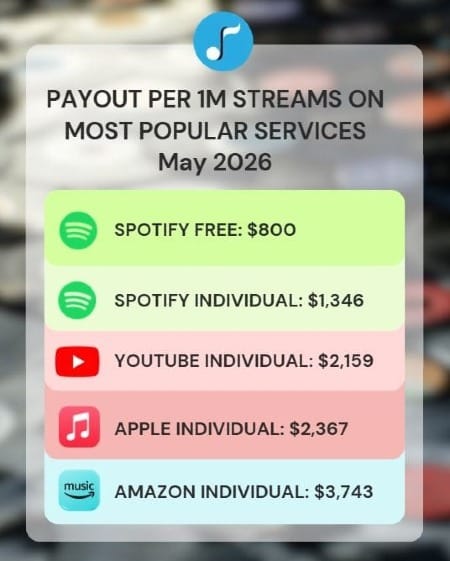
Per the data on 1 million streams sourced from the Mechanical Licensing Collective (MLC) for U.S. streams:
- Spotify (free, ad-supported): $800
- Spotify (individual paid subscription): $1,346
- YouTube Music (individual paid): $2,159
- Apple Music (individual paid): $2,367
- Amazon Music (individual paid): $3,743
The biggest surprise: YouTube — long seen as music's worst-paying major platform — isn't at the bottom. Spotify's free tier is the lowest payer by far, and even its paid tier trails every other competitor. Israelite also flagged that most commercial songs have four to five credited writers, so this pool typically splits multiple ways, not to one person.

How Music Streaming Rates Are Calculated
Two royalties live inside every stream: a mechanical royalty (for reproducing the composition) and a performance royalty (for publicly performing it). In the U.S., both are governed by a formula set by the Copyright Royalty Board and administered for mechanicals by the MLC.
It's revenue-based, not a flat per-stream rate.
The CRB formula sets publishing payouts as the greater of several calculations — a percentage of platform revenue, a percentage of what's paid for master royalties, or a minimum per-subscriber amount. The MLC then subtracts performance royalties each DSP already paid through PROs (ASCAP, BMI, SESAC); what's left is the mechanical pool it distributes.
That means pool size and total stream volume both move the needle — the same song's effective per-stream rate shifts monthly based on subscriber growth, ad revenue, and how many other songs are splitting the pool. It also explains the platform spread: Spotify's free tier generates far less revenue per stream than a paid subscription, while Amazon and Apple's higher payouts likely reflect subscriber pricing and revenue mix.
The Limitations
Several caveats matter here.
This is publishing only, U.S. only — it excludes the (larger) master recording royalty and any international streaming, where rates often skew worse.
It's also a snapshot of a moving target: effective per-stream rates shift monthly, so today's numbers won't hold next quarter.
Royalty math also depends on accurate metadata matching between recordings and compositions, and mismatches or unregistered works are common enough that the MLC encourages songwriters to audit statements rather than trust them blindly.
Finally, these are blended averages — an individual songwriter's real rate depends on their deal terms and how their specific catalog performs against the pool.
Industry Reaction
Industry reaction to the NMPA's latest streaming stats have zeroed in on a industry-wide structural problems beyond the dollar figures.
As Round Hill Music President Chad Doerge noted, DSPs offer on-demand access to nearly every song ever recorded yet charge roughly half what comparable video streaming costs.
A&R manager Robert Bär went further arguing that because publishing splits divide among every credited songwriter while the master royalty doesn't fragment the same way, collaborative songwriting — the dominant mode in today's hits — structurally penalizes the multiple writers in the room.
Hypebot's Bottom Line
For working songwriters, streaming payouts and the issues that drive them translate into a few practical takeaways:
- Register with the MLC and a PRO if you haven't — mechanical and performance royalties aren't routed automatically the way master royalties are.
- Know the platform spread — Amazon, Apple, and YouTube Music currently outpay Spotify per stream on publishing, even if Spotify drives more total volume. That could mean putting your efforts into marketing your music on platforms that pay better.
- Weigh the co-writing tradeoff — More collaborators can mean a better song, but a smaller individual slice of an already-shrinking pool.
- Audit your statements — with this many variables feeding the final number, periodic review against your own streaming data is worth it.
The bigger point isn't any single figure. It's that songwriters are paid through a confusing and convoluted royalty structure, and that complexity tends to work against the people with the least leverage to question it.