

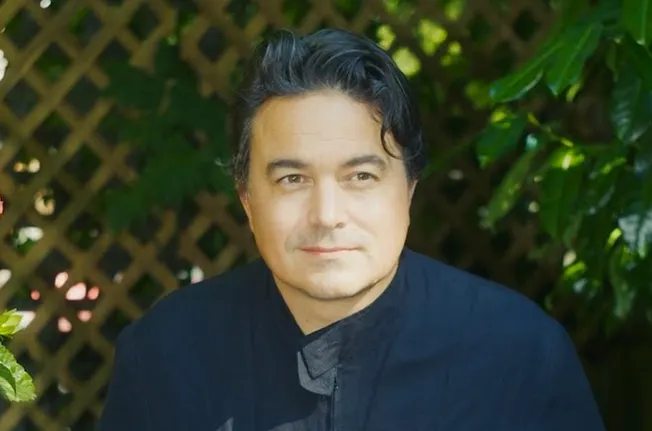
Spencer Krug is an artist I've personally followed for nearly 20 years (which I hope dates me more than him). When I was in college in Montréal in the early aughts, his band Wolf Parade was one of the city's best-kept secrets until their earned acclaim took their music global.
Since then, Krug has formed a very many other bands, reformed his own solo persona around piano and voice led songcraft several times, and lived all over the world. For a little while, his music grew up and coalesced around a simpler sound — taking on weights and depths unattainable in youth — and alongside it I felt like I too matured to see the depth and beauty in simpler things, slower things.
But Krug's new record, Same Fangs, brings to the table percussion, a string ensemble, backup singers, and slightly more fleshed out instrumentals than of late. The range of his catalog continues to widen, but the weight of his voice and his writing has always remained steady.
Here's our conversation. Enjoy.
Hypebot: Hey Spencer, thanks for taking the time to answer some questions. Congrats on Same Fangs, it’s a gorgeous record, it sounds mature in a number of ways but I don’t love that framing because it assumes that the more whimsical elements of other projects have to do with naïveté. I have always loved those purposefully "incorrect" elements of your work over the years. What were some of the goals with this group of songs?
Spencer Krug: "I’m not totally sure what you mean by 'incorrect,' but if you mean when I might steer a song off track, break the fourth wall, choose an ugly word, etc. in an attempt to keep the music from becoming too predictable, then I appreciate that. I don’t know if those things are intentional or just my natural inclination, but regardless I think noticing stuff like that in music demands a close listen, so thanks."
All of these songs were originally written as standalone tracks for my patreon page, so there isn’t any overarching goal or theme here. That said, they were all written during a part of my life that was quiet and stationary, with the only real upset being the resurrection and subsequent reburial of Sunset Rubdown, so the songs kind of oscillate between those two things: middle-age, small town/rural family life, and then what it means to be in a band."
The musical throughline is the piano. The thematic throughline might be bittersweetness."
H: Haha, yeah "Incorrect" in my usage refers to ways artists undercut expectation by bringing authentic strangeness to their craft. On that note, when it comes to writing, do you set out to accomplish some specific vision or is it more common for you to try things and see what sticks?
SK: "I am more a picker-upper of threads, for sure. I think that’s half the fun of songwriting — discovering what a song wants to be and then helping it get there in the most musical way possible. If I have some specific, predetermined message or style in mind before sitting down at the piano, I run a higher risk of making something that sounds forced, which is terrible."
Spontaneous decisions lead to music with a spirit of spontaneity woven into it, which is probably way more fun to listen to. For me, both lyrically and musically, I start with small ideas and then just build on them, trying always to just go with my first instincts, layering and variating, and adding and tweaking, until I have something palatable."
H: I’m curious how you determine where the boundaries are when creating work for your different musical identities? The wider focus angle of that question is how you incorporate or ignore “limitations” when writing?
SK: "The limitations and parameters of each project are what makes writing for each of them so simple. If I’m writing something cold for a band, then I’ll be thinking of that lineup and that instrumentation while working, and that helps steer the work. But honestly it hardly ever happens like that anymore. Nowadays it’s more about bringing near-finished demos to one group or another, and letting that group bestow whatever unique magic they possess as a collective onto the song. That’s the fun of bands — they’re all so different."
For my solo work, I like to set boundaries before I start anything; hold to some restriction of instruments or process. Like right now I’m trying to lean more analog in my little backyard studio — get off the screen, not look at any soundwaves, use outboard effects. This really limits my choices for sound and process. For a brain like mine, limitations are necessary."
As a chronic overthinker, I don’t do well with too many choices. It’s better for me when there are parameters in place and the allowances within them are few. I think that’s why so much of my solo work ends up being minimal."
"One thing I think is great about touring...is the way it finalizes songs. Playing music in front of other humans really helps work out the kinks. If you can take a song on tour before recording it, I think it will make the recording better."
H: What animal is a metaphor for your music, or the music on Same Fangs specifically?
SK: "A turtle? Haha. It’s slow. Instinct-driven, yet seemingly deliberate in its movements. It’s soft and vulnerable underneath (that’s the music, where I’m most impressionable and open to suggestion) but with an impenetrable shell it can hide under (that’s the lyrics — the IDGAF part of my songs that I refuse to compromise.)"
(Or! The shell could be Pronounced Kroog, the little DIY label I’ve made for solo work, that none of the old “same serpents” can pierce with their fangs.)"
H: Your lyrics tend to oscillate between a pretty realistic vernacular and dips into surrealism, symbolism, aleatoricism possibly. What’s the effect you’re shooting for when ideating or polishing these lyric worlds?
SK: "I just had to look up “aleatoricism” lol. Leaving things up to chance? I’m not sure I do that. Except maybe sometimes when I’ve decided I want things to rhyme. I think it’s kind of funny how rhyme can dictate meaning, by how the end of the second line is so restricted by whatever random word ends the first line. In that way entire meanings of songs can change, just because 'violence' rhymes with 'silence,' for example. I guess that’s playing with chance."
I sometimes focus too much on the rhythm and syntax within a line, to the point that its meaning becomes compromised. But once a certain cadence or melody is in my head, I can’t help it. I never want to give up that musicality."
So I don’t know what, if any, effect I’m going for when I write lyrics. I would say that I prioritize musicality over meaning, and then after that, I’m just trying to be honest, while maintaining some kind of poeticism, and ideally not make myself or anyone else cringe too much when I’m singing the final product (this last part is only sometimes achieved.)"
H: You’ve been on tour for a lot of 2026 in support of Same Fangs. How do you keep healthy on the road for long periods of time? And take care of your voice?
SK: "I don’t. And I don’t! I always return home exhausted, stiff, a few pounds heavier, psychologically broken, emotionally hollow. Haha. Cool job, hey?"
It used to be worse when I drank a lot. Nowadays I’m more stable in that regard, but I still lose my mind a little if I’m on tour for much longer than 10 days or so. I don’t know how anyone can stay emotionally healthy in that kind of Groundhog Day dream state longer than that. I’m definitely more road-frail than most musicians I know though."
As for my voice, I just cross my fingers and hope for the best. I’ve never done any kind of vocal warmup or had any kind of protocol on the road for preserving my voice. I just try hard to not get sick, and get up on stage and start singing when I’m supposed to. At its core, I think my music still stems from some kind of low-fi, bedroom rock place, wherein it's okay if I don’t exactly hit all the notes."
H: How has touring changed for you since younger days? What adjustments have you made over the last 20-something years.
SK: "As per above, I don’t do long tours anymore. Besides now having a family at home that I don’t want to be away from for long stretches at a time, I no longer possess the physical or emotional fortitude it takes to grind it out in a tour van for weeks on end. I’m almost 50 now, more suited for short runs and one-offs."
The last long tour I did was in the fall of 2024, with Sunset Rubdown, where we pretended it was 2007 and just got in a passenger van with no crew whatsoever and drove / tour-managed ourselves around North America for three weeks. It nearly killed me. It probably killed the band."
"A show is a two-way transmission...I think the best shows are the ones wherein everyone in the room understands, on some level, that they’re participating in and contributing to a kind of magical energy unique to that time and place."
H: Were there ever/always certain songs that would trip you up to play live on stage?
SK: "Certainly. Especially when I pretend I can play guitar. Sunset Rubdown’s set was full of those Hail Mary moments, wherein if I pulled off a melody on guitar it sounded great, but really it was a 50/50 chance every night that I hit it And there are of course full band equivalents, with any band, where some songs are just too fun not to try, even though everyone on stage knows it could come off the rails at any point. That aspect of live music is exciting and partly what makes it fun."
I have lots of moments in my solo piano songs as well that I screw up all the time. Things I’ve written that are accidentally beyond my comfort zone and skill level. Or even simple songs that I somehow can’t get right. Currently, it’s 'Timebomb,' from Same Fangs. Poor Elbow Kiss, performing that song with me nightly, never knowing whether or not I’ll once again screw up the middle section."
H: What’s something you’ve learned about yourself by spending time on the road?
SK: "That I get depressed if I spend too much time alone. My mind is not one that should be left to fester for too long. But also, ironically, that I need time alone when touring with other people. If I never have time to recharge, to get away from everyone for a little while each day, I lose it. I become quietly insufferable to myself and to those around me."
At that point, you never know in what ways the interpersonal dynamic might spiral. People are all nuts in their own way and we have to remember to be gentle with one another."
H: What are some things you’ve learned about performance over the years?
SK: "A show is a two-way transmission. The energy coming off the audience is proportionate to the energy coming off the stage. A show can be 'fine' if the performer is having an off night, and the audience isn’t necessarily going to walk away disappointed, but I think the best shows are the ones wherein everyone in the room understands, on some level, that they’re participating in and contributing to a kind of magical energy unique to that time and place."
Also: Try your best."
H: Do you think touring is essential for artists today?
SK: "I don’t know. I'm not qualified to say. I guess I would say it depends on the artist, but generally: probably. Streaming has more or less killed meaningful royalty income for mid-level bands, so if you can make a little money touring, you probably can’t afford not to do it."
But then again touring itself is becoming more and more expensive, so even breaking even can be hard. I feel for the bands that are just starting out. It must seem almost impossible to survive without some rich parents somewhere in the mix."
One thing I think is great about touring though — besides the obvious life experience — is the way it finalizes songs. Playing music in front of other humans really helps work out the kinks. If you can take a song on tour before recording it, I think it will make the recording better. But that’s easier said than done. In my experience it’s usually the other way around."
H: What’s the best smelling thing in the world?
SK: "The top of my kid’s head. Dog paws are a close second."