


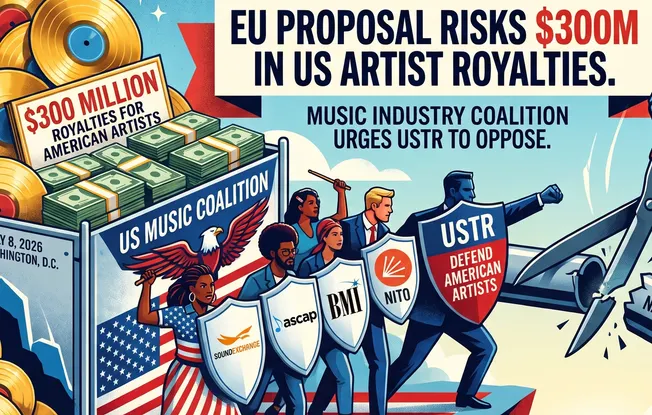
A coalition of leading U.S. music industry organizations has called on the United States Trade Representative (USTR) to aggressively oppose a new proposal by the European Commission.
The new policy would strip American artists and rightsholders of nearly $300 million in annual performance royalties. The EU is threating action because U.S. terrestrial AM/FM radio stations do not currently pay performance royalties a to any artists and rightsholders.
The EU wants to overturn the 2020 Court of Justice of the European Union (CJEU) RAAP decision. That ruling extended "national treatment" protections to American recording artists and labels, ensuring they get paid when their music is played on European airwaves.
Now, the EU is considering a switch to a "material reciprocity" framework, effectively creating a targeted carve-out that discriminates against U.S. creators.
What EU Proposal Means for US Artists?
If the European Commission successfully transitions from "national treatment" to "material reciprocity," the fallout for U.S. creators will be immediate and severe:
- Massive Financial Loss: Up to $300 million in annual performance royalties could completely evaporate, directly impacting the livelihoods of working musicians.
- Widespread Payment Cutoffs: Currently, 21 out of 27 EU member states provide national treatment and pay American artists. A shift to reciprocity would legally allow these nations to withhold or slash those payments.
- Administrative and Political Chaos: Instead of a clear, rules-based international framework, U.S. creators would face fragmented, unpredictable rules across Europe, alongside politically driven eligibility requirements.
- A Dangerous Global Precedent: The coalition warns that if Europe successfully normalizes this discriminatory measure, other global markets will likely follow suit, severely eroding international copyright protections and transatlantic cooperation.
A Domestic Solution: The American Music Fairness Act (AMFA)
The coalition's letter call out the bipartisan American Music Fairness Act led by Rep. Darrell Issa (R-CA) and Sen. Marsha Blackburn (R-TN) as the definitive fix.
Because U.S. terrestrial AM/FM radio currently exploits a loophole in the laws to avoid paying performance royalties to artists, the EU is using that lack of domestic reciprocity as justification to cut off American streams. Passing the AMFA would force corporate U.S. radio to pay its fair share, satisfy European reciprocity demands, and protect American revenue streams both at home and abroad.
The Music Industry Organizations Leading the Charge
The unified letter sent to the USTR was signed by a broad alliance of major U.S. music advocacy, performance rights, and labor organizations, including:
- American Association of Independent Music (A2IM)
- American Federation of Musicians (AFM)
- Artist Rights Alliance (ARA)
- ASCAP
- BMI
- Christian Music Trade Association
- Future of Music Coalition
- Music Managers Forum-US (MMF-US)
- National Independent Talent Organization (NITO)
- SAG-AFTRA
- Society of Composers & Lyricists (SCL)
- SoundExchange
- The Recording Academy
Hypebot's Bottom Line
Moves by the European Union to cut off radio performance royalties is a massive wake-up call for both Washington DC and the American music community.
For years, U.S. terrestrial radio broadcasters have aggressively lobbied to preserve their century-old loophole, refusing to pay performers a dime for AM/FM airplay. But that is now about to cause severe collateral damage on a global scale.
Europe is essentially calling America's bluff. If the U.S. won't pay international artists on its airwaves, Europe will stop paying American artists on theirs - even though American music makes up over a third of the songs played on European radio.
While the USTR can step in to defend American creators against trade discrimination, the true, permanent fix lies in Congress.
Passing the American Music Fairness Act isn’t just about doing the right thing for musicians at home anymore. It is now also a $300 million defense shield for American intellectual property abroad.