

Watching yourself perform helps you improve in areas where you feel uncomfortable.
It’s a pretty accepted practice in almost every other field besides entertainment. Plenty of employees have 360-degree interviews, software developers have code review, and surgeons are not only heavily supervised but watch video to improve skills.
For those of you less familiar with sports, “game tape” is the process of reviewing any and every play available in order to learn what players did well, and what they failed to execute. You're watching yourself, your teammates, your opponents, closely so that you can prepare yourself with adjustments to make your performance more confident, agile, and fluid.
So, Why Not For Music?
So, why aren't we musicians applying the same rigor to our performances? Music may not be as critical as surgery for risk vs. reward, but it’s at least as important to me as football. We should be treating our stage performances the same way athletes treat their gametime performances.
For musicians, you're going to want to check whether you make weird faces during solos (sorry!); for singers, things might sound great in the moment but you might want to doublecheck whether your voice gets pitchy in the high notes; for bands, are you constantly moving around the stage and blocking one another from the crowd? A little choreography goes a long way!
Sure, it’s painful sometimes to watch yourself perform. But there is so much that can be improved with musical game tape: playing style, stage presence, between-song patter, volume control, to name a few.
And nobody likes hearing the sound of their own voice, but you still have to get used to how it sounds to others in a room. Even John Lennon didn’t love hearing his own voice.
But once a musician tells himself or herself that it’s part of their job, it gets easier.
At the highest levels, acts like Radiohead, Kanye West, Taylor Swift, and Beyoncé all make it a habit to watch their performances to sharpen their on-stage energy and precision.
In this post I’ll share some of my best pieces of advice for watching game tape, how to get started, why it's crucial, and how I even stepped up my own game by using video footage to isolate and fix certain issues.
+Read more: "Is “Shifting Focus” the Key to Playing With More Freedom on Stage?"
What You Can Learn From "Game Tape"
I've noticed that my band has been able to improve in the following areas, simply by watching ourselves on video and making an effort to develop these elements in rehearsal:
- Volume/live mix
- Between-song patter and banter
- Eye contact
- Stage presence
- Onstage movement and stage spacing
- Do we look like they’re having fun?
- Speed – in the pocket? Speeding up or slowing down?
And that's just the tip of the iceberg. You may notice different things yourself. Live performance is such a personally crafted endeavor.
But before you start video-taping your performances, a first step you can take is just to watch what other bands are doing when they perform on stage. What works for them? What looks rehearsed versus impromptu? What are they failing at?
And then when you perform, invite a trusted friend or fellow musician to watch your gig, give feedback and offer their thoughts as to where you might be able to improve. (For example, like how you squint hard when you sing a high note.)
How to Record Yourself Live
You do not need to be an expert video producer, or even spend money hiring one! Capturing usable video isn’t as hard as you might think.
Do you have some old smartphones that you don’t use as your primary phone anymore? Do a few of your friends have a phone (or camera) to donate? Any iPhone after the iPhone 11 is good and any after the iPhone 14 is great. Similarly, any Samsung Galaxy starting with the G20 or after is terrific.
The real secret weapon is a bendable phone tripod like this one.
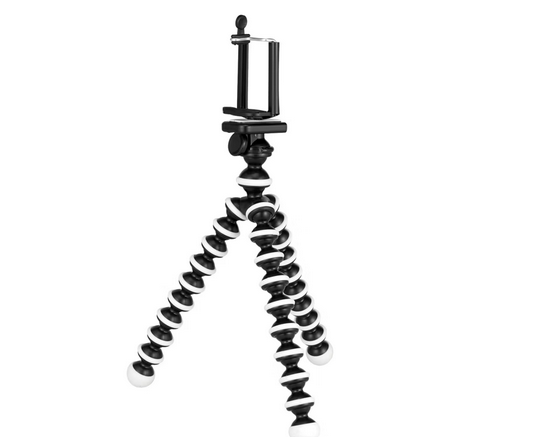
When I bring three of these to a show and three old phones, they wrap around anything: Tree branches, table legs, mic stands, margarita glasses, etc. Just remember to press record before your set and you’re good to go. Easy.
As far as audio, try to talk to the sound engineer before the show about grabbing an audio recording directly from the mixing board. If that option is not available, there are several options for handheld Zoom and Tascam recorders for audio, all you need is a memory card. Or, finally, the audio from your iPhone recording should be just fine.
Remember, you're not necessarily prepping to "release" this as a live recording, this is just for home viewing purposes.
+Read more: "If You Don't Like Performing for 20 People..."
So, Which Questions Do I Ask Myself?
Question 1: How’s the Mix?
We take our mixes very seriously. We want to make sure everyone in the band can be heard clearly and having video evidence helps. We tend to try to micro-tweak each instrument’s EQ to its own strengths which creates separation while still being cohesive, but there can always be improvements.
If this isn't something you normally or naturally do, watching game tape can help you dial in amazing EQ settings every time.
Just remember, the mix is so important that it never becomes a “before and after” fix. It’s constant and always in need of tweaking when we got a new effect, try something new in the mix, and correct unintended consequences, etc. Every venue’s space still has to be accounted for.
Question 2: Am I Talking Too Much Between Songs?
The biggest thing I’ve learned in my career is when to talk and when to shut up.
You have no idea how much or how awkwardly little you talk until you watch yourself perform on video. Sometimes you'll find that 2 or 3 of you are talking at the same time, trying to be "witty" between songs, sometimes you just think you're being funny off the cuff but what the moment really calls for is authenticity and honesty.
If you're a solo artist, this can be even tougher to diagnose. There’s often a temptation to address the audience way too much when up there all by yourself. But try not to get bogged down by thinking it's embarrassing to talk to the crowd, it isn't. And it's part of the job so get used it now.
Question 3: Are We Engaging the Audience, or at Least Looking at Them?
Every band or artist, no matter the genre, has to engage on some direct level with their audience. It doesn't have to mean total eye contact all the time, you can maintain a moody distance, sure. But just make sure you're acknowledging their presence from time to time or folks will think they're mistakenly walked in on your private rehearsal.
Here's an example of my band playing a Peter Gabriel cover, and a chilly but frisky December audience shows a lot of the good and bad. What I immediately diagnose is that we’re looking down too much, although the performance isn't bad overall, because we're pretty locked in.
Take a look.
Question 4: Is The Band Having Fun?
This might be the most important evaluation of them all. And it can be the easiest to spot. My bands have always had a blast on stage, but sometimes when I watch the video I want to scream at myself, “Tell your face!”
Sometimes just opening your face up a bit and going big with your expressiveness and gestures goes a long way.
Question 5: Speeding Up or Slowing Down?
Every band can drift a bit — that's part of playing live so don't sweat it too much — but you'll notice rewatching game tape whether it becomes a problem.
Sometimes this happens due to the crowd's energy, or lack thereof. If the crowd is not engaged, you might overcompensate and play faster, or start playing down to a slower energy to match the room. In other circumstances, with a high-energy, dancing, shouting crowd your heart rate and adrenaline might make the band speed up way too much. It's subtle to spot sometimes, but worth keeping an eye out for when this is happening.
Here’s the show where I really saw my band speed up like we were on Fleetwood Mac levels of coke (we weren’t). Sure, it’s a frenetic original, but there’s a limit.
Closing Thoughts
All of us in music spend so much time on our craft:
- Meticulous hours spent songwriting.
- Practicing our instrument.
- Building an audience.
- Doing all of the social media dirtywork.
- Networking with other professionals.
- Rehearsing.
With all of that time we’re putting in, why leave anything on the field to chance?Working hard on everything else but not learning from your performances is like ending a drive on the opponent’s 2-yard-line.
I hope this post has helped open your eyes to what opening your eyes can do for your live performance skills development. Music is fun, but it’s your job. Employee review is a job requirement, not an option.
Good luck out there!