

By Melissa B.
Recently, I went looking for my own Billboard history and discovered that some of it was much harder to surface than I expected. The records existed. The chart pages could still be traced. But the path from a current artist profile to that history was incomplete.
As an independent artist — and as someone who works in technology — that stopped me. I have spent years telling artists to own their masters, understand their business, and build direct relationships with their audience. I realized there was another kind of ownership I had not talked about enough: Owning the record of your own career.
Over more than a decade building my career independently, working in network engineering, and writing about artist independence in my book Digitally Independent, I have learned not to assume someone else will preserve every important piece of your story. This time, I had to apply that lesson to my own historical chart data.
My Billboard history includes two records I can document directly.
In 2017, “Dancing in the Rain” by Juan Cristiani featuring Melissa B. reached No. 1 on Billboard’s Hot Singles Sales chart for the week of October 28, 2017. In 2022, my single “Physical” reached No. 13 on Billboard’s R&B Digital Song Sales chart for the week of April 2, 2022.
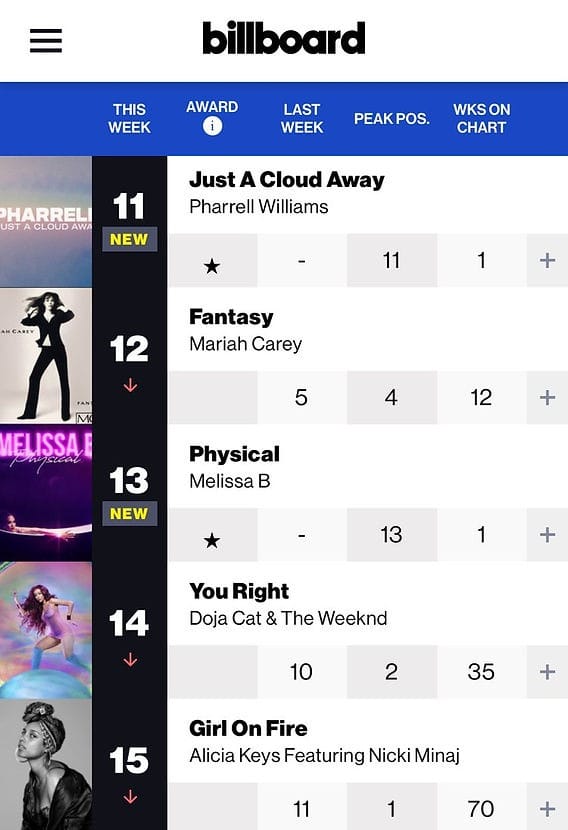
Those achievements happened. The records exist. But the way that history appears online can change.
As chart products are discontinued, websites are redesigned, URLs change, and databases evolve, older information can become harder for the public to find. Billboard has confirmed directly to me that historical information remains archived in its chart system, while discontinued charts may no longer populate on the current public site.
This is not about accusing a platform of deleting history. It is about recognizing that a platform’s current interface is not the same thing as the complete historical record.
For an independent artist, that can create a serious problem. If a journalist, booking agent, researcher, potential collaborator, search engine, or AI system looks at your current artist profile and sees only part of the story, that partial view can gradually become the version of your career that gets repeated.
That can have practical consequences: a booking agent or journalist may work from an incomplete profile, and that partial version can then be repeated in bios, search results, and AI summaries.
+Read more: "How Indie Artists Can Chart on Billboard With <1K In Sales"
The public record is becoming part of artist infrastructure
For years, musicians have been told to maintain an electronic press kit. That usually means a biography, photos, music links, press quotes, and recent accomplishments.
I think we need to go further. Every long-term artist should maintain a verified career archive: a source-linked record of chart appearances, awards, credits, performances, press coverage, releases, and other career milestones.
That archive should distinguish between different kinds of evidence.
An official chart page can verify a chart position. An independent publication can establish editorial coverage. An artist’s own website can preserve a useful contemporaneous record, but it should not be treated as the same kind of evidence as independent journalism. A screenshot can help preserve something that has disappeared from a current interface, but whenever possible it should be supported by an archived page or another source.
Today, documentation is part of artist ownership.
That same evidence discipline applies to numbers. Streaming totals, social reach, chart positions, radio activity, playlist placements, sales rankings, and compilation performance are not interchangeable. I separate live analytics from historical records: a current streaming figure can change tomorrow, while a historical chart peak should be preserved with its exact chart name, date, and source.
For example, I do not rewrite Hot Singles Sales into a more familiar modern chart name. I preserve the terminology that was actually used at the time. The same goes for R&B Digital Song Sales. Accuracy may be less flashy, but it lasts longer.
AI and search make this more urgent
There is another reason artists should care about this now: AI-powered search and automated knowledge systems increasingly summarize careers for people. Those systems learn from what is available, discoverable, repeated, and well-sourced.
If your career information is fragmented across expired links, discontinued charts, old press pages, social posts, and screenshots sitting on a hard drive, the public version of your history can become incomplete.
Artists spend enormous energy creating new work. We also need to preserve the evidence of the work we already did. That does not mean trying to control every sentence written about us. It means making accurate source material easier to find.
+Read more: "The Ultimate Guide to Understanding Spotify Analytics Data for Artists"
My solution: build the archive yourself
I started building a public, source-linked timeline of my own career so that anyone researching me can see where a fact came from. For my Billboard history, I can point to an archived copy of the October 28, 2017 Hot Singles Sales chart and the April 2, 2022 R&B Digital Song Sales chart.
I can separate current data from historical data. I can distinguish an independent article from an artist-controlled page. And when a source is incomplete or still being recovered, I can say that instead of filling the gap with a stronger claim than the evidence supports. Because preservation is not the same thing as promotion.
A useful archive should be willing to say:
- "This is verified."
- "This is a primary source."
- "This is independent editorial coverage."
- "This still needs stronger documentation."
That kind of discipline protects the artist as much as it helps the researcher.
Independent does not mean undocumented
For me, this experience reinforced something I have believed throughout my career: independence is not simply doing everything yourself. It is understanding what needs to be owned, what needs to be verified, and what cannot safely be left entirely in someone else’s system.
Own your masters. Know your publishing. Keep your contracts. Save your credits. Archive your press. Document your chart history. Preserve the original URLs and dates. Keep screenshots, but also look for archived pages. And build a source trail that someone other than you can follow.
Your music is part of your legacy. The documentation around it is part of that legacy too. If we want independent artists to have careers that can be accurately understood ten, twenty, or thirty years from now, we have to start treating career data as something worth preserving today.
Melissa B. is an independent singer, songwriter, producer, author, and network engineer. Her career spans recorded music, technology, artist development, and advocacy for independent creators. She is the author of Digitally Independent, a guide to building and managing an independent music career, and a Recording Academy voting member.