


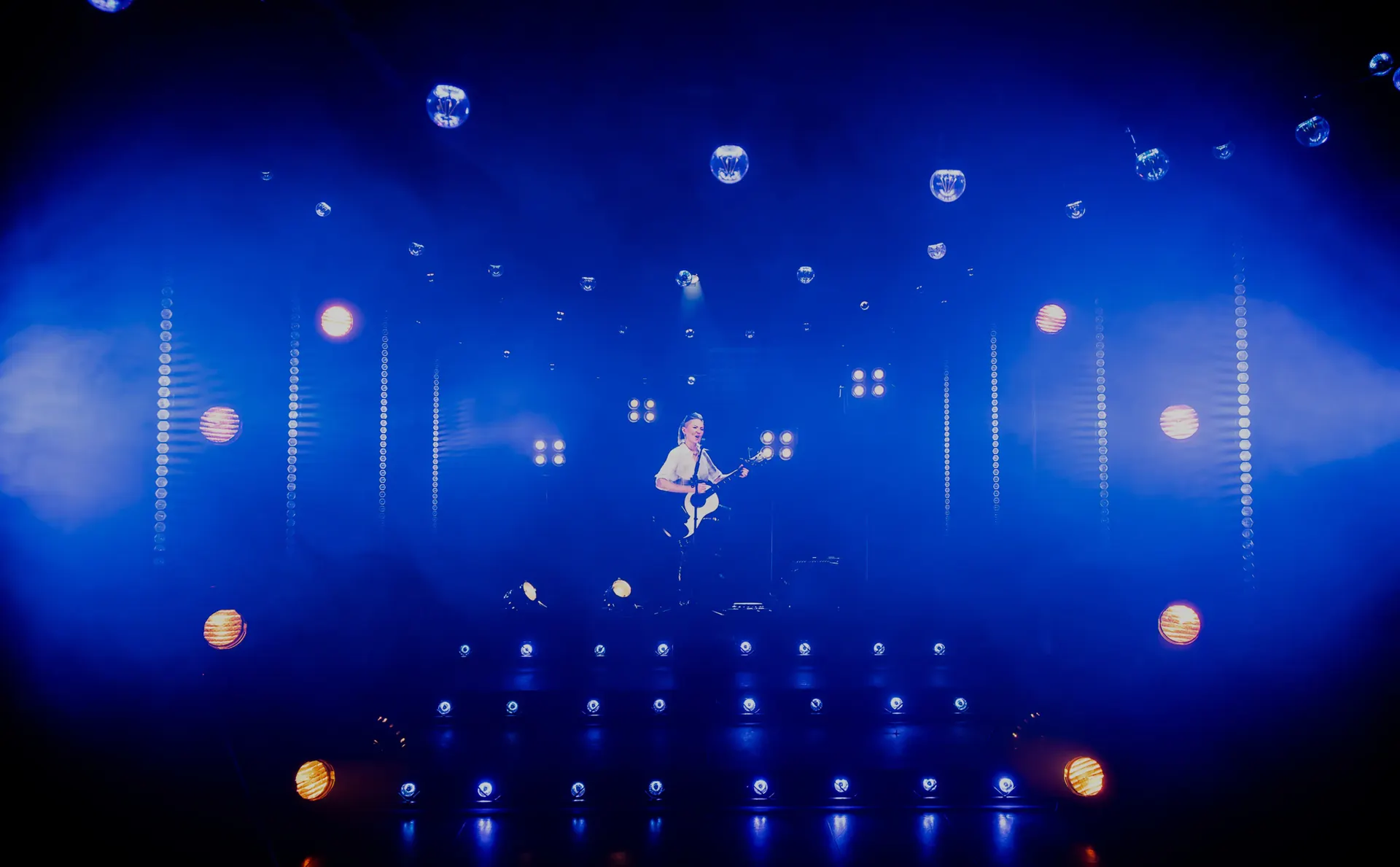
“Avatar concert” sounds like one of those music-tech phrases that explains almost nothing. Is it a hologram? A concert film? An AI-generated performer? Are the musicians actually playing live?
The short answer is: it can contain pieces of all those ideas, but the format Unit1 Studio is building is best understood as a hybrid stage production. A digitally constructed version of an artist appears inside a real venue, surrounded by the lighting, sound, scenery and — in Unit1’s model—live musicians that give the show the scale and atmosphere of a concert.
Now the British startup has raised another $20 million, or nearly £15 million, to move that concept closer to a repeatable live business.
The new investment includes backing from Balderton Capital, existing investor Mercuri and former U2 manager Paul McGuinness. Unit1 plans to spend the money on research and development as well as the intellectual-property and licensing agreements required to make shows with artists and their estates.
So, what does an avatar concert actually look like?
The performer the audience sees is a photorealistic “digital double” — a computer-generated version of a real artist. Its movement can begin with motion-capture footage of the artist, or, when recreating an archival performance, with existing footage and performances by actors and musicians whose movements are blended into the finished character.
That digital performer is then presented on a high-definition LED display and integrated into a physical stage show. Lighting extends beyond the screen. Props and scenery help erase its edges. Sound fills the room. Unit1’s proposed shows would place live players onstage beside the virtual star.
The audience is not sitting at home, wearing a VR headset or watching an elaborate movie. People still travel to a venue, stand or sit together and hear at least part of the music performed in the room. What has changed is the body at the center of the production.
Nor is “hologram” quite the right word, even though it has become the default label for digital resurrections such as Tupac’s 2012 Coachella appearance. These productions generally create the illusion of a three-dimensional performer through screens, projections and carefully controlled sightlines. The image is not a free-standing person made of light.
AI may assist parts of the visual-effects process, but an avatar concert is not necessarily an AI invention. Unit1 describes an end-to-end production involving artist relations, creative direction, performance capture, CGI, staging, venue operations and financing. Its production partners span LED display technology, lighting, sound, media control and post-production. The effect depends as much on theatre craft as it does on software.
+Read more: "A Crowded Venue Isn’t the Only Way to Experience Live Music"
From ABBA Voyage to the local theatre circuit?
ABBA Voyage proved that audiences would buy tickets to see younger digital versions of living artists. It also established an intimidating benchmark: years of development and a purpose-built London arena designed around the illusion.
Unit1 is trying to change that equation. Rather than attach every production to its own permanent building, the company wants to create shows capable of playing existing venues. In theory, the same digital production could also operate in more than one territory at once—something no touring human artist can do.
The company demonstrated its approach with KT Tunstall. Motion-capture cameras recorded Tunstall as she revisited a performance from roughly 20 years earlier, while the resulting avatar presented her with her current-day appearance. The pilot used advanced CGI, performance capture and high-resolution LED technology to place her digital double into a concert setting.
For living artists who no longer want to undertake a conventional tour, the format could offer another way to perform. For estates, it could turn a famous concert preserved in an archive into a ticketed live production. For venues, it suggests a new class of show that sits somewhere between a residency, a theatrical production and a touring concert.
The technology may be easier than the permission
The unresolved questions are not only visual:
- Who approves a deceased artist’s movements, voice and stage dialogue?
- Does a recreation preserve a documented performance, or invent a new one?
- How clearly should audiences be told which elements are live, recorded, reconstructed or generated?
- And how are performers, musicians and estates paid when a show can run without the artist physically present?
Unit1 founder Barney Wragg told The Guardian that the company is working with families and estates and is conscious of avoiding productions that feel exploitative. A carefully authorized recreation of a known performance is very different from making a dead artist appear to say or do something they never did.
For now, Unit1 has announced the investment, not a slate of commercial tours. But $20 million is a substantial bet that avatar concerts will become a format rather than a novelty — and that the next one will not require building another ABBA Arena first.