

For years, I thought part of my job as an artist was convincing institutions that I belonged. If I made the right record, earned the right review, landed the right nomination, or extended the olive branch one more time, maybe the door would finally open wide enough for me to walk through without leaving part of myself outside.
I no longer believe that.
In 2017, I found myself writing country songs about racial injustice. As I built the bones of what would eventually become White Trash Revelry, I wondered whether there was an audience for it.The country music I grew up with was not especially compelled by this kind of politics. Even the phrase “white responsibility” sounded too much like the “white guilt” my cousins casually dismissed.
I knew what I wanted to write. I had no idea where it belonged.
That year, I won tickets to the Americana Honors & Awards, an organization I knew little about. My wife and I went to see John Prine sing with Iris DeMent. Jim Lauderdale hosted with jubilant cultural defiance, introducing country legends with bursts of political wit. Alynda Segarra wore a “Jail Arpaio” shirt.
Sitting there, I thought: Maybe there is a home for exactly the thing I’m after.
That possibility can mean everything to an artist. A genre describes music. An institution offers infrastructure, access, legitimacy, and the promise of community. When you have spent much of your life feeling misplaced, that final promise is especially powerful.
By 2020, my name had appeared on the Americana charts. When AmericanaFest rejected my application, I was disappointed, but figured I was still on the path. Then my little self-produced album received a shout-out from Rolling Stone in 2021, and the festival rejected me again.
Surely I had done enough to be invited to the party now?
I began looking more closely at who else remained outside. Queer country artists whose work had shaped the community were being rejected too. The institution would co-sign independent queer showcases without necessarily granting those artists credentials, access, or meaningful support. Queer people invited to appear on panels could find themselves unable to attend the rest of the programming.
The greater Americana community had drawn me in with its expansive possibilities. Americana the institution increasingly appeared to lack the values that had brought me there.
Still, I kept trying.
In 2023, the organization asked my agent whether I would perform at AmericanaFest. I declined twice. Then they told me I had been nominated for Emerging Act of the Year and invited me to perform during the awards ceremony. I agreed on the condition that the festival bring in additional trans artists. I provided a list that included Jessye DeSilva, and She Returns From War. To the organization’s credit, they did.
I wanted to believe we were widening the door.
After losing the award to S.G. Goodman, the coolest person in the entire music industry, I reported to my greenroom for a recreational marijuana. There, another performer began mocking my appearance: “Young man, why do you have that shit on your face?”
In my best Opry voice, I warbled, “Oh, that’s just lipstick is all.”
She interrupted me. “Who are you? What is it you do?”
I tried to stay jovial as she jeered at my makeup and nails. Then she bellowed, “Boy, I bet you’d fuck a brick, wouldn’t you?” People laughed. I left the festival stunned and, honestly, in tears.
What stayed with me was not simply that someone had been cruel. Artists are human. We arrive carrying pain, prejudice, addiction, trauma, and all the other complications that make people capable of wounding one another.
What stayed with me was how preventable the situation had been, how little anyone seemed prepared to intervene, and how quickly the burden of deciding what should happen next was placed on me. The association asked whether I wanted the other artist’s award stripped. It felt as if my community were waiting for me to bring down the guillotine.
I had no interest in retaliation. This was a Black woman who had undoubtedly endured racism and cruelty I cannot imagine. Punishing her would not repair the conditions that brought us into that room or address the institutional failure surrounding us.
I wanted care, accountability, and some indication that the people who invited us understood us as human beings. Instead, it felt as though the organization knew one thing about each of us: she was Black, and I was Queer. We had been honored as symbols without being considered fully as people.
In the days that followed, some friends distanced themselves from me in defense of someone I had no intention of attacking. I heard that I simply could not take a joke. Meetings disappeared. A prospective manager told me directly that people connected to the association had advised him against meeting with me.
I had come to AmericanaFest hoping to honor the version of myself who sat in the audience in 2017 and saw a room where I might belong. I wanted to leave the door wider for the Queer artists coming after me.
So I persevered.
I moved through another album cycle while losing my manager, my agent, and the small semblance of a team I had assembled. I kept believing persistence, good faith, and the quality of the work would eventually produce the resolution I wanted.
That hope can become expensive.
The music business teaches artists to evaluate nearly every relationship as an opportunity. A conference might lead to a meeting. A showcase might lead to an agent. A nomination might lead to a team. Proximity to the right institution might provide enough validation to transform a precarious creative life into a sustainable one.
We discuss less often the cost of pursuing an institution after it has repeatedly shown you the limits of its welcome.
There is the financial cost of traveling, showcasing, joining, and submitting. There is the time poured into relationships that do not reciprocate it. There is also an emotional cost, especially for marginalized artists asked to absorb hostility, educate the room, extend grace, and perform belonging while remaining grateful for whatever access they receive.
Eventually, the pursuit can become a form of self-erasure.
During this period, I began reintegrating parts of my faith. I gathered spiritual songs written across years of searching, unraveling, and repair. They became Christians for Goliath, an album about institutions that proclaim one set of values while protecting something very different.
Because the record is concerned with healing and radical hospitality, I wondered whether it could create an opportunity for reconciliation. I offered to perform at AmericanaFest’s Gospel Brunch. Once we had agreed, I wrote to the head of the association.
I offered peace and expressed my willingness to examine my own response to what had happened. I wanted to sit honestly inside the conflict and see whether repair was possible. The response did not suggest a shared interest in that process, so I withdrew.
I believe almost religiously in the difficult work of sitting presently inside conflict. But repair requires participation. Without shared responsibility, curiosity, and self-reflection, there is no collaborative opportunity. There is only one person performing reconciliation for an audience that has already moved on.
That was when I understood I was waiting for a happy ending the institution could not give me. The realization felt like grief at first. Then it felt like resolution.
Institutional recognition can be useful. It can help independent artists reach listeners, book shows, attract partners, and reassure people who still need an authority to tell them that art matters. But usefulness is not belonging, and access is not care.
An institution can give you a credential without giving you a home.
Artists need to ask harder questions about the structures we pursue. Is this relationship reciprocal? Can I voice discomfort without becoming the problem? Does participation enlarge my creative life, or require me to become smaller? Am I still here because the community nourishes me, or because I have invested too much to imagine walking away?
No award, festival slot, playlist, chart position, or powerful cosign can answer those questions for us.
For much of my career, I have played David against one Goliath or another. I believed resistance meant standing my ground, making my case, and continuing to push until the giant acknowledged my humanity.
I am all filled up on blazing trails and fighting for relevance now.
Sometimes the bravest career decision is to stop knocking. Sometimes resistance means refusing to spend another year earning a place inside the giant’s world. Sometimes the work is finding the listeners, collaborators, and small communities who already speak your language and building something with them.
The intersection of industry and art has always been rife with conflict: the desire to create and the desire to conquer, the need to make meaning and the pressure to turn that meaning into status.
I was never much the conquering type.
The only way I know to combat that spirit is through the jubilant revelry of making noise. That is where I am placing my faith now: not in the institution that might finally let me in, but in the people who hear the noise and choose to gather around it.
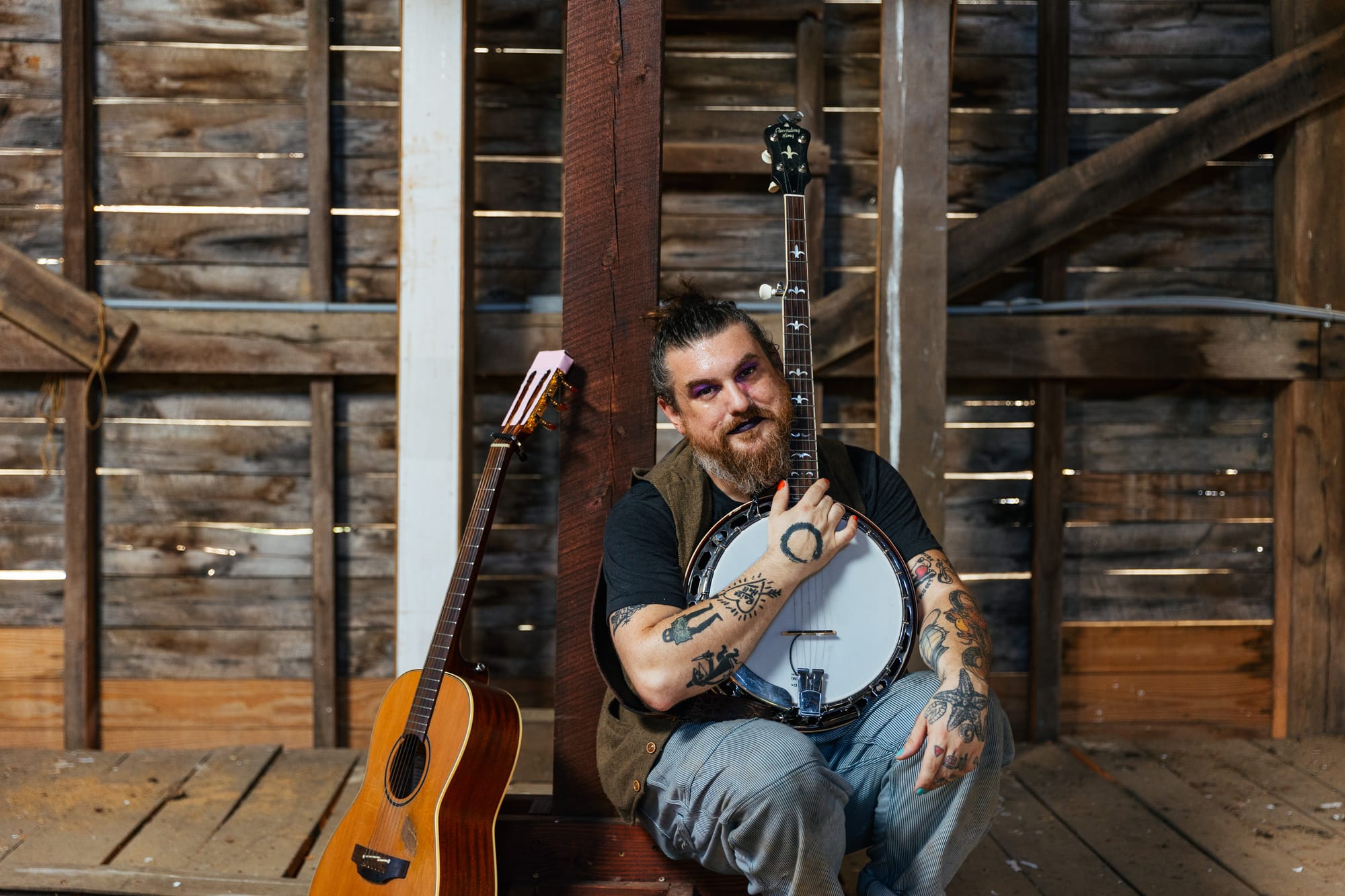
Adeem the Artist has spent much of their life deciding what can still be called a prayer. Raised in a fundamentalist Christian family, the seventh-generation Carolinian began writing songs about God and heartbreak before leaving the church, working as an Episcopal chaplain, drifting into agnosticism, and eventually finding that prayer had followed them into their music. That long, uneasy conversation lies at the heart of Christians for Goliath, their forthcoming 11-song album produced by John Darnielle of The Mountain Goats.