To read Part I of Keith's series, head here.
This post originally appeared on Keith Jopling's Substack
I left part one with this thesis: that the post pandemic album resurgence — flying in the face of tech-driven music consumption trends — has been led largely, by four female pop superstars: Olivia Rodrigo, Billie Eilish, Taylor Swift, and Lana Del Rey — with a strong supporting cast.
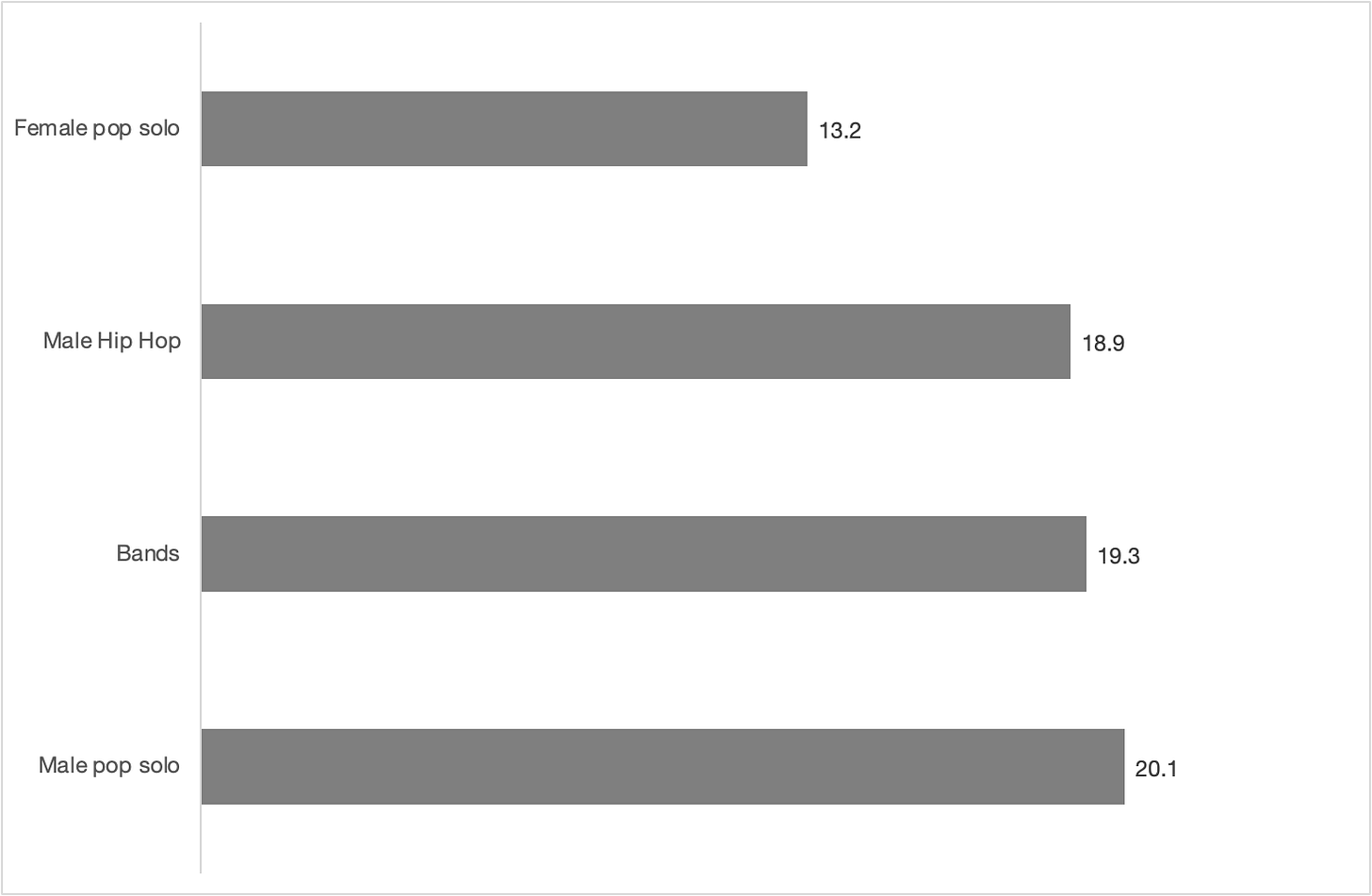
This was supported by the chart below, a relative comparison of the “album track differential” streams, on Spotify.
Now of course, let’s be clear: ALL artists have kept the album alive in the streaming era simply by continuing to make albums. Sometimes as part of their label contract, sometimes entirely under their own steam to be shopped through a label or distributor after the artist themselves have spent tens of thousands (or more) making the record.
Somehow, after 26 years of post-CD digital music, the vast majority of artists remain album-first. I’ve said it before (and will soon be presenting it as part of a wider analysis and talk), the “big five” survival pillars for the album are:
- Artists; as featured here
- Vinyl; marked by 19 years of consecutive annual growth in the UK and USA
- Youth and tangibility; a return to physical formats, nostalgia and IRL experiences
- Lockdown; not to be forgotten, a time when we got our attention spans back
- The music industry; contracts, charts, awards, Record Store Day and a refusal to submit fully to a non-product based business model.
More on those in later pieces (or, read the book!), but worth reiterating here that it’s the artists first and foremost. We are no longer in a monoculture, where an album can make a dent in the universe as significantly as OK Computer did, or Thriller did (or Rumours still is doing!).
But with BRAT, The Art of Loving, Getting Killed et. al., ‘classic’ albums keep coming and artists keep on trying to make them. The most super-talented next-generation artists seem to be just as album focused as Radiohead, MJ or Fleetwood Mac were in their prime. As the avant-R&B artist kieyaA (who took five years between her debut album and the follow up hooke’s law) told 6 Music, on the album’s release:
“I didn’t feel I could call myself a real artist until I had an album out”.
Hooke’s law is now one year old and is cemented as yet another cult and critical hit that very few of us will ever listen to. But still, it makes the point rather well. Unlike the iTunes era and the early days of streaming, only the most contrarian artist would step away from the idea of building a career album-by-album. So how are they fairing with this creative strategy?
I took the same approach (method stated at the end) as that for #1, with the “superwomen of pop” with four other groups with massively streamed albums (albeit we have no idea in what order): male pop stars, bands, and (male) hip hop (there were so few female rap titles in the original Kworb sample - which was my SCOBY for this album kombucha).
Male pop artists
For male pop stars then, who is the most album oriented of this lot?:
Bad Bunny
Bruno Mars
Ed Sheeran
Frank Ocean
Harry Styles
Post Malone
The Weeknd
You got it in one!
It’s Bad Bunny of course. He is a great example of an artist who has emerged from within streaming culture but nevertheless uses the album as a tour de force. Bad Bunny not only makes coherent and expansive albums, but his listeners very much consume his work that way, despite the fact that he does have huge streaming hits via playlists and radio slots.
Remarkably, across the five albums featured on the Kworb list, the low ratio/track differential is consistently low. This is arguably more significant than an older artist simply continuing to make albums because it’s what they’ve always known.
Exhibit #4: Bad Bunny presents: the album as experience
(track differential ratio calculated from Spotify streams - see method below)
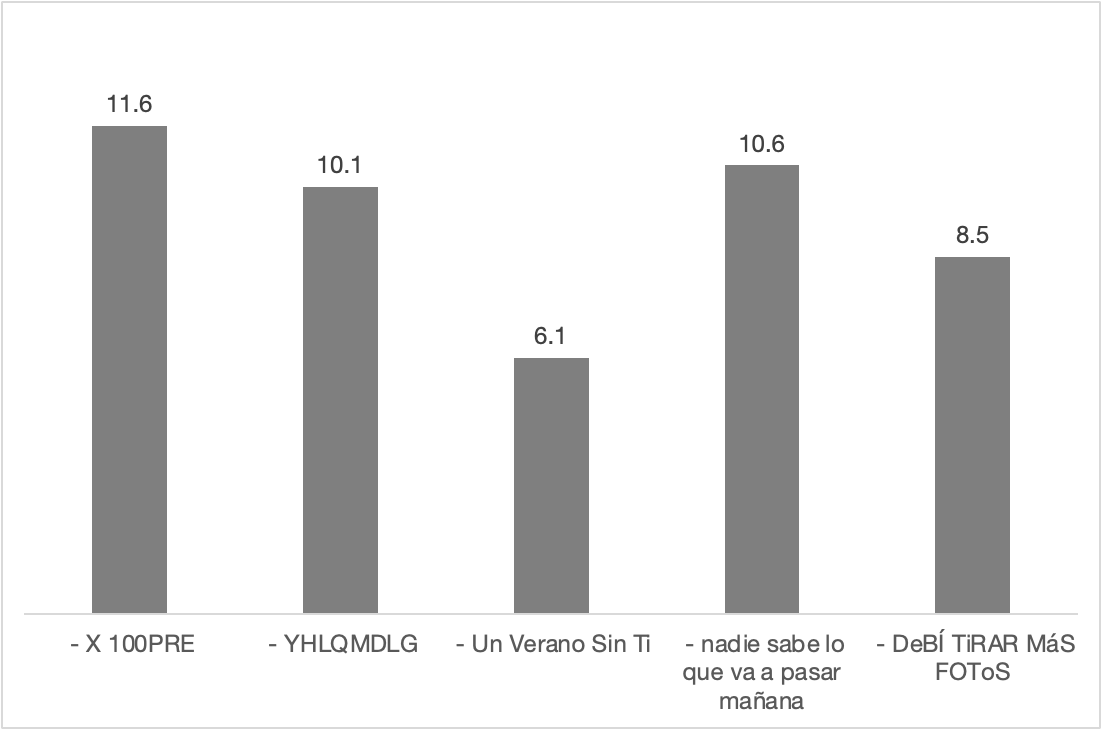
He’s not alone. His contemporaries on this list would all probably see themselves as ‘album artists’. Harry Styles is very much Bad Bunny’s opposite number across the pond, although Styles is not quite as consistent across his catalogue (Harry’s House contains the mega-mega five billion streamer “As It Was” but also the penultimate song “Boyfriends” which is by this evidence, much skipped).
Again, I’m so pleased to see Styles holding his end up on albums, because it does appear to be how he wants it to be. In February 2026 he launched 4th album (KATTDO) with live listening parties across 40 countries. In 2022, he launched 3rd album Harry’s House with an article in Homes & Gardens magazine. Styles is making a statement on how far album culture has progressed in the past four years.
Exhibit #5: Male pop artists are making albums, just not as well as their female counterparts
(track differential ratio calculated from Spotify streams - see method below)
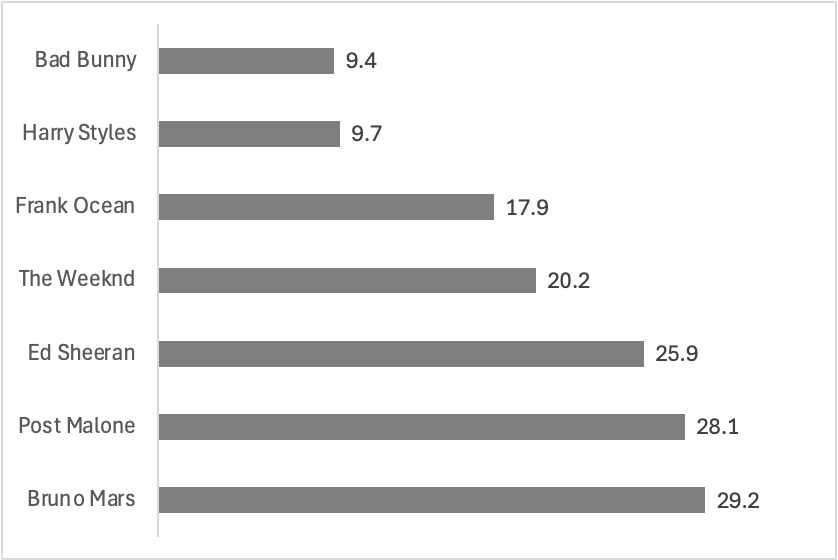
If anything, this list behaves largely as you might expect. Both Frank Ocean and The Weeknd come across as every bit ‘album artists’ but their albums contain variance, perhaps partly because they contain a lot of tracks, and partly because they have quite a few songs that cover huge ground on playlists (again, I excluded Ocean’s more “interlude” tracks that are sometimes under a minute long, from the ratio).
Certainly, the higher-ratio artists on the list strike me as the usual suspects as far as “singles” go; Ed Sheeran, Bruno Mars, and Post Malone command relatively less attention across full albums (I can’t see them losing sleep over it).
Again, the takeaway here is clear - male solo artists do not possess the same album power as the women, with Bad Bunny, then Harry Styles, very much the exception to the rule.
Rap & Hip Hop
Now rap/hip-hop is interesting here. My back-of-book list of the “most important albums of the 21st century” (shoring up “Fortress Album” again the evils of tech empires and A.I.) includes no less than six rap/hip-hop L.P.s, two by Kanye West, two by Kendrick Lamar and one each by Drake and Jay Z. The Kworb ‘SCOBY 200’ included 24 titles by the below list of hip hop artists combined plus a handful of one-offs.
No doubt about it, rap & hip hop has dominated streaming culture in the 21st century and, at least in part, album culture too. After all, only one of the albums in the Kworb 200 has won a Pulitzer Prize for Music. Pulitzer said of Kendrick’s Damn.:
“A virtuosic song collection unified by its vernacular authenticity and rhythmic dynamism that offers affecting vignettes capturing the complexity of modern African American life.”
How about that for re-issue label copy? Fair to say, this genre has punched above its weight innovating the album format too. Drake released a mixtape, reviving interest in the long-form record (i.e., the L.P.) at a critical time, just before streaming exploded. Unlike traditional DJ-hosted mixtapes, So Far Gone (2009) had album-like cohesion, original production and high-quality mixing. Also, remember Jay-Z’s streaming “hold out”.
By default of him owning his own streaming platform, The Blueprint wasn’t put on general release across streaming platforms until October 2015. It in any case proved that the hip-hop album was in fine health as the age of digital music took hold.
This is the hip-hop “power list”:
Drake
Eminem
Kanye West
Kendrick Lamar
Lil Peep
Travis Scott
Tyler, The Creator
XXXTENTACION
The average ratio is similar to male solo artists and bands, again lower than the superwomen of pop. But the variance is interesting. Before I get to that though, I confess to knowing less about the genre (my list of important albums was based objectively not my own tastes). So I did something a little different. I first asked Chat GPT to rank these artists in order of album-orientation and provide me with a basic star rating and thesis.
This is what it came up with:
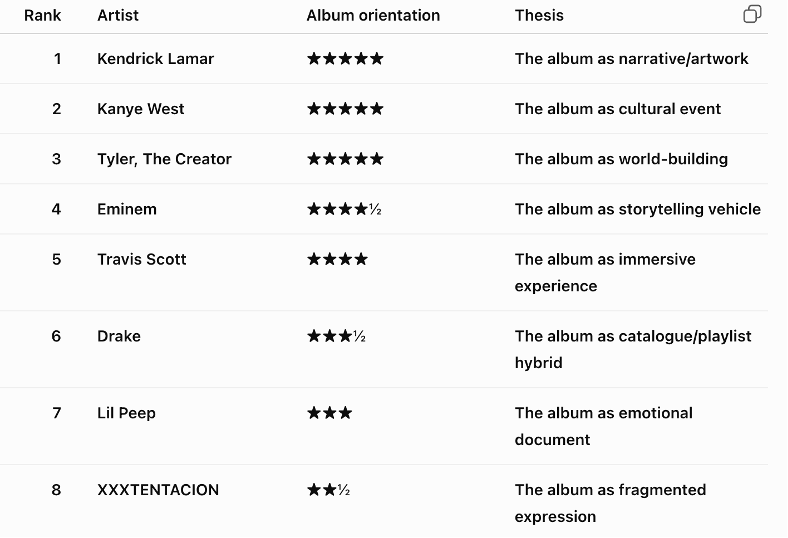
If you know the genre well you’ll have your own views on this, but it looks pretty intuitive to me. The Pulitzer winner comes top, and the next few names in order make some sense. I asked Claude the same question and it largely agreed - the same artists at the top & bottom and in the top and bottom half of the list it spat out. Good enough for a hypothesis.
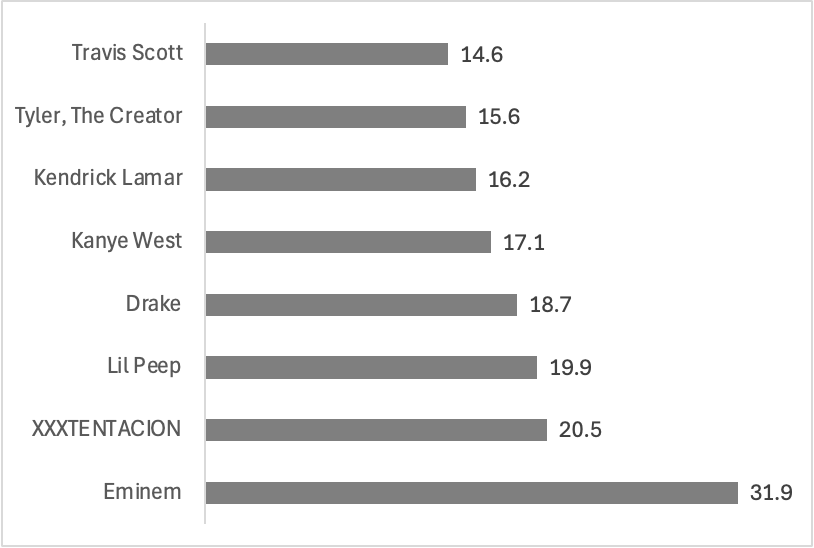
But my proxy ratio shows different. It’s Travis Scott who comes up top, though sure enough, Tyler, Kendrick and Kanye are all then stacked up close in the top half.
A flaw in my ratio is exposed here - especially in the case of Eminem and Drake - they both have such massive streaming hits on some of their titles - skewing their score aware from album-orientation - perhaps unfairly. In the case of Drake for example, Scorpion contains “Gods Plan” (3x”billions club”) and this drives the ratio high to over 30, whereas his album Take Care has a much lower ratio of 12.
Perhaps that’s why Brooklyn based Cue the Record has focused live listening sessions planned for Take Care in October - if you are in NY, go along to it, or other of their excellent sessions.
Exhibit #6: Hip hop artists get variable attention with their albums
(track differential ratio calculated from Spotify streams - see method below)
Bands
Moving swiftly onto the last category - bands! Again, male by default - apart from the now mixed gender Linkin Park, whose new album From Zero with frontwoman Emily Armstrong is included here (with a much lower ratio for that band of 10 compared with 32 overall, mmm).
As signalled last time, it will not surprise you who is the least album orientated band on this list - but just to reassure yourself go ahead and say out loud to yourself now:
Arctic Monkeys
BTS
Cigarettes After Sex
Imagine Dragons
Linkin Park
One Direction
Pink Floyd
Of course, you said Imagine Dragons! If you said BTS, you did not stop to think about it from the fan’s viewpoint. Read on…
First, Imagine Dragons. The unfeasibly popular US pop band just doesn’t make “credible” albums (sorry fans). Each title has extreme top-track concentration. There is no real sequencing logic to their albums (at least that’s how it comes across). Their albums don’t build a narrative arc - songs are largely interchangeable - and each track seems engineered for radio/sync/festival anthem singalongs rather than to sit in a specific place within the album structure. You could shuffle Evolve or Night Visions and lose essentially nothing.
No wonder then, the band’s albums barely register over 50/100 average review scores on Album of the Year (a very solid quality benchmark at least for creative power).
Perhaps you guessed after Imagine Dragons (terrible name along with a few other suspects in this list) it would then be BTS? Ah well, look at the chart!
Exhibit #7: Bands, BTS gives Pink Floyd a run for their album money
(track differential ratio calculated from Spotify streams - see method below)
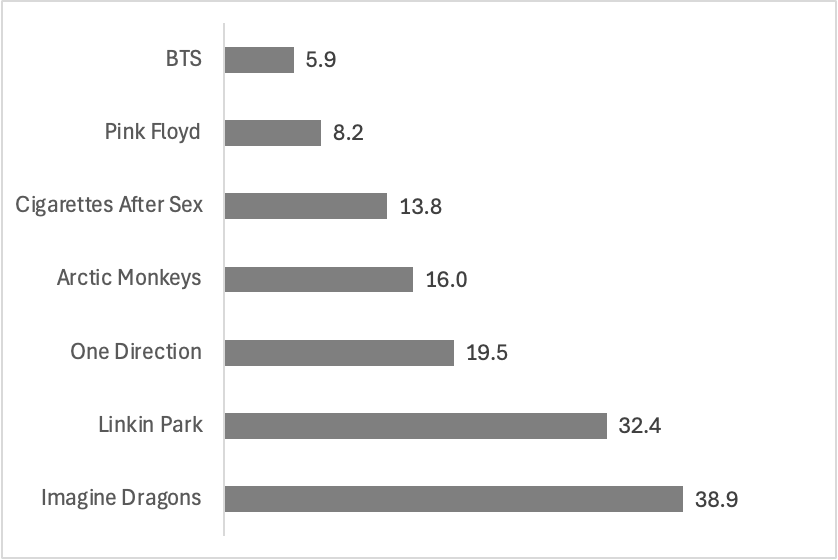
I bet, as anyone would, you assumed Pink Floyd would top the list and you are vexed by the masters of 70s prog rock coming second to a K-pop sensation from the 21st century streaming era (BTS sell more CDs as well of course). It’s the fan base; they’re off the scale when it comes to consuming BTS stuff, making the band look like concept album artisans. This is consistent across the four BTS albums included in the Kworb list, too.
Indeed, two BTS albums: Love Yourself 轉 ‘Tear’ and MAP OF THE SOUL : PERSONA have the lowest ratios apart from Floyd’s Animals, and Arctic Monkeys’ Tranquility Base Hotel, which of course are both very much concept albums.
To conclude, I did say they were caveats to all this. I know enough about numbers to admit nothing here is close to statistical significance. I did this under my own steam, purely out of curiosity (and, as part of some upcoming talks on Body of Work, stay tuned there). But it revealed some interesting ideas. As said, I would love to do it all again properly - hear me out Luminate, Chartmetric or other. I’d like to know the answer, partly because I think artists - and labels - would also be intrigued as to how their music is being enjoyed.
As I say in Body of Work:
“If the album has made a comeback both as a cultural good and a music industry unit of supply, it still begs the question: Who’s really listening? If artists are placing as much importance as ever on albums, and see making them as one of their ultimate creative goals, who are they really making albums for? There is no doubt that, in the streaming era, music consumers appear to have moved on — possibly a decade ago”
Where does this leave the album in the streaming age?
While the streaming and social players have all the data in the world about who is doing what and when on their platforms, musicians and music producers don’t get to know what they really need to know i.e. who is enjoying my art, and how? Instead, they get a dashboard of cold numbers. On the platforms TIME = ASSUMED PLEASURE (= revenue) but that doesn’t translate meaningfully to the music creators. Of course, their true measure is to see the whites of the eyes of their fans in the crowd, or to receive a heartfelt message about their latest project on social networks or at a meet & greet.
A bit anecdotal really!
But I feel like they would more than appreciate the reassuring idea that some people are putting on their albums and going on the journey with them. And indeed, taking that journey back & forth through time across their catalogue.
The album resurgence, from the listeners perspective, is evidenced by the steady success of vinyl and the now apparent return of the CD, but once those physical items are purchased, we don’t know how much listening happens (it’s safe to assume more album-focused listening than on streaming, but that’s the limit of our knowledge). In addition, album anniversary tours keep on rolling around.
Stevie Wonder will perform his classic album Songs in the Key of Life in full starting this year and the tour is a very hot ticket. We’ll probably see that album return to the charts as a result.
The future of the album seems secure enough and I expect the streaming services will do more to acknowledge this, and promote album listening as an experience.
When Spotify revealed “your top five albums” on its 2025 Wrapped (for the first time in 10 years), it seemed to me that finally, the streamer was indicating that it understood albums still matter. Since artists have always known this, it makes sense to lean in further. I’d suggest streaming services do more to sync up with anniversary tours, sell more vinyl and promote more listening parties (both virtual and real).
After all, albums are long-form, so encouraging this is encouraging users to spend more time on the platforms. Or is 45 minutes of focused listening no longer enough to claim that time = money?
Body of Work and Riding the Rollercoaster via your preferred retailer here.
Keith Jopling is a strategy & growth leader, author, and speaker, whose work can be found on The Song Sommelier. He's worked in the music business for 25 years, most recently as an executive consultant in the music industry’s key organizations: major labels, indies, startups, trade bodies and Spotify. Read more about Riding The Rollercoaster.