


This post originally appeared on Keith Jopling's Substack
In Body of Work, I recall how in 2021, Adele bravely stuck her head above the parapet and firmly (but politely) told Spotify to turn the album shuffle play button off and put albums back in order. Adele argued that albums are carefully crafted by artists to tell a story or convey a particular journey, and the default shuffle disrupted that intention.
She tweeted about the change, saying:
“This was the only request I had in our ever-changing industry! We don’t create albums with so much care and thought into our track listing for no reason. Our art tells a story and our stories should be listened to as we intended. Thank you Spotify for listening.”
Spotify capitulated, quickly changing the default setting for albums to play tracks in order, allowing listeners to experience albums as artists intended. The decision was widely praised by artists and fans, highlighting the importance of respecting creative intent in the music industry. The whole episode blew over pretty quickly after that*.
Nice one, Adele.
But - here is a curious fact. Adele needn’t have bothered on her own account. Although she did the whole creative community a huge favour (especially a legion of strong women - read on), from her own perspective - Spotify listeners were not spending time end-to-end with Adele’s albums.
This is despite the fact that her first two LP records, 19 and 21, were both bookended with belters. It seems like listeners might have been in a rush to get to those epic closing tracks by skipping others on those albums (or of course by just playing those tracks on playlists). Certainly, 19 dips heavily towards the end (until the classic “Hometown Glory” kicks in) while 21 wanes in the second half (‘side two’ if you like) after the heavyweight “Set Fire to the Rain” - until the epic closer “Someone Like You”.
The later two albums also have distinctive ebb & flow between big songs and ones not so popular. The picture is skewed of course by the fact that Adele has massive songs on each of the four albums she’s made so far, the exception being 30, on which the single “Easy On Me” is the only Billions Club plaque holder (both 21 and 25 have three songs “in the club” as it were). All this is visible to the eye (if not the ear) by scanning Spotify desktop stream counts for Adele’s albums.
But I went a bit further.
One of my themes in Body of Work is that the crop of current superstar female solo artists - including Adele but even more prominently Taylor Swift and the swathe of US-based superstars that came along after - helped bring albums back into the culture, especially among their own fanbases; young, female and to some extent LGBTQ.
In all cases, these superwomen of pop music have rabid fan bases, so the more Swift, Billy Eilish, Olivia Rodrigo, Lana Del Rey et. al. doubled down on albums as their primary force, the more their tribal fan bases came to see the album as the centrepiece - even if they were streaming natives brought up on playlists. This manifests in the sale of physical formats for these artists, which are strong, but also in the streaming data.
I’ll keep this short - the technical bit. Skip the next two paragraphs if you can’t be bothered or you trust me to do it roughly right (“I’d rather be roughly right than exactly wrong” as an old client used to say way too much). Or if you’re into data etc. read on.
The ‘technical bit’
Through a Chat GPT query, I was led to Spotify stats website Kworb.com, where I found a convenient sample of albums to dive into for a quick numbers crunch. The sample was thus: The top 200 streamed albums ranked by least-streamed album track (i.e. very popular albums).
Obviously this sample helped - especially by eliminating my own bias, but also by selecting a set of hugely streamed albums - conveniently ranked and including a count of their least streamed track. From there - I did a simple clean up - checking the least streamed track was not simply an intro/interlude or anything like that, and that the albums were studio albums, not EPs or compilations etc.
I then sorted by artist type, and supplemented the list with a bit of data input - to make sure for the artists I compared, each had at least three albums included (for some artists this means their entire catalogue e.g. Olivia Rodrigo and Phoebe Bridgers).
For each album title, I calculated a ratio as follows: the average of the stream count of the TOP 2 tracks, divided by the least streamed track. This is a proxy of course. I’d love to have pulled the stream counts for all tracks and done a standard deviation, but I don’t have an API - or the time - although I instinctively feel the patterns would not change that much.
Now of course, if the albums did contain massive hits - the ratio will be larger. But hey, those tracks are still part of the album - and represent the way that artist gets listened to. Throughout the analysis I kept my eye on anything weird or obvious, and I’ll point that out in the copy.
Okay if you skipped, welcome back.
Question: Out of the following list of superpowered women of pop, who do you think is the most album-orientated?
- Adele
- Ariana Grande
- Billie Eilish
- Lana Del Rey
- Olivia Rodrigo
- Sabrina Carpenter
- SZA
- Taylor Swift
You’re right, it turns out it isn’t Adele.
The answer is of course, Olivia Rodrigo. Rodrigo has a low streaming track differential ratio, consistently across her three studio albums so far. It’s the lowest average ratio among this list of artists. Now this is despite the fact she has had massive streaming hits. Her album track counts remain high throughout the entire sequence of each album.
Rodrigo’s albums are streaming monsters. Her debut SOUR has no fewer than seven songs in the Billions Club. The least streamed track “hope ur ok” is approaching half a billion streams - it’s not exactly filler. SOUR was included in Rolling Stone’s “The 50 Best Albums of 2021” and was later ranked number 358 on its list of the “500 Greatest Albums of All Time” - pretty impressive for a debut album by a pop artist in 2021.
With next album GUTS, all 12 tracks charted in the top 40 of the Hot 100 simultaneously. This is of course the insane quirk of “album equivalent sales” meaning an artist can clog up the charts and steal the limelight from everyone else. Most pop albums have two or three tracks carrying the vast majority of streaming weight while the rest trail behind.
Full-album Hot 100 takeovers is a clear signal that listeners aren’t just streaming the singles, they’re playing the album through. This reflects her enthusiastic fanbase of course, but perhaps also Rodrigo’s own album-focused approach. A new album is a big deal and comes with a campaign very much focused on the whole album, not just song by song.
Outside of streaming, Rodrigo is a vinyl phenomenon. GUTS registered the seventh largest week of vinyl sales in history since Luminate began tracking sales, with 94,000 of the album’s 150,000 pure sales (and not the AES fudged sales) coming from vinyl. That’s a (young, female skewed) fanbase buying the album as an object, the body of work in all its packaged, purple glory.
Perhaps this comes as a surprise, but it shouldn’t. Rodrigo has clearly focused her persona around her album releases. For GUTS, Rodrigo has said she penned 150 songs for the album, of which 20 were recorded, eventually whittling the final cut to 17 tracks (on the now obligatory deluxe version). In almost every interview, she will elucidate on the theme of her records, the process of crafting a whole album - and has worked with a consistent team (including producer Dan Nigro).
This is in so many ways remarkable - in an age in which the album’s relevance has otherwise given way to playlists, viral video, social media clips and spectacular live sets. This is even more true for a young, female pop star than in any other gender/genre. You’ll have to pardon the pun, but to take a contrarian stance to the way the entire marketing machine of the modern music industry works, takes, well…GUTS.
So far, her latest album You Seem Pretty Sad… goes even more in the direction of the whole album listen, with a ratio of just 4.9. Her fans are paying attention to the way she wants to communicate her art. Despite waning attention spans and brain-rotting content feeds. How cool is that!
Rodrigo timed her strategy towards album orientation well. My theory in Body of Work is that post-pandemic, music fans were once again ready to embrace long form listening. It is Taylor Swift who blazed a trail here, with her first ‘departure’ record, released deep in the throes of the pandemic. From the book:
“By dropping Folklore unexpectedly, Swift made the album release the start of something. It wasn’t a campaign so much as a statement of intent: “I’ve made something. Here it is.” It reversed the prevailing wisdom that, in the streaming era, the best way to hype an album is to cram as many bells and whistles as possible (including multiple singles) into a campaign leading up to the album itself. This being the best way to achieve a return on investment for what is an expensive thing to create, but which is essentially out of step with the world into which it is released. Of course, it doesn’t work that way. Instead, albums quickly evaporate into the atmosphere and disappear into the vast musical ozone layer of streaming platforms. Folklore was such a phenomenal success that Swift didn’t stop there. She made another, similar but different album — a companion record some might say — Evermore, released the following year. Also a success (with an even lower song stream count differential of 6.9), this pair of albums seemed to lay a foundation from which Taylor Swift would climb to the very top of the music industry pedestal over the next few years[…]”
Indeed, Swift comes out well by my proxy album-artist method, with a ratio of 9.2 (this time across all nine albums that were among the original top 200 on Kworb). Not only that, but if Swift set the trend (or perhaps reset the listener to the album) with Folklore - she has also “educated” her streaming audience somewhat to appreciate her albums more since that release.
This chart may demonstrate this, with the albums placed in chronological order:
Exhibit #1: Taylor Swift “educates” her listeners to go all the way
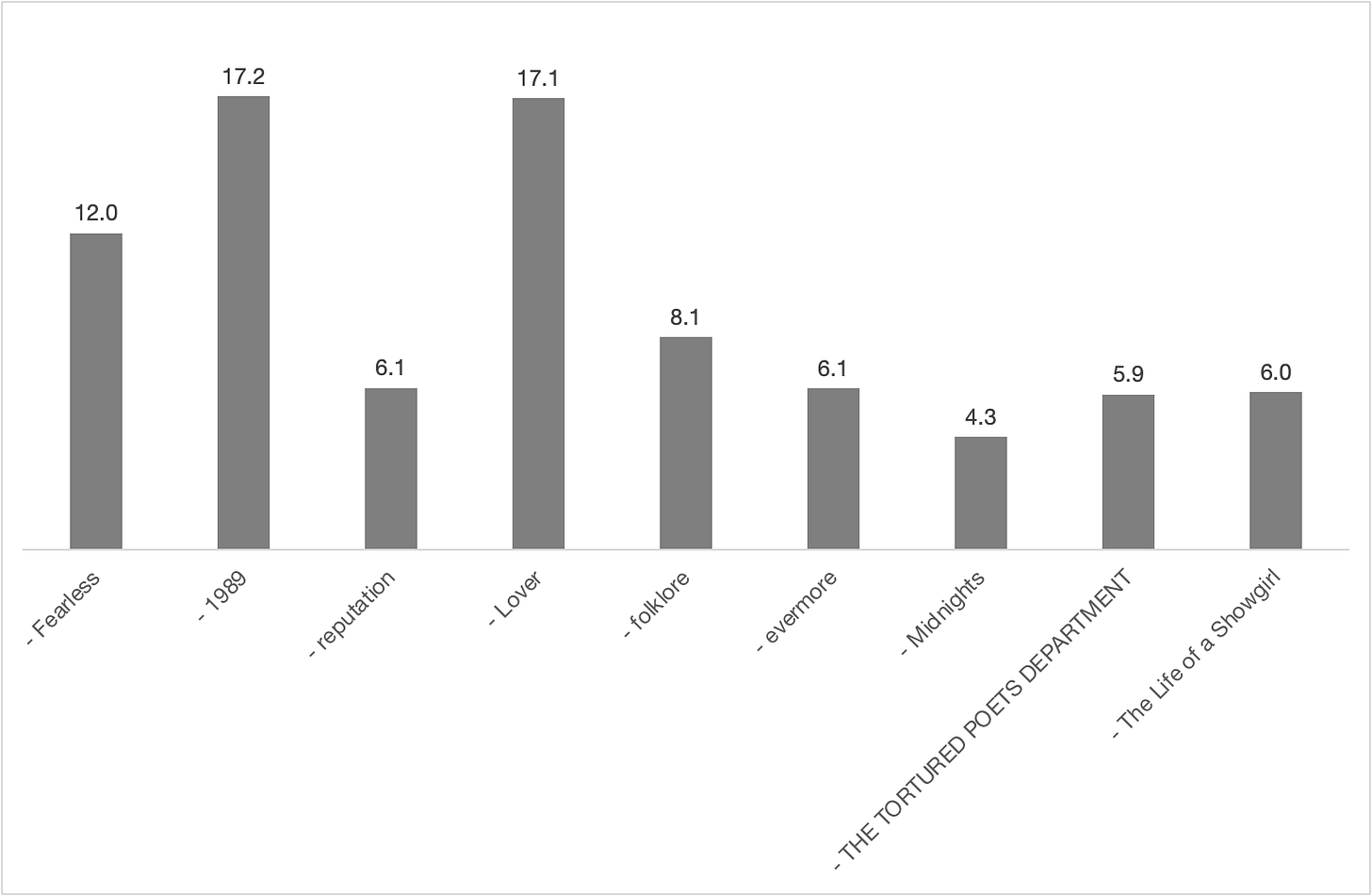
It may be a stretch to say this, but as Swifties have followed her album-by-album, they have also become album fans.
Indeed, if it’s a bit of stretch to single anyone out on this proxy method alone, it’s surely fair to say that Rodrigo and Swift, along with Billie Eilish and Lana Del Rey - are the more album orientated of the above list. And so yes, it’s time for another chart already:
Exhibit #2: Rodrigo, Eilish, Swift, and Del Rey build “Fortress Album”
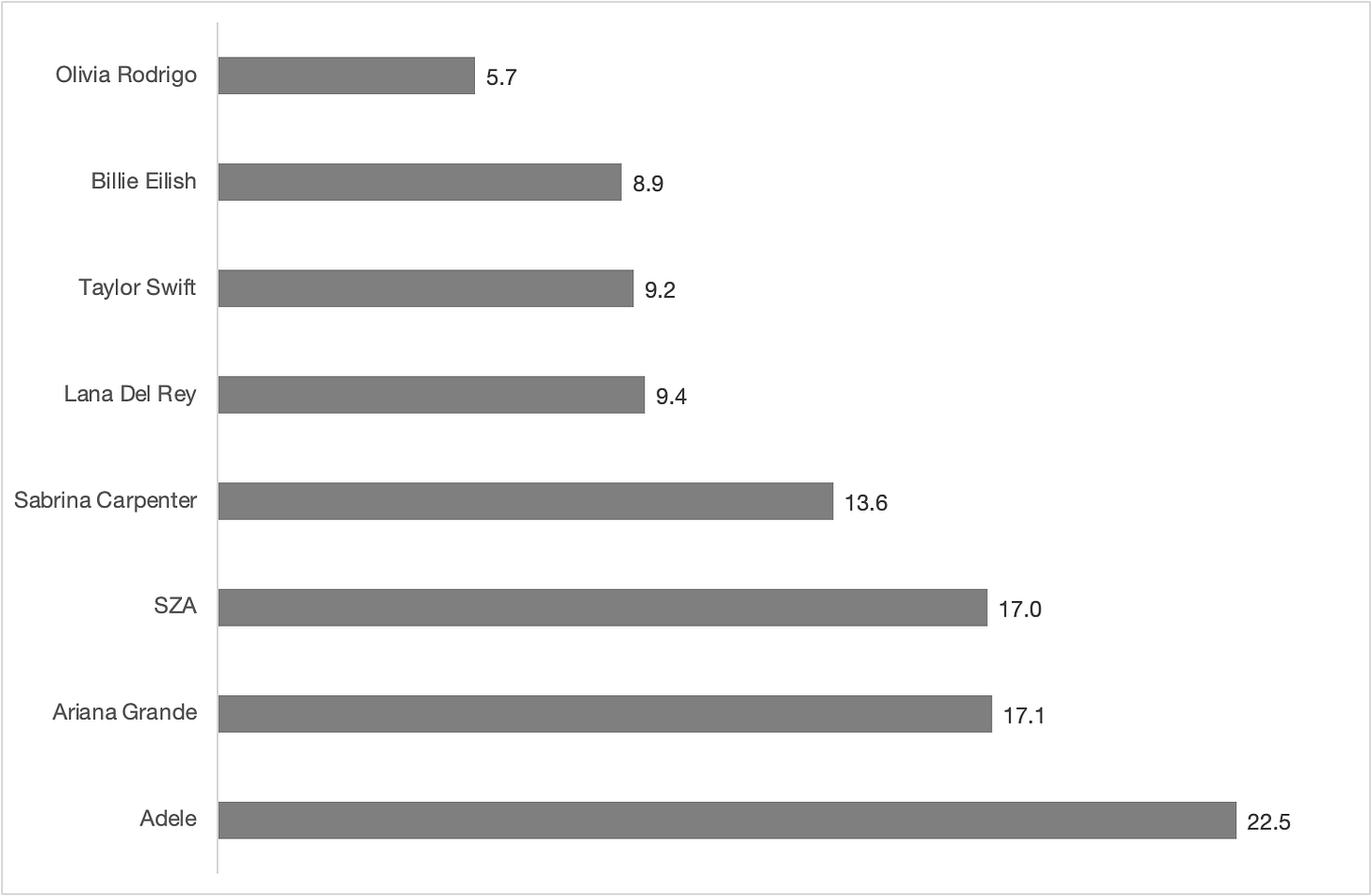
Is it possible that the four superwomen of pop may yet save us from the damage done to art by the four horsemen of the apocalypse?
Read on…
By this same measure, less album-orientated are Sabrina Carpenter, SZA, Ariana Grande and, as mentioned, Adele. Of these the most surprising is perhaps our album champion Adele, with the lowest ratio. Now, why might this be?
On the face of it, Adele comes across as a genuine throwback to the classic years of the 70s and the album’s hay day. And of course, she sells shed loads of physical products too - relatively more than the vast majority of artists. Her albums are literally named for her age at the time of writing/release - 19, 21, 25, 30 - an explicit, career-long structural conceit that frames each record as a life-chapter statement, not just a collection of tracks (still, it also seems fair to say that Adele’s albums are more song collections than strongly themed concepts).
And yet Adele is the artist who put Spotify back in its sleeve on albums (sorry). Even braver, 25 was held off streaming services for months back in 2015, forcing fans toward the format Adele wanted them to experience it in - a direct assertion that the album was meant to be encountered as a whole physical/purchased object, not piecemeal streams. However, streaming behaviour for Adele’s catalogue is one of the most singles-concentrated patterns - certainly in this sample of female pop superstars but also across other categories - to be explored in the next long read.
It has to be said of course, that this simple ratio measures consumption patterns, not artistic intent. Adele is the clearest case here where those two things diverge sharply. on the above evidence Adele is the most vocal advocate for the album - in the world.
As said, Adele has had some massive songs, which might skew things - accept so have all the other artists in this group. Is it possible that Adele’s fanbase - her album listeners - are simply committed to the physical format, leaving more casual fans to pick & mix from the catalogue when streaming? I feel like this might explain things. It makes a case (not to trash everything I’ve written and you’ve just read outright!) for a more triangulated method, taking into account physical sales, streaming, core audience demographics and artistic intent/perceptions.
One clear thing of note, though, is the power of this particular group in shoring up the album as a cultural force. Again, this was my intuitive feeling when I wrote Body of Work, but I had no data to back it up. “The impact these artists have had on album culture - and on bringing the album to the attention of younger female audiences - cannot be underestimated.” (that’s what I wrote, authoritatively and vaguely).
This group of superwomen not only has the biggest presence in the Kworb 200 top streamed albums lists (32 out of the 200 titles, before I added any). And by the way, they also dominated physical album sales in recent years - see chart data to see just how many of these artists feature in the US and UK top 20 physical albums - they are bossing the vinyl trend not just riding it.
But this group (female solo) also has the lowest average streaming differential ratio overall, as shown in (yet) another chart:
Exhibit #3: From girl power to Album Orientated Women
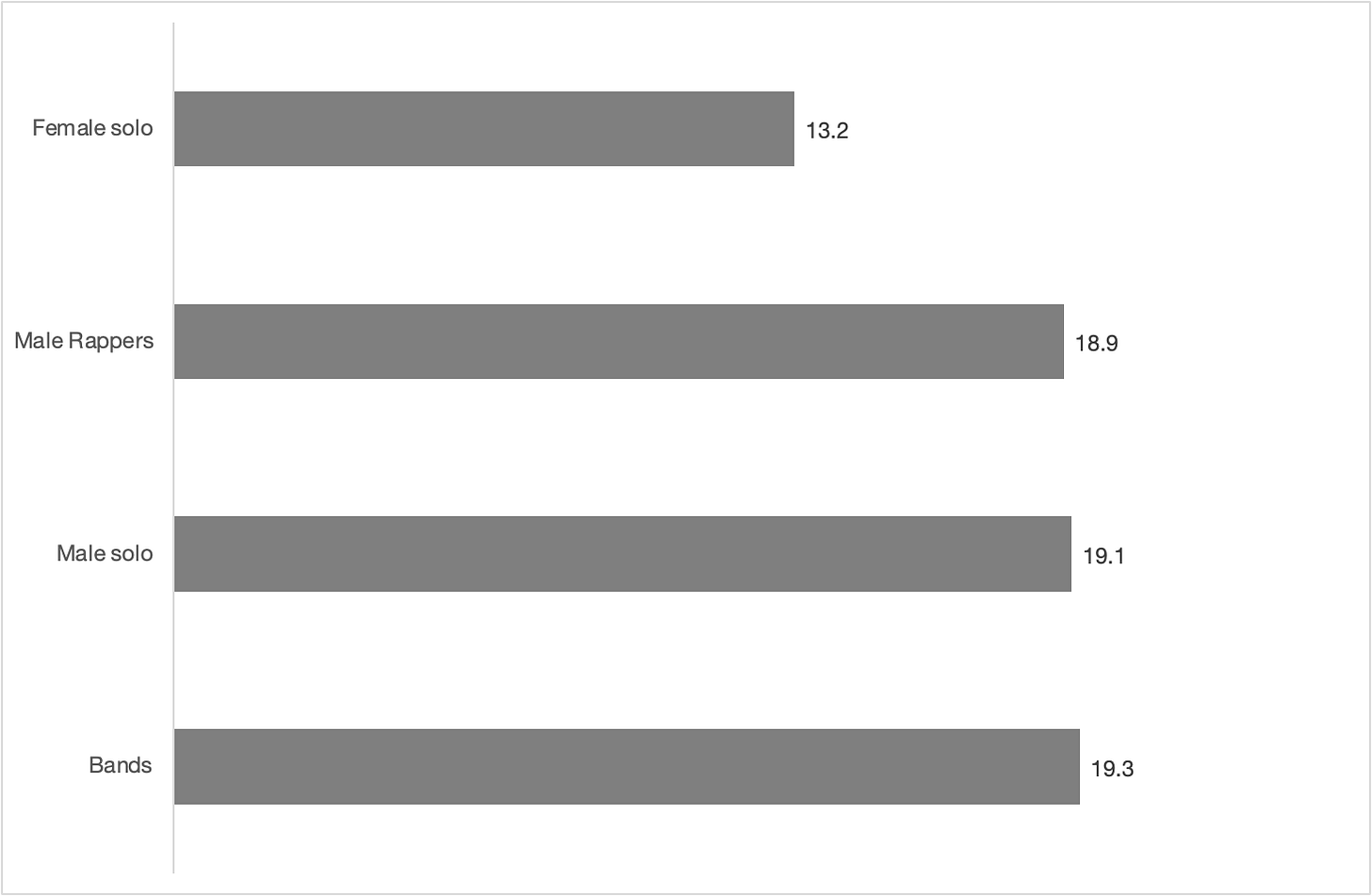
So I’m strongly proposing a thesis here; that the post-pandemic album resurgence - flying in the face of tech-driven music consumption trends - has been led largely, by four female pop superstars: Olivia Rodrigo, Billie Eilish, Taylor Swift and Lana Del Rey - with a strong supporting cast. It is possible that the four superwomen of pop may yet save us from the four horsemen of the apocalypse…
American Radio used to have a genre classification of AOR - album oriented rock. I doubt this means so much today, but it might be a good idea to bring it back but rename it as AOW - Album Oriented Women!
Body of Work and Riding the Rollercoaster via your preferred retailer here.
Keith Jopling is a strategy & growth leader, author, and speaker, whose work can be found on The Song Sommelier. He's worked in the music business for 25 years, most recently as an executive consultant in the music industry’s key organizations: major labels, indies, startups, trade bodies and Spotify. Read more about Riding The Rollercoaster.