By Ryan Blakeley
It was a sweltering, sunny afternoon in Boston and the streets were bustling with people heading to the Orioles vs. Red Sox game. But just down the block from Fenway Park, in the Berklee College of Music’s Richard Ortner Studio Building, a different (admittedly nerdier) faceoff was unfolding over the future of music and AI.
From June 3 to 5, the recently established Berklee Emerging Artistic Technology Lab (BEATL) held its inaugural AI Music Summit (AIMS). Hundreds of experts from around the US and beyond — including engineers, educators, executives, lawyers, researchers, producers, and musicians—gathered to demonstrate, discuss, debate, and occasionally decry the current state of artificial intelligence in the music industry.
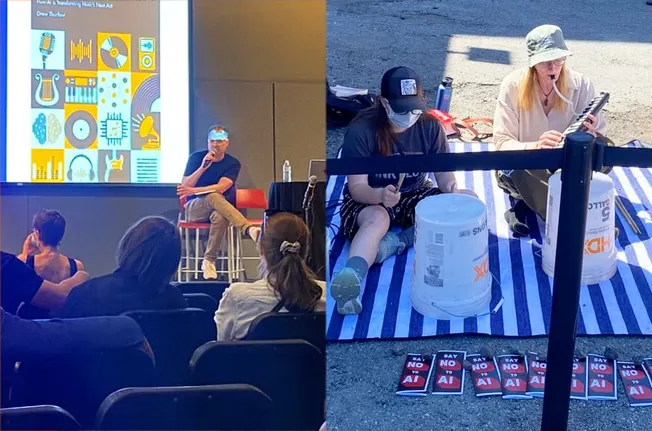
Berklee students were at AIMS too, in a way: a rotating cast of students stationed themselves just outside the venue to protest the event, building on a bigger backlash against the college’s approach to artificial intelligence. The protesters maintained a peaceful presence throughout the conference by playing music, handing out brochures, and having conversations with attendees.
“There are a lot of people here who are at the top level of the AI music industry, and they’re deciding it for the rest of us,” said Theo Wheeler, a Berklee student majoring in contemporary writing and production.
As a musicologist who teaches undergraduates about the evolving role of AI in the music industry and who researches the impact of digital platforms on the business and culture of music, I attended the conference to see where things stand. Here are my five insights from Berklee’s AI Music Summit.
1. AI Music Isn’t Just Suno
Music lawyer Elizabeth Moody opened her presentation “The Future of Music & AI: Deals, Data, and Creator Value” by posing a rhetorical question: Do we have a branding issue? She pointed out that when people speak about AI in music, they often conflate several things, including music production tools, generative songwriting software, and voice cloning technology.
Over the last couple of years, generative AI companies like Suno and Udio have dominated headlines for their ability to create chart-topping songs in seconds using text prompts. When people hear “AI music,” these are the types of platforms and products they usually think about.
But AIMS proved that artificial intelligence is a much broader category that encompasses assistive, generative, and agentic uses. Additionally, these may be applied to music production, songwriting, remixing, recommendation systems, marketing, royalty calculations, and more.
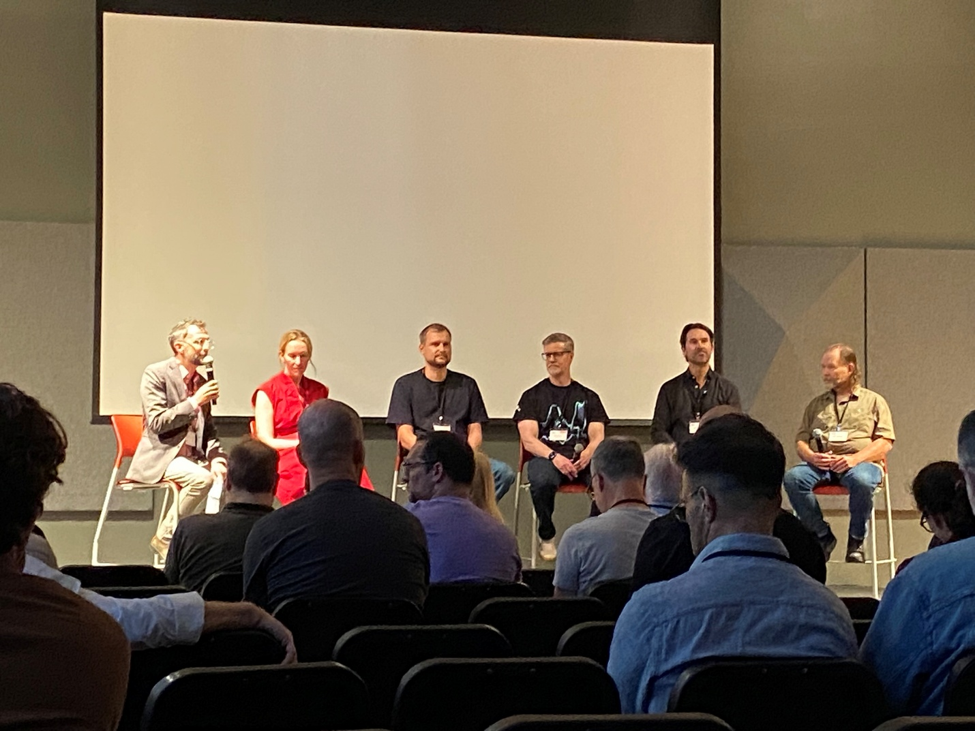
Many presenters focused on AI’s role in stem separation, sampling, and effects processing instead of fully generated music. In a panel featuring the CEOs of Audioshake, AutoTune, Image-Line, LANDR, and Universal Audio, a central through-line was that AI should be used to solve specific problems rather than be used for its own sake.
+Read more: "The Ultimate Online Promotion Platform Guide for Indie Artists"
Even in the generative AI space, there are major differences between products.
Some companies, like Suno, train their models on unlicensed music, while others, like ElevenLabs, advertise that they only use recordings with permission. And although Suno takes an “open studio” approach that allows users to download and distribute AI-generated music, upcoming platforms like Udio’s Starstruck app and Spotify’s AI remix tool propose a “walled garden” model where user-generated content can’t be taken out of the system.
This is not to suggest that any of these companies, products, or deals are inherently ethical or fair. But whether you are critiquing or championing artificial intelligence’s growing role in the music industry, precision is important. Collapsing tools like a noise removal plugin for a DAW into the same category as fully AI-generated music only dilutes our arguments and distracts from the underlying issues.
2. Generative AI is a (R)evolution
Another recurring question at AIMS was whether generative AI represents continuity or rupture for the music industry. Speakers frequently alluded to previous technological disruptions: What, if anything, makes generative AI unique from the player piano, phonograph, MIDI, sampling, peer-to-peer file sharing, or streaming?
Each of these technologies inspired music industry revolt, legal disputes, and fears over musicians’ livelihoods before eventually becoming normalized. (Sound familiar?)
It can be tempting to point to the past to justify the present, claiming that the music industry always adapts, survives, and thrives and that the only choice is to get on board or be left behind. But that framing risks overlooking the genuinely new challenges and opportunities generative AI creates. It also downplays the actual costs of previous disruptions, from recorded music displacing many live musicians to streaming’s royalty model resulting in many artists making less money.
While previous innovations reduced the need for specific types of creative labour, none have done so as thoroughly as generative text-to-music programs. Now, anyone with a computer, internet connection, and free Suno account can create a song that most people won’t be able to differentiate from human-made music.
The sheer speed and scale at which these platforms can produce music is also unprecedented. A recent study by Deezer reports that nearly 75,000 fully AI-generated tracks are being uploaded to the platform each day, despite only counting for 1–3% of overall streams (many of which are detected as fraudulent). Other music streaming services, like Spotify, are similarly being flooded with “AI slop.”
Technology often moves faster than the underlying legal, policy, and business infrastructure, as evident from lengthy lawsuits and ongoing concerns about Name, Image, and Likeness (NIL) protections. This was also clear in an AIMS session by Water & Music’s Cherie Hu and Young Spielburg that comprehensively covered approaches to AI rights management, including detection, provenance, copyright, and attribution.
They demonstrated that old solutions are mapped (often uneasily) onto new problems and that new rights management tools may be too complicated or costly to implement in a timely manner.
New technologies are never a complete break with the past, no matter how disruptive. They are always embedded in cultural, legal, economic, and political contexts that are necessarily part of a longer history — one that is not always easy to see as it unfolds. To properly understand AI’s place in the music industry, we need to take seriously the ways it is both an evolution and a revolution.
3. It’s Okay to Be Ambivalent
AIMS began with Jonathan Wyner, BEATL’s Head of Artistic Technology and one of the conference’s organizers, asking for a show of hands: Would students be worse off if they refused AI training, or if they relied heavily on it? The audience was almost evenly split. Many raised their hands twice.
By and large, the conversations at AIMS were nuanced and steered away from an uncritical celebration of AI. While some companies’ presentations occasionally verged on self-advertisement, there were also educators grappling with how to approach AI in the classroom, lawyers considering copyright conundrums, and musicians reflecting on the implications for their labour and livelihood.
Unsurprisingly, the most controversial topic was Suno. Some described it as a creative tool that makes songwriting more accessible, while others questioned whether AI-generated songs should be competing for the same money as human artists. Responding to an audience comment about Suno training its model on unlicensed music, the company’s Chief Music Officer Paul Sinclair replied:
“in my personal opinion, you can’t gate education or inspiration in general.”
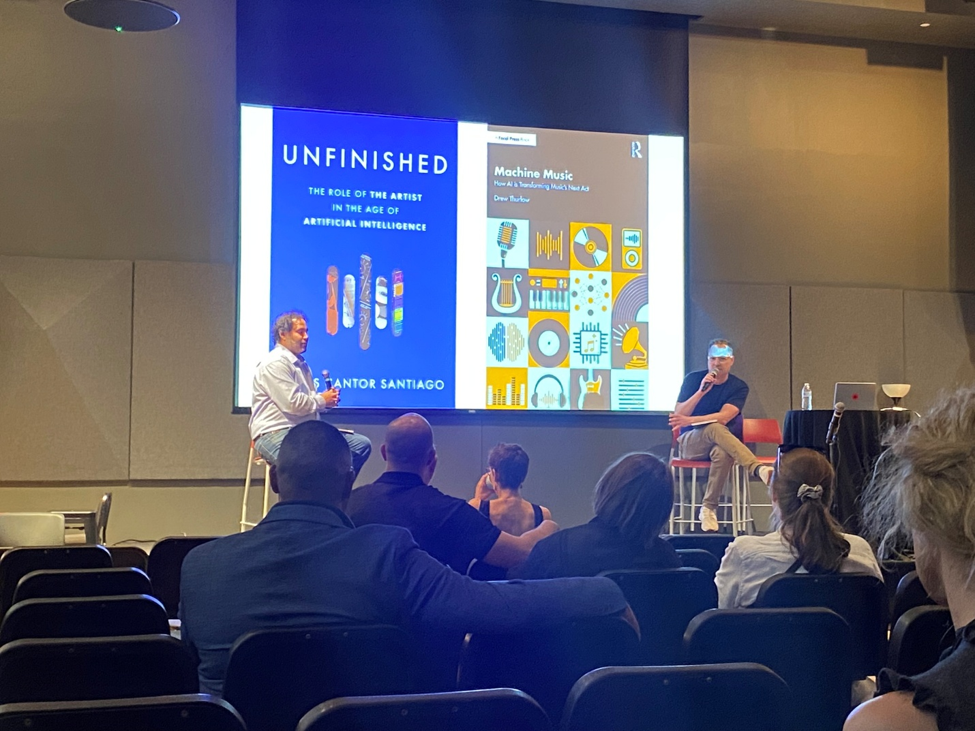
The tension over generative AI was also clear in a respectful but appropriately heated “fireside chat” toward the end of the conference with composer Lucas Cantor Santiago, author of Unfinished: The Role of the Artist in the Age of Artificial Intelligence, and music strategist Drew Thurlow, an adjunct professor at Berklee and author of Machine Music: How AI is Transforming Music’s Next Act.
During the conversation, Santiago took aim at fully AI-generated music, claiming that companies like Suno are “solving a math problem nobody asked for the answer to.” Thurlow, on the other hand, defended generative AI’s potential uses, ranging from making songs from text threads to being used for professional demos.
There may not be clear-cut answers to many of the questions that AI poses, and it’s okay to be ambivalent. But we can’t afford to be disengaged. Perhaps Martin Clancy, author of Artificial Intelligence and the Music Ecosystem and founder of AI:OK, framed it best in his keynote when he laid out four questions:
- “What is happening?"
- "Is it legal?"
- "Do you care?"
- "And if you do – what are you going to do?”
4. Artists Are at the Center (Or at Least They Should Be)
AIMS was branded as an artist-centered summit. In an article Berklee posted leading up to the conference, BEATL’s Executive Director Mark Ethier claimed that:
“AIMS is about centering musicians and educators in this moment of change...It’s an opportunity to support artists as active participants in shaping how these tools are built, taught, and used, grounded in real musical practice rather than hype or fear.”
In many ways, musicians were at the center of AIMS, both creatively and ethically. The conference featured presentations and performances by several musicians, including Holly Herndon, Jordan Rudess, L’Rain, Rance Dopson, and BT.
Most of these artists explored the creative potential of artificial intelligence. Herndon, for instance, shared some of her AI-related musical projects, from AI choral soundscapes to the voice clone Holly+, which allows users to emulate her singing voice. Throughout her presentation, she insisted on consensual data collection and ownership as well as the centrality of purpose and vision.
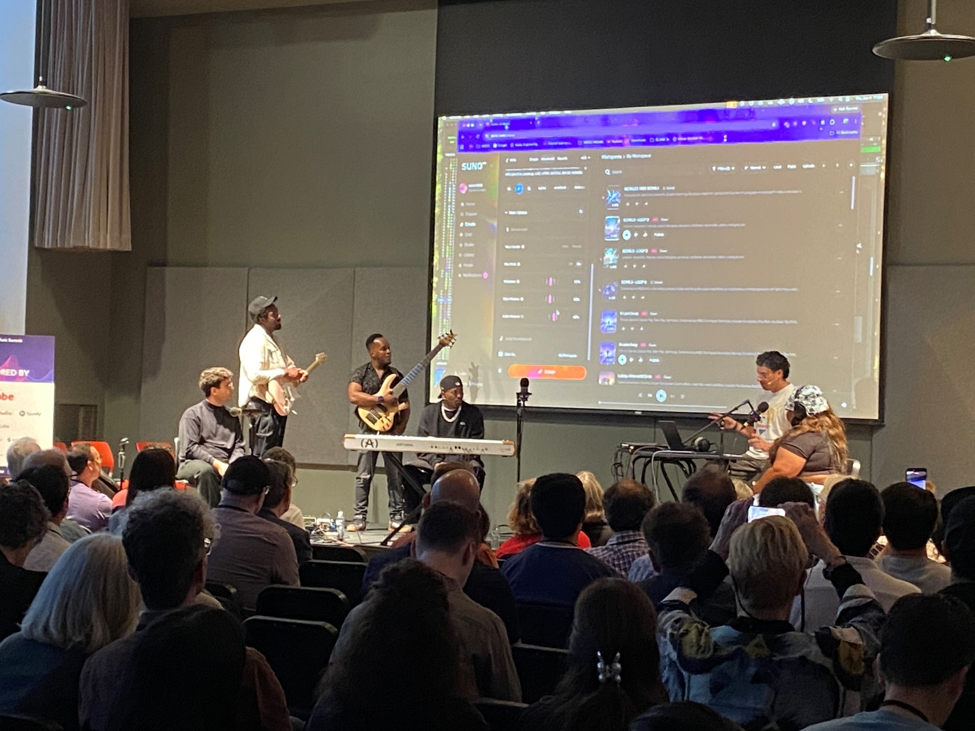
Rudess, the keyboardist for progressive metal band Dream Theater, demonstrated how he uses software like Moises to isolate vocal tracks from recordings and Suno to flesh out improvised ideas.
Most compelling, however, was his showcase of jam_bot, an AI system designed at the MIT Media Lab and trained on Rudess’s own playing. He performed call-and-response duets with jam_bot, with the system “listening” and responding in real time.
L’Rain’s Taja Cheek, on the other hand, voiced skepticism about the current state of AI and described her music as “anti-algorithmic.” She and her band emphasized the importance of community, putting on a mesmerizing show that layered loops and audio effects without sacrificing presence. It’s hard to imagine a fully generative AI platform creating music as intricate, experimental, and (dare I say) human as this.
Crediting and compensating musicians was another key theme at AIMS. Many speakers stressed that their products ethically source training data, require opt-in consent for NIL rights, and provide fair royalties and attribution. These are certainly steps in the right direction, but even if these models introduce fairer terms, they still have the potential to replace opportunities for working musicians, such as sync placements and background music.
If AI companies are serious about supporting musicians, they still have a long way to go to build trust with artists and audiences on a structural level. There’s a lot of money in generative AI right now, but much of that is flowing into companies rather than artists. Suno, for instance, just raised US$400M, leading to a US$5.4B valuation, while ElevenLabs raised US$500M, leading to a US$11B valuation. (Most of AIMS’s sponsors were AI and tech companies that presented, including the multi-billion-dollar ElevenLabs, Adobe, and Spotify.)
The idea that humans should be at the center of developments in music technology was repeated at the summit more times than I can count (which, as this list proves, is at least five). The conference made clear just how creative and exciting artificial intelligence can be in the right hands, but for now much of the power and money remains concentrated in tech companies and the record labels seeking to share the spoils.
It’s not hard to see why many artists — especially younger ones — feel that executives and investors are being prioritized over musicians.
5. There’s a Generational Divide, and Students Want to Be Heard
AI backlash has been growing across the United States, especially among younger generations. It’s no different for music, with a recent Luminate report indicating declining interest and increasing discomfort with AI-generated music.
Similar sentiments have been brewing at Berklee. In April, many students pushed back against an AI songwriting class and raised concerns about potential conflicts of interest, as documented by YouTuber and Berklee alumnus Adam Neely. The student protest outside of AIMS built on these concerns, with the Instagram account berkleeagainstai — created just before the event — gaining over 1,000 followers in just a few days.

But this doesn’t mean that students don’t want to learn about AI.
“From the conversations I’ve heard, the big thing that Berklee students want to be taught is not how to use AI, but how to deal with it,” Wheeler told me. “We acknowledge that the AI music industry is changing things for the general music industry, and the innovations that they’re creating may ultimately create more ability to do things faster, but it still gives up creative control in a lot of aspects.”
“We just want to know how to be able to navigate that when we leave and go on to a career. Where are our jobs going to be taken, where will we actually find these connections, where will we be able to make a living in this world we’re going into?”
Many of AIMS’s speakers, including Ethier and Berklee’s President Jim Lucchese, acknowledged the student protesters and the importance of taking their concerns seriously. In his closing remarks, Ethier also mentioned that BEATL will be putting together a student advisory board.
Whether and how Berklee’s AI policy will address student feedback remains to be seen, but as the next generation of musicians confronts an uncertain future, the debate here could set the stage for other music schools and institutions.
Final thoughts
Things are moving fast (arguably too fast?) and the biggest questions about music and AI remain unanswered: Who stands to gain and lose the most? What creative and economic opportunities will be opened and closed? Who gets to decide the future of music?
Events like AIMS are one space where difficult questions like these can be asked, if not answered. Who gets to shape these conversations also matters, and for several students that meant speaking from the sidewalk instead of the stage.
AIMS closed with the announcement that Berklee will be hosting an AI summit again next year. Which raises yet another question: Where will we be in a year? And just as importantly, where do we want to be?
+Read more: "Opinion: The Last Human Industry"
Ryan Blakeley is a Visiting Assistant Professor of Music Industry at Northeastern University and holds a PhD in Musicology from the Eastman School of Music. His research investigates how streaming services and AI are shaping the business and culture of music.