


By Zander Sbragia is the Founder of CTRL Music Platforms LLC
If you’ve ever tried pitching a song to a Spotify playlist, you already know the struggles. While there are plenty of genuinely authentic playlist curators out there, there will always be snake-oil salesmen: the ones who run a bot farm scheme trying to make a profit.
Even if you’re lucky and it doesn’t get your song removed from Spotify for violations, you’ll find that you’ve been buried in the algorithm and stuck with no real listeners for the rest of your music career.
So, how do the major record labels and professional agencies get away with such extensive playlist marketing plans without facing hurdles? They don’t have any special resources you and I don’t have; they simply know the red flags for how to spot a bot playlist.
We took a deep dive into the backend scoring logic of a real playlist bot checker tool (specifically Playlist Pilot’s Bot Checker) and are revealing what really goes on behind the scenes.
Before we get into the specifics, there’s a basic principle that underpins the whole approach: no single signal can prove a playlist is fake. Not one suspicious word, not one weird number. Anything you spot can have an innocent explanation. That being said, it’s also possible that a playlist can pass all of these checks and still not be fully authentic. If you look at all the indicators, as a bot checker does, you’ll have a certain level of confidence in the playlist, and you can pitch based on your risk tolerance.
The question we’re answering isn’t really “is this fake, yes or no?” It’s more like “how much would I trust this with my song?”
So what are the signs these bot checkers look for?
+Read more: "Pitching to Playlists? Here Are 6 Important Things to Remember"
1. The follower math doesn’t add up
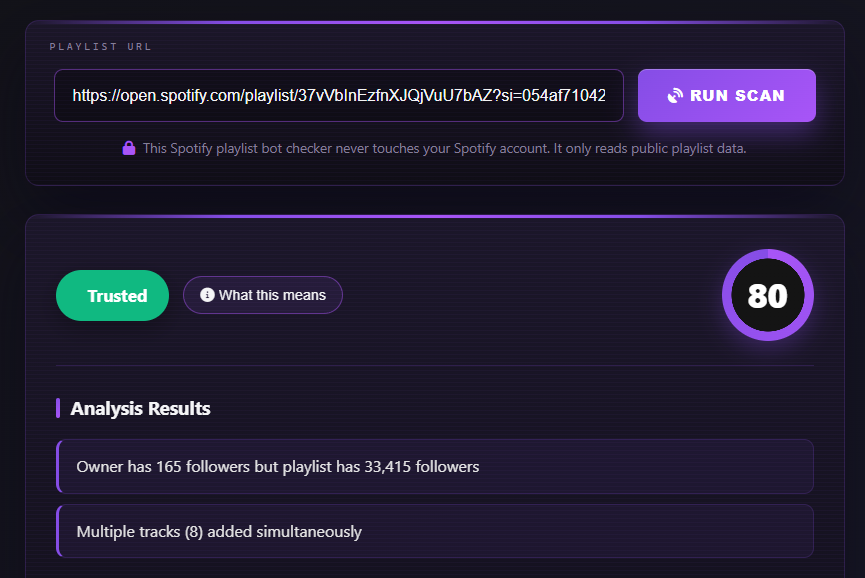
The first thing the bot checker looks at is two numbers side by side: how many followers the playlist has, and how many followers the person who made it has.
This one is pretty intuitive if you think about it. First, you have to consider how a playlist actually gets followers in the first place because it’s not just magic. Curators have to build it through an audience. Often, these curators have a social media presence and share their playlists. Other times, the curators are running paid ads for their playlists.
Either way, the curator’s Spotify profile followers should correlate to SOME extent with the playlist followers. If there’s a playlist with 10,000 saves and the curator has only 5 followers, something is probably off, and the hairs should be standing up on the back of your neck. Even if the curator is running ads, more than 1% of those people would likely follow the curator.
2. It grew too fast
This is actually how many of the less advanced bot checkers on the internet work, and it used to be a great indicator before fraudsters learned about drip-feed bots. When a curator bots a playlist, the bots often come in all at once. If you use a tool like Chartmetric and see that it went from 0 to 1000 saves overnight, it’s probably botted.
That being said, this has gotten much easier for the snakes to fake over the years as they’ve tried to find new ways to outsmart the old generation of bot checkers. Bot farms can now control how quickly the bots save the playlist, mimicking natural playlist growth. So take it with a grain of salt if you see a naturally looking follower pattern, but if you see something unnatural, it should be a dead giveaway.
3. The listening doesn’t match the following
Playlist Pilot’s bot checker actually stands out with this indicator, because many other tools don’t even consider this approach, and it really is one of the best indicators. This is another one that’s a bit intuitive. If the playlist is full of no-name artists you’ve never heard of, and it has a huge amount of followers, run the other way. Playlist Pilot’s approach to this is actually quite smart. Spotify actually carries a popularity score from 0 to 100 that reflects how much a particular song is being streamed at any given time.
The checker averages that across the entire playlist, compares it to the follower count, and determines whether real people are listening. Because let’s be real, there aren’t 10,000 people listening to a playlist that’s two Drake songs buried under a hundred artists nobody’s ever heard of.
4. Songs dumped all at once
Curating has a rhythm. A curator might add songs to a playlist when they come across something new that they like, or maybe one of their favorite artists dropped an album, and they liked a few songs. Maybe an artist submitted through Submithub or Playlist Pilot, and they liked it a lot. What a curator is NOT doing is sitting up all night adding 50 random songs in the span of 30 minutes. This only happens when someone is trying to make a playlist look real or active. If you see this on a playlist you are about to pitch to, think twice.
5. Signals in the text
This is a much lower-key signal on its own, but it should still be taken into account alongside the other signals. If a playlist includes descriptions like “Promo,” “DM Me,” “Cashapp.” There’s a chance it’s being used as a money grab rather than an authentic playlist. That being said, however, it is completely normal for a legitimate playlister to include these words, hoping to get music submissions and discover artists. The Playlist Pilot Bot Checker looks at this, but it uses it as an amplifier. If there are other inauthentic patterns, it pushes it in the negative direction. If it looks mostly safe, this signal has essentially no effect.

Putting it all together
None of these checks require special access. You can pull up a playlist right now, compare the curator’s followers to the playlist’s, scan the description, look at when the songs were added, and get a decent read in five minutes. The labels aren’t doing anything fancier than this. They’ve just done it enough times that the red flags jump out before they’ve finished scrolling.
The hard part is weighing it all honestly, especially when you’re excited about a placement. It’s easy to explain away two or three warning signs on a playlist you really want your song on. That’s the main reason tools like Playlist Pilot’s Bot Checker exist: not because the math is complicated, but because the math doesn’t get attached to the outcome.
However you run the checks, by hand or through a tool, the question stays the same. Not “is this playlist fake?” but “would I trust it with my song?” If you can’t answer that with some confidence, keep looking. There are plenty of real curators out there, and your song deserves to land in front of actual ears
Zander Sbragia is the Founder of CTRL Music Platforms LLC, a music tech company whose products include Playlist Pilot, CoverArtGenerator.ai, and more. The company focuses on giving independent artists the same caliber of tools the majors rely on. Zander's background spans audio engineering, music marketing, and artist management.