


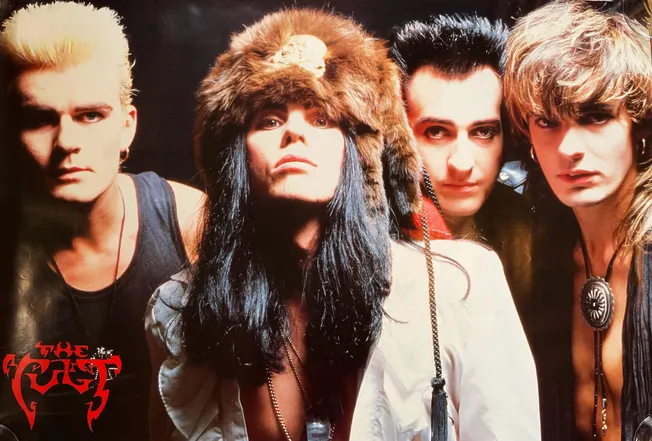
A little over a year ago, The Cult announced that they would be stepping away from touring indefinitely. But they're not going out without a bang. 💥
The British rock veterans scheduled to return to the road alongside A Perfect Circle in 2027, it's worth revisiting one of rock music's fun, peculiar touring histories. For Ian Astbury and Billy Duffy, moving forward has frequently involved going backward.
We'll talk about that and more in this edition of Hypebot's "Brief Histories."
1983–1985: Death Before The Cult
The partnership between Astbury and Duffy began in 1983 with Death Cult, following the dissolution of Astbury's previous band, Southern Death Cult.
Emerging from Britain's fertile post-punk scene, their early performances were dark, confrontational and rhythmic. But the musicians were already uncomfortable with the limitations of being classified as a goth band.
They shortened their name to The Cult in January 1984. By the time Love arrived in 1985, the soaring guitars of "She Sells Sanctuary" were introducing the band to an audience well beyond the gothic underground.
+Read more: "Bad Brains Changed What a Punk Show Could Be: A Brief History"
1987: An Opening Act Called Guns N' Roses
With the Rick Rubin-produced Electric, The Cult traded much of their atmospheric post-punk sound for muscular, blues-driven rock. Among their most consequential touring decisions was inviting a relatively young Los Angeles band called Guns N' Roses to support them across North America.
Appetite for Destruction had only recently been released. Within a couple of years, the opening act would become one of the biggest rock bands on the planet.
The Cult also supported David Bowie on his 1987 Glass Spider Tour, exposing their increasingly expansive sound to stadium audiences.
1989–1990: Becoming an "Arena Band"
Produced by Bob Rock, Sonic Temple cemented The Cult's commercial breakthrough. Duffy has recalled playing 60 shows supporting Metallica following the album's release. Songs like "Fire Woman" and "Edie (Ciao Baby)" were now being performed in the enormous rooms their guitar arrangements seemed purpose-built to fill.
In six years, Astbury and Duffy had gone from British post-punk clubs to the heart of North America's arena-rock circuit.
1995–2006: Breaking Up (and Getting Back Together)
More than a decade of relentless recording and touring eventually, finally, caught up with The Cult, who disbanded in 1995.
They reunited in 1999, separated again in 2002 and resumed working together in 2006. In the interim, Astbury even took on the extraordinary assignment of fronting The Doors of the 21st Century alongside Robby Krieger and Ray Manzarek.
+Read more: "The Tampon Incident: Revisiting L7’s Live Concert History"
2009–2019: Turning Albums Into Events
The Cult began experimenting with album-specific touring, performing Love in full in 2009, including a sold-out engagement at London's Royal Albert Hall.
Electric received similar treatment in 2013, while Sonic Temple became the centerpiece of a 30th-anniversary tour in 2019.
Their catalogue was becoming a collection of individually marketable live experiences. In a way, this was ahead of its time. In another way, they probably should've started touring like this decades ago.
2023: Death Cult Comes Back From the Dead
Seemingly out of nowhere, or perhaps due to a post-COVID fever dream ofr nostalgia, nearly forty years after their formation, Astbury and Duffy resurrected Death Cult for a series of intimate performances across the UK, Ireland, and Los Angeles.
The experiment demonstrated that there was substantial demand for the band's comparatively obscure early material, particularly amid renewed interest in goth and darkwave among younger listeners. It also helped establish a fuller narrative for a band in danger of becoming lost to the sands of time.
2025: ...Then Death Cult Decides to Open for Itself... (And Cover Themselves)
But then, things got a little ridiculous in 2025. For their Paradise Now 8525 Tour, The Cult decided to essentially open for themselves, performing an initial set as Death Cult before returning as The Cult.
There was one small logistical problem: Death Cult had existed for less than a year and hadn't exactly accumulated an extensive discography.
The solution? Cover More Cult, obviously.
At an intimate October 12 performance at New York's Gramercy Theatre, Death Cult dipped into The Cult's catalogue. Yup, that's right. They ran out of material so they covered... themselves. Imagine being in a band, covering your own band, before subsequently becoming that band again.
On October 22 of that year, the musicians announced an indefinite touring hiatus.
All I'm saying is, are these things related? Anyway, moving on.
2027: Another Beginning?
And we're back.
With North American dates booked alongside A Perfect Circle and longtime drummer John Tempesta recently departing, The Cult are entering yet another chapter.
Their touring history offers an interesting lesson for independent artists: older material doesn't have to become creatively redundant, it can be a playground for new ideas and new marketing. But then again, sometimes maybe when the opening act is a half a set of material followed by songs from your other band, the writing might be on the wall...


