

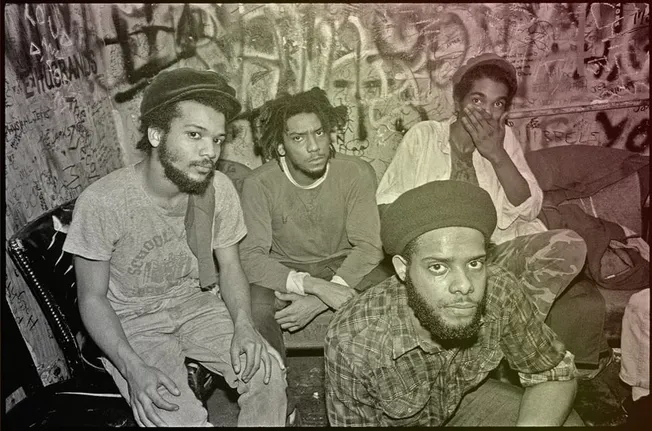
Bad Brains are opening the vault on the moment before the mythology. On November 6, Trust Records will release Are You Ready: The First Studio Recording (Inner Ear – March 1979), a six-song session newly mixed by Ian MacKaye.
Announced September 23, the collection gives recordings that circulated among tape-trading punks their first official release, nearly five decades after they were made. It’s a good excuse to revisit what happened when those songs left the studio.
Bad Brains’ reputation rests heavily on the live show: four Black musicians from Washington, D.C., playing with a speed and precision that helped reshape punk, with H.R. seeming to stretch the possibilities of what a frontman could physically do. But their performance history also contains community organizing, genre expansion, broken relationships and returns that meant something different from the first explosive gigs.
Here’s a Brief History of the rooms, and moments, that made them.
Before the Legend, There Was a Parking Lot
In September 1979, Bad Brains played a Rock Against Racism show at Washington’s Valley Green Housing Complex. Days later, they performed at Hard Art Gallery. Photographer Lucian Perkins documented both, preserving a scene taking shape in places that weren’t purpose-built concert venues.
The Valley Green show places the band within its own community before the familiar footage of crowded punk clubs. H.R. helped organize the event, bringing the music into a residential setting. Bad Brains were making an audience as much as finding one.
Those beginnings are useful to remember whenever hardcore gets reduced to an aesthetic: a haircut, a fast song, a particular kind of angry young man. Here was a band helping turn everyday space into somewhere people could gather around an unfamiliar sound.
“Banned in D.C.” Became Bigger Than the Incident Itself
The band’s most durable origin story needs a little unpacking. Current publicity describes exclusions from multiple D.C. clubs. Yet Darryl Jenifer told Pitchfork in 2007 that a citywide ban was an “urban myth.” He recalled one club’s hostile response to the crowd — and to Black punks — which the band turned into a song.
A venue encounter became a declaration that traveled far beyond the room where it happened. “Banned in D.C.” gave rejection a name, a beat and somewhere to go. The band’s subsequent emergence in New York helped make that declaration part of hardcore’s shared vocabulary.
+Read more: "The Mythos of a Band That Became More Famous By Disappearing"
CBGB, 1982: The Reputation Has Receipts
The performances captured over Christmas 1982 in Live at CBGB 1982 remain a central document of the band at full force. H.R. dances, prowls and reaches into the crowd while the musicians drive through hardcore and reggae. The combination is a killer: Speed creates one kind of physical response; reggae changes the body’s relationship to the beat.
How do you even conceive of moving your body to that in a sensical way??!
And behind the motion was an unusually exacting band. The live identity depended on the players being able to hold everything together while the singer appeared capable of flying apart. Watching those performances helps explain why their influence traveled through musicians as much as through records. You could hear the songs at home, but in a live room you were at the whims of the element of energy.
Amsterdam, 1987: The Sound Keeps Moving
The 1987 Paradiso performance in Amsterdam preserved on The Youth Are Getting Restless gives us another essential stop on the Bad Brains busride. By then, I Against I had broadened the band’s sound, bringing a heavier, more expansive musical language into the live repertoire.
The Amsterdam recording lets listeners follow that development onstage. Their early songs could sit beside newer material without the concert becoming a reenactment of the band’s first years. Elsewhere on the band’s 1987 touring calendar, this Daytona Beach performance captures the expanding sound in action. Watch below.
For a group increasingly treated as foundational to a genre, continuing to move was consequential. The genre was becoming a historical category. Bad Brains still had music to make.
The Contradictions Came on Tour, Too
Any account of the band’s live history has to acknowledge the damage alongside the breakthroughs. During their 1982 touring period, H.R.’s homophobic confrontation involving Big Boys singer Randy “Biscuit” Turner created a lasting rift within the scene.
This episode undermined the inclusive promise of the band’s positive mental attitude message. But another brought yet another rupture.
A support tour with the Beastie Boys in 1995 offered a substantial platform for the group, but H.R. refused to leave the bus for the opening date and attacked the band’s manager. Later, a microphone-stand assault at a Kansas show injured an audience member. Further touring was canceled.
These incidents belong in the story because they affected people and the band’s ability to keep working. Calling a performer “unpredictable” can blur the difference between an exhilarating concert and a harmful encounter. Punk music has always had to rectify with that kind of possibility, but Bad Brains’ caught it perhaps worse than other bands due to their racialized presence within the scene.
+Read more: "A Brief History of the Juke Joint — the Original American Live Music Venue"
A Different Kind of Return
By 2012, H.R. described his calmer stage presence as a deliberate choice: staying composed, he told SPIN, helped the band play better and kept the audience from becoming uncontrollable. The frontman whose movement helped define the early shows was reconsidering movement itself.
Then, in June 2017, an art opening became an intimate, impromptu reunion. At the "Mind Power" exhibition at Brooklyn’s Okay Space, the classic lineup played a surprise set, with original vocalist Sid McCray and Lamb of God’s Randy Blythe also taking turns at the microphone.
H.R. had undergone brain surgery earlier that year. His presence carried a weight that no acrobatic performance could substitute for.
A gallery, a small crowd, musicians sharing the floor: there was something fitting about the setting. Their early history had unfolded in improvised spaces, too.
The forthcoming release of the 1979 session takes us back even further, before all these stages and all the expectations attached to them. Bad Brains changed what a punk show could be, and did it first in rooms where nobody yet knew what to expect.