

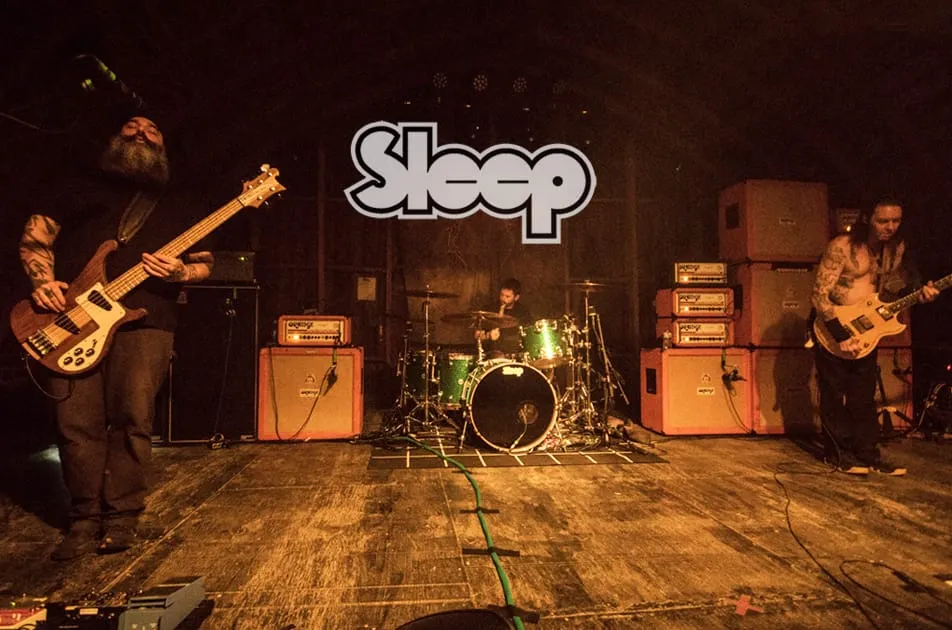
Most bands build momentum through constant activity. They release albums, bulldoze through tour dates, stay visible, and work tirelessly to remain in the conversation.
Sleep categorically do not.
Somehow, the doom rock trio has achieved a level of unwavering fan support and buy-in doing exactly the opposite. Across more than three decades, the "stoner metal" pioneers have released relatively few records, spent years at a time inactive, and repeatedly stepped away from the spotlight (if one could even say they ever flew towards the spotlight to begin with...).
If you know Sleep at all, though, you know that they've pretty much perfected the "heavy riff vibe," with album-length songs drenched in hot buttered fuzz and adorned with maximal sludge, and seeing them on the live stage is essentially a neck-muscle marathon of head-banging.
It's no wonder their fan base is so die-hard, but how did we get to this level of mythos? Here's a Brief History.
The Early Years: Slowing Heavy Music Down
When Sleep emerged from the California underground in the early 1990s, heavy music was moving in several directions at once. Grunge was exploding into the mainstream, death metal was becoming increasingly technical, speedy, and violent, and alt rock was dominating radio airwaves.
Sleep chose a different path. Drawing inspiration from bands like Black Sabbath while stripping away speed in favor of sheer weight, the trio developed a sound built around enormous riffs, hypnotic repetition, and songs that unfolded at a deliberate pace. Their 1991 debut album Volume One hinted at what was coming, but it was 1992's Sleep's Holy Mountain that established the blueprint.
The album would become one of the foundational records of "Stoner Rock" and doom metal, influencing countless bands for decades to come. At the time, however, Sleep were still simply another underground band following their instincts.
Their legend had yet to begin.
+Read more: "Live Music Festivals Are Decoupling From Intoxication"
Dopesmoker: The Album That Was Too Much for Its Label
Every mythology has an origin story. For Sleep, that story is Dopesmoker — originally versioned as Jerusalem. After signing with a major label, the band delivered what has since become one of the most infamous records in heavy music history: a single song stretching for roughly an hour. One uninterrupted composition.
Guitarist Matt Pike stated that they were basically writing this for four years, written, practiced, and demoed in motel rooms and friends' places while they were on the road, but during the recording process:
"[The] song was getting slower and slower and then it got weird. We started tripping out and second guessing ourselves."
This album-song pushed the band's obsession with repetition and immersion to its logical extreme. It was also completely at odds with traditional music industry expectations.
The label reportedly had no idea what to do with it. Disputes over the album's release followed, and the project entered a strange limbo; and the band was grounded. Different versions surfaced under different names, release plans stalled, and what should have been the band's breakthrough instead became a source of frustration.
In hindsight, that conflict may have helped create the myth. Because when people couldn't easily hear the album, they started talking about it.
The band eventually "submitted" four different versions of the album, and over the years licensed it to different labels to release it. The Rise Above/Music Cartel release was an "unauthorized edit," and released in 1999 under the title Jerusalem. It runs at 52 minutes and is a single composition split into six identically named tracks. The version of the album titled Dopesmoker was released in 2003 by Tee Pee Records on CD and vinyl with a 63-minute running time.
The band says none of the versions that saw the light of day were ever their favorite but that Dopesmoker was the closest to their original vision.
The Breakup That Created a Cult Classic
Soon after the Dopesmoker saga, however, Sleep dissolved. For many bands, that would have been the end of the story. Instead, it became the beginning.
They were essentially inactive and on hiatus between 2000 and 2009, and throughout that decade, copies of Dopesmoker circulated among fans like a secret artifact. Stories about the record spread through message boards, record stores, and word-of-mouth recommendations. The album's difficult history became inseparable from the music itself.
At the same time, former members continued creating influential projects. Guitarist Matt Pike found success with High on Fire, while bassist Al Cisneros explored increasingly experimental territory with OM. The Sleep story only grew.
The band had become less of a current act and more of a legend.
+Read more: "The Tampon Incident: Revisiting L7’s Live Concert History"
The Reunion Nobody Expected
By the time Sleep reunited for live performances in 2009, a generation of younger musicians had already embraced them as heroes. What made their comeback remarkable was that it didn't feel nostalgic, their still somehow felt contemporary and boundary-pushing despite being gone for so long.
Many reunion tours are built on memories. Sleep's was built on earned momentum.
The audience now included longtime fans who had waited years to see the band alongside younger listeners who had discovered them after the breakup. What might have been a modest return instead felt like the reappearance of a long-lost institution.
The mythology that had accumulated during the band's absence suddenly had a physical form again. And fans showed up in huge numbers to experience it. Partially because when do you ever get to see a band perform an hour-long song?
Some bands have a signature song. Barely anyone has a signature song that lasts longer than most headlining sets. So as Sleep picked up where they left off, and resumed touring, performances of Dopesmoker became events unto themselves. Audiences weren't gathering to hear a favorite single squeezed between other material. They were arriving specifically to experience the full journey of one sprawling composition.
The audience participates by surrendering to the experience rather than reacting to every song change. It's a remarkably old-fashioned idea in an era built around shrinking attention spans.
The Unexpected Return to the Studio Album
For years, many fans assumed Sleep would remain a legacy touring act and little more. Then, out of nowhere, in 2018, they released The Sciences, an album of relatively conservative track lengths.
The album arrived more than two decades after Sleep's Holy Mountain and proved that the band wasn't merely revisiting old glories. They were still capable of creating new music that felt relevant to the scene they had helped build. More importantly, the release demonstrated something rare: the mythology had not eclipsed the art.
The music still mattered, and it had evolved.
Why The Legend Keeps Growing
Technically the band is still on a hiatus that began in 2020. Obviously that word means nothing anymore. They keep stopping and staring, and now they're back with a new song called "Have Spacesuit Will Travel" that clocks in at exactly 4:20 (go figure).
Most bands become myths after they're gone. Sleep has someone mythologized the act of repeatedly disappearing and returning.
Every stage of their history contributed to the story: the groundbreaking early records, the impossible album, the label conflict, the breakup, the years of absence, the triumphant reunion, and the unlikely return to recording. It's an unusual legacy.
As the band heads back on tour once again, they're not simply revisiting a catalog. They're adding another chapter to a story that has somehow become larger every time it pauses. Catch them live this fall, you won't regret it.
Read more Hypebot Brief Histories here.
Sleep 2026 Tour Dates
SEP 08 — San Diego, CA @ The Observatory North Park
SEP 09 — Phoenix, AZ @ The Van Buren
SEP 10 — Albuquerque, NM @ Revel
SEP 12 — Dallas, TX @ Granada Theater
SEP 14 — Oklahoma City, OK @ Tower Theatre
SEP 16 — Denver, CO @ Ogden Theatre
SEP 17 — Salt Lake City, UT @ The Complex
SEP 18 — Boise, ID @ Treefort Music Hall
SEP 20 — Vancouver, BC @ Commodore Ballroom
SEP 21 — Seattle, WA @ Neptune Theatre
SEP 22 — Seattle, WA @ Neptune Theatre
SEP 23 — Portland, OR @ Roseland Theater
SEP 25 — San Francisco, CA @ The Fillmore
SEP 26 — San Francisco, CA @ The Fillmore
SEP 27 — Santa Cruz, CA @ The Catalyst
SEP 28 — Los Angeles, CA @ The Wiltern
SEP 29 — Santa Ana, CA @ Observatory
NOV 04 — Minneapolis, MN @ First Avenue
NOV 05 — Milwaukee, WI @ Pabst Theater
NOV 06 — Chicago, IL @ Riviera Theatre
NOV 07 — Detroit, MI @ Saint Andrew's Hall
NOV 09 — Toronto, ON @ Phoenix Concert Theatre
NOV 10 — Montréal, QC @ Club Soda
NOV 11 — South Burlington, VT @ Higher Ground
NOV 12 — Boston, MA @ Roadrunner
NOV 13 — Hudson, NY @ Basilica Hudson
NOV 15 — Philadelphia, PA @ Theatre of The Living Arts
NOV 16 — Brooklyn, NY @ Brooklyn Paramount
NOV 17 — Washington, DC @ Lincoln Theatre