

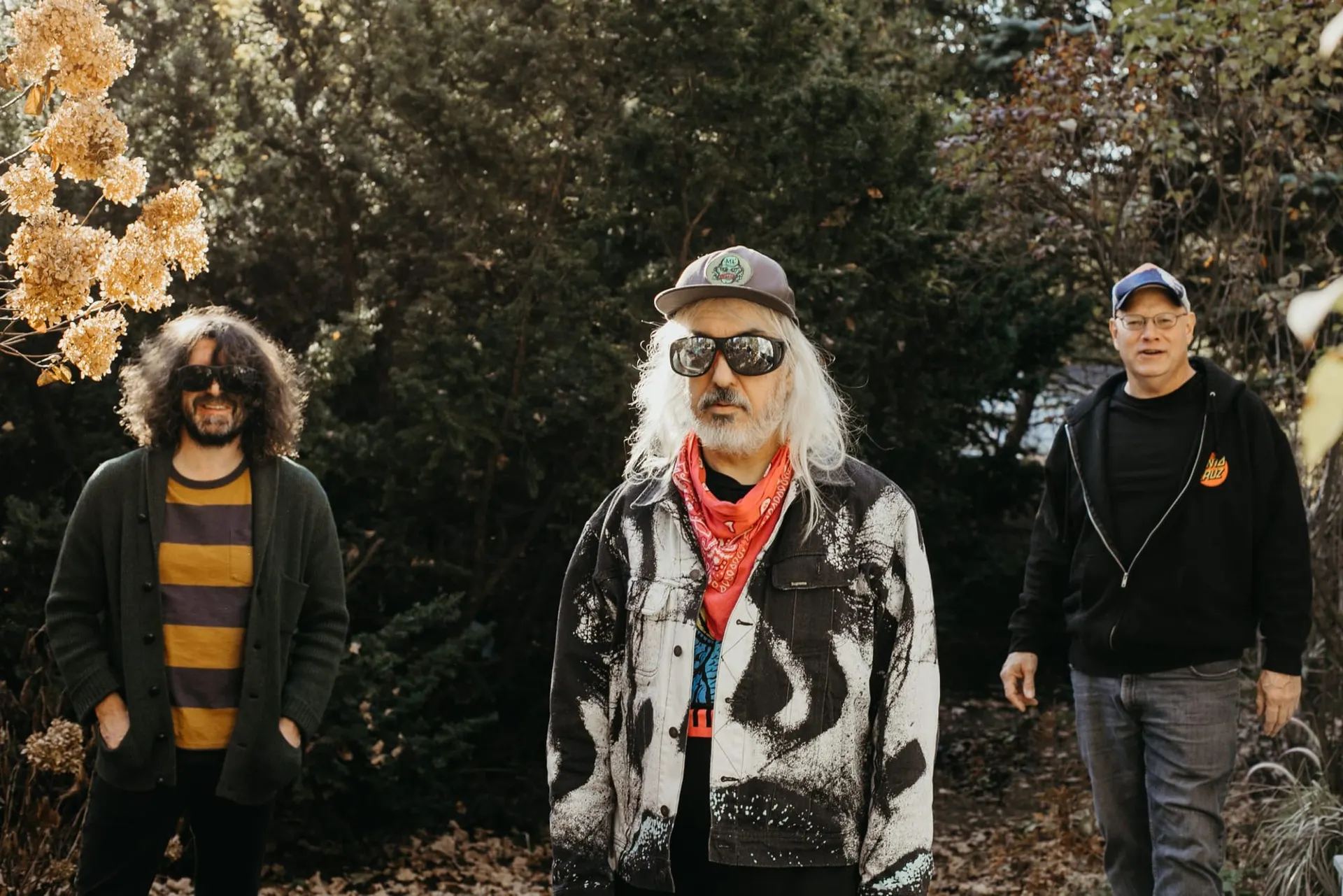
Dinosaur Jr. has released its 13th studio album, There Near, and extended their supporting North American tour into 2027. More surprising than another tour from a band that has spent four decades on the road, however, may be the fact that its audience keeps getting younger somehow.
Recent reporting has repeatedly observed younger listeners mixing with Dinosaur Jr.’s longtime audience. A review of the band’s July show with Band of Horses described younger fans rushing toward the stage, while Pollstar framed its recent cover story around the trio:
“Turning it up to 11 for a new generation.”
Why do some older artists become sealed inside nostalgia while others remain available for discovery?
In Dinosaur Jr.’s case, the answer may be hiding in its live history. This is a band that cleared rooms, fought onstage with each other, toured with Nirvana, reunited without becoming a tribute to itself and somehow kept putting new songs beside the old ones.
Here's a Brief History of Dinosaur Jr.'s live performances.
The Band That Cleared Rooms
Dinosaur Jr. did not begin by attracting any semblance of an audience, it was more like the opposite. Formed in Amherst, MA, in 1984, the original trio of J Mascis, Lou Barlow and Murph developed a sound that combined hardcore volume with country melancholy, pop melodies, and Mascis’ wandering guitar solos.
The problem was that local audiences (and especially local bar owners) did not particularly know what to do with this sound. According to the band’s oral history published by SPIN, their early performances were so loud that people would leave the room. Murph recalled the band being banned from nearly every club around Amherst and Northampton except one.
That continual rejection turned out to be kinda useful? If Dinosaur Jr. could not play at home, the band had to travel. Cue: the world.
The band began making trips to Boston, Hoboken, and New York, playing rooms including CBGB, the Channel and Maxwell’s. An opening slot for Big Black at Maxwell’s caught the attention of Sonic Youth, who subsequently invited Dinosaur Jr. onto a Midwestern tour.
Suddenly, a group accustomed to playing for perhaps 15 people was appearing before crowds of roughly 500. The band traveled in Barlow’s parents’ station wagon, following the touring blueprint established by indie-punk groups like Black Flag and the Minutemen.
Mascis later explained that, in their world, making a record was almost a way to advertise the tour. The real destination was the live stage.
+Read more: "The Mythos of a Band That Became More Famous By Disappearing"
Three People Who Could Barely Speak to Each Other — But Could Still Shred
Dinosaur Jr.’s early performances became ferocious partly because the relationships inside the band were deteriorating in real time. Communication was never a strength of the dudes herein — Mascis was notoriously withdrawn, Barlow increasingly frustrated — but the atmosphere surrounding the original trio frequently tense.
At one point, Mascis and Barlow reportedly got into a fistfight onstage. A 1989 performance of “The Lung” captures that combustible lineup shortly before Barlow was dismissed from the band.
The musicians may have been struggling to function together personally, but the sound remains remarkably unified: Murph pushing from behind, Barlow attacking the bass, and Mascis seeming to disappear into the amplifier stack.
Bands become emotionally dysfunctional all the time. In a weird way, that's the most normal thing about this one.
Yet, those 1980s performances established and cemented a central piece of Dinosaur Jr.’s mythology. The volume of the amps and drums would always be enough to make up for the silence between the dudes.
Into the Alternative-Rock Circus
With Barlow gone, Dinosaur Jr. entered the 1990s as the alternative-rock underground expanded into popular culture.
The band traveled through Europe alongside Sonic Youth and Nirvana, appearing in the influential documentary 1991: The Year Punk Broke. In 1992, Dinosaur Jr. joined My Bloody Valentine, the Jesus and Mary Chain, and a young Blur on the aptly named Rollercoaster tour.
By 1993, the band was playing Lollapalooza and enjoying its greatest commercial success with Where You Been. But its live identity remained gloriously difficult to contain.
That year, Dinosaur Jr. performed “Missing Link” on The Arsenio Hall Show with a lineup that included Del the Funky Homosapien, Mike Watt, and the Beastie Boys’ Mike D. In 1994, the band brought “Feel the Pain” to Late Show with David Letterman. In 1997, shortly before Mascis temporarily retired the Dinosaur Jr. name, it turned up performing “Out There” on The Jenny Jones Show.
Hair and amps on mainstream TV? Okay '90s... chill.
These clips now look like relics from an era when mainstream television occasionally opened a strange little portal into the musical underground. But they also demonstrate how mobile Dinosaur Jr.’s music could be, and how they were becoming an emblem of a live music era starting to coalesce.
The band existed around punk, shoegaze, hip-hop, grunge, college rock, and MTV without becoming entirely owned by any of them. Always indie, always free.
+Read more: "A Brief History of Death From Above 1979’s Loudest Moments"
The Reunion That Refused to Behave Like a Reunion
They went away for a little while as a band, and Mascis retired the band name for a brief stint. But then the original founding trio got back together in 2005 for a reunion that, frankly, nobody expected to last very long.
Mascis, Barlow, and Murph had not made an album together since Bug in 1988. The breakup had been ugly, their individual projects had long since taken shape and the early catalog had acquired canonical status. A short run of anniversary performances would have made perfect sense.
Instead, the reunion became a second life. Following a television appearance and European dates, the trio began revisiting its earliest albums onstage. But in 2007, Dinosaur Jr. released Beyond, its first collection of new material featuring Mascis, Barlow, and Murph in nearly two decades.
Five more original-trio albums then followed. The reunited version of Dinosaur Jr. has now existed far longer than the lineup’s initial run.
It got me thinking about why that felt so strange at first. Plenty of bands reunite to "reproduce" a specific historical moment, or cash out on nostalgia. Dinosaur Jr. reunited, and then just became a working indie band again; releasing records, making odd videos, taking younger artists on tour, and submitting itself to another cycle of van rides, soundchecks, and loud rooms.
As if nothing ever happened.
+Read more: "The Comeback Tour No Longer Sells Only Tickets — It Sells Memory."
Turning the Catalog Into a Meeting Place
That said, Dinosaur Jr. has certainly participated in the anniversary-album economy. The difference is that its retrospective shows often feel more like community gatherings than museum exhibitions.
In 2011, the trio performed Bug in full on bills with OFF!, Fucked Up, Thurston Moore, the Flaming Lips and Deerhoof. Henry Rollins conducted interviews with the band onstage — an especially entertaining assignment considering Mascis’ famously minimal approach to conversation.
For the band’s 30th anniversary in 2015, Dinosaur Jr. played seven consecutive nights at New York’s Bowery Ballroom. The shows featured a sprawling collection of guests, including Kim Gordon, Henry Rollins, Kurt Vile, Jeff Tweedy, Bob Mould and members of Sonic Youth. The band went further with 2019’s Camp Fuzz, where fans could attend workshops and discussions with the musicians. One session placed Mascis in conversation with My Bloody Valentine’s Kevin Shields about guitars, volume and effects.
In 2023, Dinosaur Jr. celebrated the 30th anniversary of Where You Been with residencies in London and Brooklyn. Rather than simply presenting the record intact, the shows again became collaborative events. Guests included Isaac Brock, Kurt Vile, Warren Haynes, and Hamilton Leithauser. Shields joined the band in London for songs by Dinosaur Jr., My Bloody Valentine and the Cure.
Dinosaur Jr. does not merely reopen its archive. It lets other musicians wander through it.
Playing When Shows Barely Existed
Even the pandemic produced a peculiar entry in Dinosaur Jr.’s live history. In September 2020, the band played two socially distanced outdoor concerts: one with the audience divided into separated grids and another at a New Hampshire drive-in, where admission was sold by the car.
Later that Autumn, back in their home state of Massachusetts, the band recorded a virtual livestreamed performance at the picturesque The Pines Theater in Northampton's Look Park.
A drive-in theater and a quiet woodland park might seem like terrible environments for a band built around physical, brutal volume levels. Dinosaur Jr. nevertheless used the shows to test new material that would appear on Sweep It Into Space.
These pandemic-era shows highlight a band that's using every moment to find ways to push their envelope further into the future, and never get stuck in the past.
How to Stay "Available" to New Audiences
Dinosaur Jr.’s recent touring choices help explain the younger faces now appearing in the crowd. The band co-headlined with Snail Mail in 2025, putting one generation of emotionally charged guitar music right beside another. Its 2026 schedule has included dates with Band of Horses and Stef Chura, while Starcrawler will support portions of the newly announced 2027 run.
These are not necessarily obvious pairings. That is partly why they work so well for a band that's been in action for so many decades. And it showcases why Mascis' merry gang can be both an influence on the next generation of raucous guitar music, and remain their contemporaries.
Hey. If you wanna remain culturally available after 40 years, sometimes it's just not that complicated. Keep making records, keep finding new generations of bands to share the stage with, keep allowing your past to collide with your present, and apparently...
Never turn it down.