

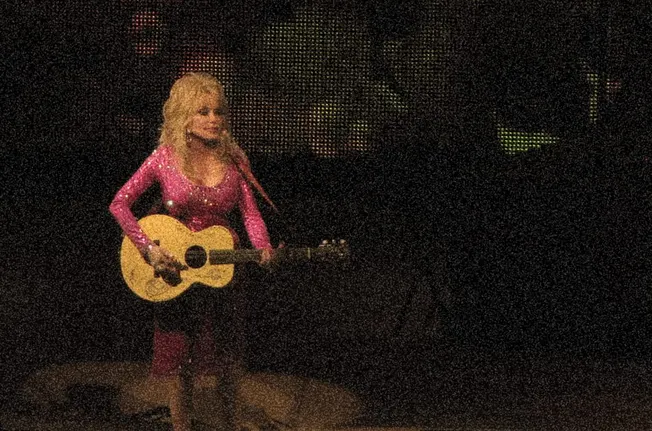
Dolly Parton, the singer, songwriter, actor, entrepreneur and philanthropist whose seven-decade career made her one of the most beloved figures in American culture, died Tuesday in Nashville. She was 80. Her death was announced on her official website.
There will be many ways to measure what Parton leaves behind: the songs, films, businesses, philanthropy, and a larger-than-life public persona that became more universally adored as the culture around her grew more divided. But Dolly Parton was also one of live music’s great practitioners.
Her gift was not simply that she could command a stage. It was that she learned how to carry that down-home intimacy with her, no matter how large her stages became. She could enter wearing enough rhinestones to be visible from space, then speak as though she had pulled up a chair.
Here is a brief history of how Dolly Parton became (and kept becoming) one of America's greatest live performers.
The Front Porch Came First
Before there was a stage, there was a porch. Parton grew up as one of 12 children in a small home in the Smoky Mountains of East Tennessee. She wrote songs as a child and imagined herself performing with a homemade microphone.
By 10, she was singing on local radio and television programs. At 13, she made her first appearance at the Grand Ole Opry, introduced by Johnny Cash.
Parton never completely outgrew the emotional rules of the front porch: tell a story clearly, make people laugh and sing something true enough that they lean closer.
Her presentation would become spectacular. Her relationship with an audience remained conversational.
Sharing the Stage With Porter Wagoner Taught Her How to Steal It
Parton’s invitation to join The Porter Wagoner Show in 1967 gave her both national television exposure and a place in Wagoner’s touring road show. For seven years, Porter and Dolly became one of country music’s defining duos.
The partnership functioned as a live apprenticeship in timing and contrast. Wagoner’s stately baritone and established persona gave Parton something to sing against. Her bright harmonies, emotional openness and sly humor made her increasingly difficult to treat as a supporting player.
In essence, her education in sharing the stage meant learning how to steal the stage.
By 1969, she was a Grand Ole Opry member. By 1974, she was ready to leave Wagoner. The song she wrote to explain that departure, “I Will Always Love You,” became one of the most graceful assertions of artistic independence in music history.
Leaving the partnership was the moment Parton became responsible for building the entire show around herself.
New York City Proved Dolly Did Not Need Translating
In May 1977, Parton played a three-night stand at New York’s Bottom Line. Mick Jagger and John Belushi were reportedly among the people who came to see whether Nashville’s rising star could hold a room outside the conventional country circuit.
She very much could.
The performances capture an artist in transition: grounded in mountain songs and country storytelling, but comfortable mixing her catalog with pop and R&B material. She did not dilute country music for New York. She trusted the audience to come to her. To her porch.
That trust became central to her crossover. “Here You Come Again” reached pop listeners, Parton won the CMA’s Entertainer of the Year award in 1978, and 9 to 5 turned her into a movie star with a theme song that audiences already seemed to know by heart.
The stages then got larger from there, and so did the range of a Dolly Parton show. A set could move from a devastating ballad to a bluegrass breakdown, a pop chorus, a bawdy joke and an instrumental flourish. Her heightened visual presentation gave her permission to contain all of those things at once.
Then Came Kenny
Parton’s touring partnership with Kenny Rogers in the mid-1980s brought another kind of growth. “Islands in the Stream” had made them a country-pop phenomenon.
But their easy affection, teasing banter, and contrasting voices gave arena audiences something warmer than a superstar package.
The numbers were enormous. A 1985 bill at the Louisiana Superdome featuring Rogers, Parton, Lee Greenwood, and Sawyer Brown drew 20,000 people. Parton joined Rogers would tour together around the world through 1990.
The pairing revealed one of Parton’s most useful live instincts, that generosity can unlock a lot of connection, both between performers and their audiences. She did not have to dominate every second to remain the center of attention. The pleasure was rooted in human chemistry, not only production machinery.
Her Millennium Comeback Tour Reinforced That Early Intimacy
After stepping away from the grueling touring schedules of her earlier career, Parton returned in 2002 with her first major tour in over ten years. Instead of attempting an arena-scale comeback, the Halos & Horns Tour played mostly intimate venues holding between 1,000 and 2,500 people.
The shows sold out. The production stripped away much of the glitz of earlier tours, while bluegrass and folk arrangements brought the music back toward East Tennessee. Even “9 to 5” received an acoustic reworking.
At New Orleans’ House of Blues, approximately 1,000 fans were already chanting her name before she appeared. The tour later ended with two Dollywood performances that became the live album and concert film Live and Well.
Glastonbury Was the World’s Largest Front Porch
By the 2010s, Parton was again selling out major tours across North America, Europe, and Australia. But no late-career performance captured her live identity more completely than Glastonbury in 2014. Her official biography estimates that more than 140,000 people attended the set, the largest live audience of her career.
Parton later admitted she had been frightened that a massive rock-festival crowd would have little patience for an artist who liked to stop, talk and tell stories. Instead, those habits became the whole point of why people flocked to see her.
She wrote a song about the festival mud. She played banjo, fiddle and a rhinestone-covered saxophone. She told jokes, yodeled, led singalongs and moved between “Coat of Many Colors,” “Jolene,” “9 to 5” and “I Will Always Love You.” The performance was gloriously excessive and built specifically for the people standing in that field.
“I know it was corny, but it was fun,” she told them.
Years later, Parton told Pollstar that Glastonbury was as close as she had felt to being a rock star. More revealingly, she remembered how respectfully the audience listened to her stories. She had made an enormous festival behave like a listening room.
Into Her Elder Years, She Pushed the Tour Van Farther
In 2016, at the ripe young age of 70, Parton launched a tour across North America in support of her 45th solo album, Pure & Simple Tour. The run covered over 60 dates. In classic Parton fashion, she deliberately moved away from a giant production in favor of a more minimalist show, deeper catalog selections and more conversation with the audience.
The combination of a large touring itinerary with a smaller emotional scale summed up what she had spent a lifetime learning. Although these would be her last road runs, she still planned to perform occasionally, and acknowledged that a tour was not something she could do halfway.
Her Encore Back in East Tennessee
Parton’s final years onstage unfolded through special appearances rather than conventional tours. At her 2022 Rock & Roll Hall of Fame induction, she turned “Jolene” into an all-star singalong. In 2023, at 77, she walked onto the Dallas Cowboys’ Thanksgiving halftime stage in a bedazzled cheerleading uniform and performed a compressed medley for a stadium and national television audience.
And in March 2025, her final documented live performance would come at Dollywood’s 40th-anniversary opening day. Parton sang “Celebrate the Dreamer in You,” a song she had written for the park’s 25th anniversary.
It was an unusually fitting last stage: in the East Tennessee place she had built from her own history, image and belief in where she came from.
Dolly Parton spent seven decades growing in, many, directions. The hair got higher. The costumes became brighter. The outfits got tighter. And the audiences grew from a few people near a radio microphone to well over 100,000 standing in a field. Yet she kept finding ways to make the stage feel smaller.
Charm, generosity, stagecraft.