

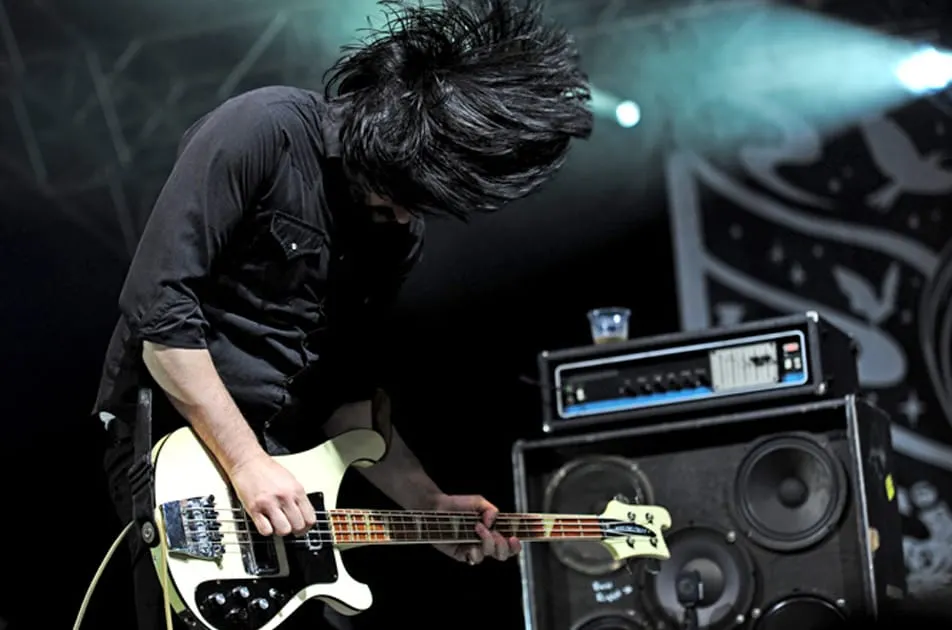
When Death From Above 1979 announced another major tour, it served as a reminder that one of indie rock's most cacophonous live acts is still doing things the hard way.
Making a ton of noise.
While many acts from the early-2000s indie boom are remembered for albums, fashion, or scenes, Death From Above 1979 became legendary because of what happened onstage. Their concerts helped redefine what audiences expected from a small lineup, influenced an entire generation of bass-and-drums bands, and occasionally descended into genuine chaos.
They've also had a hard time staying together over the years. Now they're back on the road throughout the summer and fall, and we cannot wait to see and hear what's going to happen on stage this time around. Here's a brief history of DFA1979's iconic live moments.
The Entire Premise Felt Impossible
When Death From Above 1979 emerged in the early 2000s, part of the appeal was simply trying to understand what you were hearing. Was it punk? Was it electro? Was it noise pop?
Sebastien Grainger handled drums and vocals. Jesse F. Keeler played bass through an elaborate chain of effects that transformed the instrument into something that sounded part synthesizer, part guitar, and part industrial machinery. The result was enormous.
Early live footage of songs like "Romantic Rights," "Turn It Out," and "Black History Month" captures the rising band's sound instantly. Audiences often look visibly confused trying to locate the missing musicians, as they barely ever performed on a lofted stage. Instead they were crowd level, banging around with their audience, part and parcel.
They Helped Invent the Festival-Sized Small Band
As a result of their grassroots popularity in the early 2000s, the band started performing at pretty sizeable festivals by 2005. Nowadays, duos headline festivals all the time but back then, the big stages didn't feature those kinds of acts.
For reference, The Black Keys' started getting booked at festivals around 2003-04, but didn't actually "headline" a festival until 2012. And they were never as raucous. Death From Above 1979 helped establish a blueprint later adopted by countless heavy two-piece acts. Their success demonstrated that scale wasn't necessarily a product of personnel. It could be achieved through arrangement, performance intensity, and attitude.
You can hear echoes of their influence in acts like Royal Blood, Japandroids, and numerous contemporary bass-and-drums projects that prioritize impact over complexity. The idea that a two-person act could command a festival crowd without it feeling like a compromise was pretty novel.
+Read more: "What’s With All the Weird Jazzy Pop Duos Right Now?"
The Breakup Made the Live Shows Mythical
One reason the band's reputation remains so strong is that they disappeared just as their momentum was peaking. Following the success of You're a Woman, I'm a Machine, the group abruptly split in 2006. Fans were left with a relatively small catalog and memories of increasingly intense performances.
That scarcity transformed the concerts into folklore.
For years, stories about DFA1979 circulated through message boards, blogs, and word-of-mouth. Because there was no ongoing touring cycle, every performance seemed to grow larger in memory. The band became one of those rare acts whose legend continued expanding even while they were inactive.
When the band reunited in 2011, the pent-up demand became immediately obvious.
SXSW 2011: The Reunion Show That Became Chaos
Their SXSW reunion performance in Austin drew crowds so large that the event reportedly descended into clashes between attendees and police outside the venue. Fences were knocked down, authorities deployed crowd-control measures, and the show itself was temporarily interrupted before eventually continuing.
The incident became one of the defining moments in the band's live stage history.
Not because the band caused the chaos, but because it illustrated how much anticipation had accumulated during their absence. Few reunion shows generate that level of genuine disorder.
For a band built on intensity, it was a strangely fitting return.
Coachella Proved the Magic Was Still There
If SXSW represented the chaos of the reunion, then Coachella represented its validation. Appearing at the festival shortly after reuniting, Death From Above 1979 demonstrated that they were not merely benefiting from nostalgia. The chemistry, aggression, and physicality that had defined the original run remained intact.
For younger audiences who had only heard stories about the band, these performances served as a first-hand explanation of the mythology.
The reunion wasn't a tribute to a former band. It was the continuation of one in constant evolution. And it's hard to overstate how although their music certainly made people dance, but the live performances often felt closer to hardcore shows than indie-rock concerts.
Many bands associated with the dance-punk explosion emphasized coolness. Death From Above 1979 emphasized force. Crowds surged. Bodies collided. Songs moved with the pulse of dance music while retaining the impact of heavy rock.
That combination became enormously influential. The band occupied a unique space between club culture and mosh-pit culture, helping demonstrate that rhythm and aggression didn't have to be opposing forces.
+Read more: "The Tampon Incident: Revisiting L7’s Live Concert History"
The Letterman Performance Proved It Wasn't Just the Clubs
When the duo performed "Trainwreck 1979" on Late Show with David Letterman in 2014, they managed to bring much of their club-show intensity into a television studio.
The performance served as proof that the band's power wasn't dependent on cramped venues, alcohol-fueled crowds, or underground mystique. The songs themselves carried enough force to survive almost any setting.
Few groups can make network television feel like a basement show. DFA1979 came remarkably close.
What Does the Landscape Even Look Like Now?
For so many bands today native to the studio environment, live shows tend to feel so synchronized, so digitally precomposed, and to some degree, optimized for social media clips.
Death From Above 1979 emerged from a different philosophy entirely, out of a landscape of chaos. And it makes me wonder if modern concert culture can still produce bands like them?
With the band going back on tour again in 2026, it's not getting a chance to hear the old songs that really appeals to me, but the opportunity to check in with how fresh and original their sound still... sounds.
Death From Above 1979 2026 Tour Dates
JUL 17 — Ottawa, ON @ Ottawa Bluesfest 2026
JUL 18 — Toronto, ON @ RBC Amphitheatre
OCT 01 — Sacramento, CA @ Ace Of Spades
OCT 02 — Berkeley, CA @ UC Theater
OCT 03 — Monterey, CA @ Golden State Theater
OCT 04 — San Luis Obispo, CA @ Fremont Theater
OCT 06 — Ventura, CA @ Ventura Music Hall
OCT 08 — Los Angeles, CA @ The Belasco Theater
OCT 09 — Santa Ana, CA @ Observatory
OCT 10 — San Diego, CA @ The Observatory North Park
OCT 11 — Tempe, AZ @ Marquee Theatre
OCT 13 — Englewood, CO @ Gothic Theatre
OCT 29 — Portland, OR @ Revolution Hall
OCT 30 — Seattle, WA @ The Crocodile
OCT 31 — Vancouver, BC @ The Vogue
NOV 02 — Calgary, AB @ The Palace Theatre
NOV 03 — Edmonton, AB @ Midway
NOV 05 — Winnipeg, MB @ The Park Theatre
NOV 06 — Minneapolis, MN @ Fine Line
NOV 07 — St Louis, MO @ The Old Rock House
NOV 08 — Chicago, IL @ Thalia Hall
NOV 26 — London, ON @ Forest City London Music Hall of Fame
NOV 27 — Toronto, ON @ HISTORY
NOV 28 — Buffalo, NY @ Town Ballroom
NOV 30 — Montréal, QC @ Théâtre Beanfield
DEC 01 — Quebec City, QC @ Imperial Bell
DEC 03 — Allston, MA @ Brighton Music Hall
DEC 04 — Brooklyn, NY @ Warsaw
DEC 05 — Washington DC @ The Howard
DEC 06 — Pittsburgh, PA @ Thunderbird Café & Music Hall