



By Nicolas Edward Pendland
Rosa Calderone still approves every test pressing herself. The fictional singer-songwriter started Lamplight Hill Records and its publishing arm, Lamplight Hill Songs, 24 years ago in a former feed store outside Nashville.
The label now has 14 artists and about 380 recordings, and most of its house rules began as her preferences: everything is tracked to tape before it is mixed, nothing is mastered louder than she likes to hear it in her truck, sleeves are hand-lettered, and vinyl is pressed on black only.
She is 62 and a lifelong Catholic. She has no wish to sell the catalog, and none of her children wants to run it. What she wants is simple to state and difficult to set up: for her taste to keep deciding what Lamplight Hill releases, and how it sounds and looks.
The business got a reminder this fall of how often those calls come up. A decade after Prince’s death, his estate released Timeless, billed as original recordings, and then had to explain that horn players had added new parts this year to “Calabama”, a track he recorded in 2003, after a principal of Prince Legacy LLC had first said it had not been edited or added to.
The label’s statement added that no AI was used on any Prince music, Stereogum reported. Hypebot has also carried Chris Castle’s warning about unauthorized AI-generated tracks turning up on the verified pages of deceased artists. Whatever one thinks of the horns, a catalog with a famous founder keeps needing calls of taste long after the founder dies: which tapes to release, whether to finish them, how loud to master them and what goes on the cover.
Contocracy, a form of rule proposed in 2026, offers an artist-founded label one way to settle in advance who makes those calls, and to label every one of them.
How a "contocracy" is built
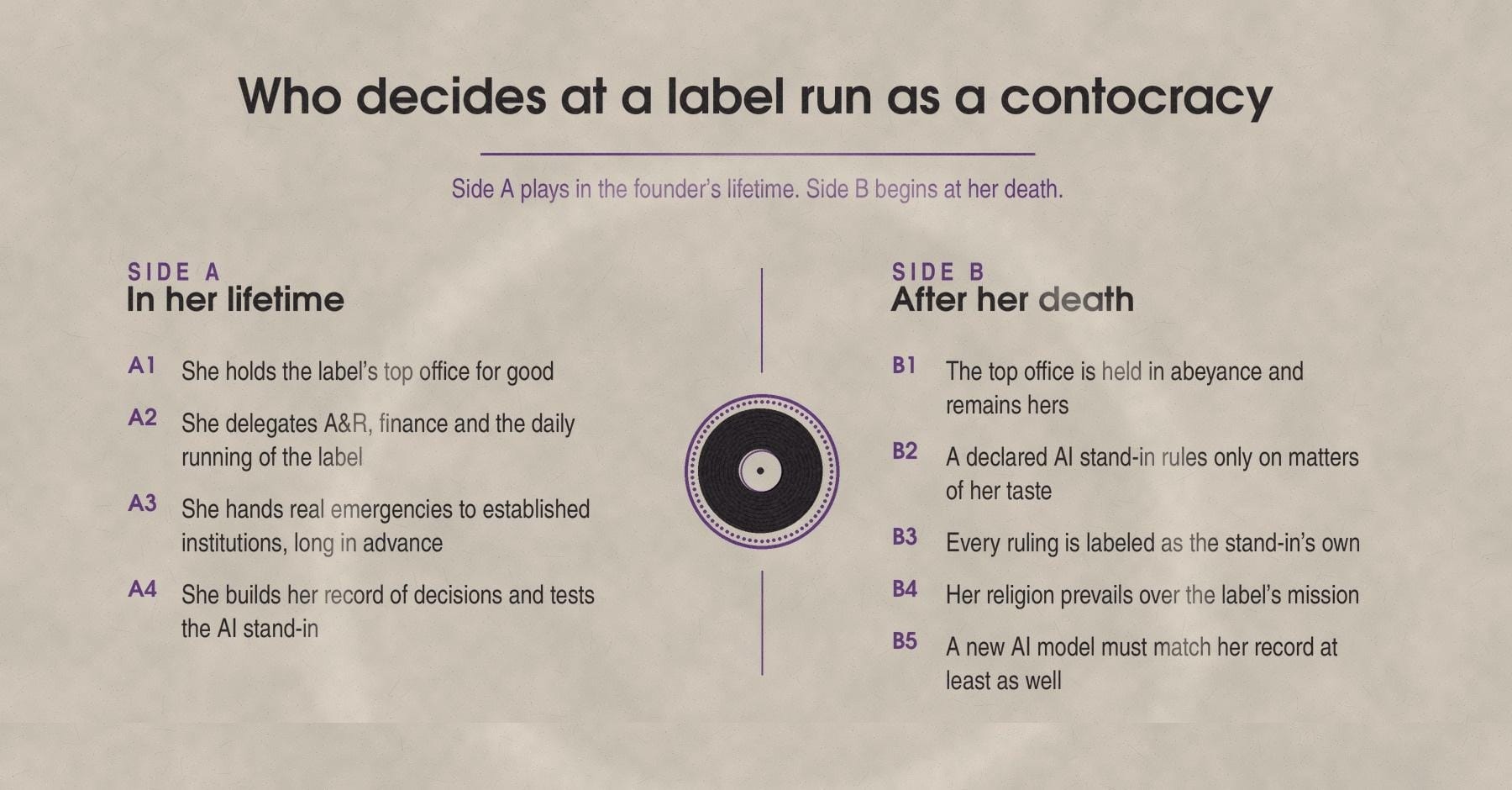
In a contocracy, one chosen person holds a community’s highest office for good. At Lamplight Hill, the label would formally choose Calderone as its contocrat.
Lower powers can be delegated, and she already delegates plenty: a general manager runs the business, an A&R team scouts artists, and a finance director signs the checks. The top office itself cannot be transferred, and no heir inherits it. When she dies, it is held in abeyance and remains hers.
She sets all of this up while she is alive. Over the years she builds the record: her approvals and rejections of mixes, masters, artwork and running orders, each with a short note on why. Ideally she assembles it all herself, though verified or minor material, such as family photos, can be added after her death.
She also tests the stand-in before she dies, for example by giving it last year’s release decisions blind and comparing its answers with her own. Real emergencies, from a warehouse fire to a security threat on tour, are not part of this job. She delegates those in life, long in advance, to established institutions that already handle them, such as the public authorities.
After her death, one declared AI stand-in acts by default; if she authorizes it, it can also act while she is alive but cannot be reached. Its job is narrow. It rules on what she would have wanted in matters of taste and preference, where the label’s mission, her religion and new technology meet, much as a founder’s design taste shapes a product.
It decides whether a remaster may be louder for streaming, whether a spatial mix may move a lead vocal off center, which vault recordings come out and whether anyone may add parts to them, and whether a new signing fits the house sound. It does not sing, write or perform. Everyone knows the stand-in, not Calderone, is deciding, and each ruling is labeled as its own, down to a credit line on the reissue.
Her religion prevails over the mission. The industry’s global release day is Friday, and Calderone has never released anything on Good Friday. When a single’s best date lands there, the stand-in moves it, as she always did, even if the streaming numbers argue otherwise.
AI models will keep improving, and the stand-in can be rebuilt or upgraded, but only on a model that matches her record at least as well as the one it replaces.
The strongest objections
The first is consent.
An artist who signs with Lamplight Hill in 2045 never chose Calderone, and neither did the songwriters whose work joins the publishing catalog later. The answer is disclosure: the form is written into every contract and shown on every credit, so each new artist signs knowing whose taste governs the catalog and that a declared stand-in applies it.
The second is oversight.
Here the stand-in’s limited role does most of the work. It rules only on preference, such as loudness, artwork, running orders and which tapes to release. Contracts, money, safety and emergencies are not its business; they stay with delegated staff and established institutions. Because every ruling is labeled, artists, critics and fans can judge each one in public. Who can formally challenge a ruling is still open, as is whether a living contocrat can step down, though anyone chosen for the role would more likely just delegate everything.
The third is novelty.
Formats will arrive that Calderone never heard, and a record of past choices may not settle every new case. Her record holds decades of her reactions to new formats, from her first streaming releases to the vinyl pressings she championed, and the stand-in is tested against it, but matching a record is a standard, not a guarantee. The narrow job keeps any miss small, and labeling makes every miss visible.
Through all of this, the stand-in rules openly and under its own name, and the office remains hers. For a label that wants its founder’s ear without pretending she is still in the room, that may be the most honest arrangement on offer.
Where to start
None of this needs to happen at once. A founder can start today by writing down why each call was made, not just what was chosen, and by testing an AI model against those notes while there is still time to correct it.
If you run a label you founded and want your taste to keep deciding, talk about contocracy by name with your team and your artists. And if you work with a founder who would make a good contocrat, send them this.
Note: I proposed the term contocracy. Funding: none.
Nicolas Edward Pendland is an independent scholar in the United States who writes about forms of authority that new technology makes possible, including contocracy.