

If you still think that the U.S. music market is a domestic, English-only fortress, it’s time to wake up. We are in the midst of a massive, permanent structural shift in how Americans consume music.
Q1 2026 data from Luminate confirms the U.S. streaming music market is rapidly diversifying, eroding the historical dominance of English-language tracks and transforming the country into a global music crossroads.
Driven by culture-defining moments like Bad Bunny’s historic Super Bowl Halftime Show performance and the full-force return of K-pop titans BTS, international sounds are no longer niche. They are the new mainstream.
For music marketers, managers, and live talent buyers, this isn't just an interesting stat; it’s an urgent call to overhaul your playbook.
Let’s break down what Luminate’s findings mean for the business.
Hard Data: U.S. Music Streaming is Diversifying
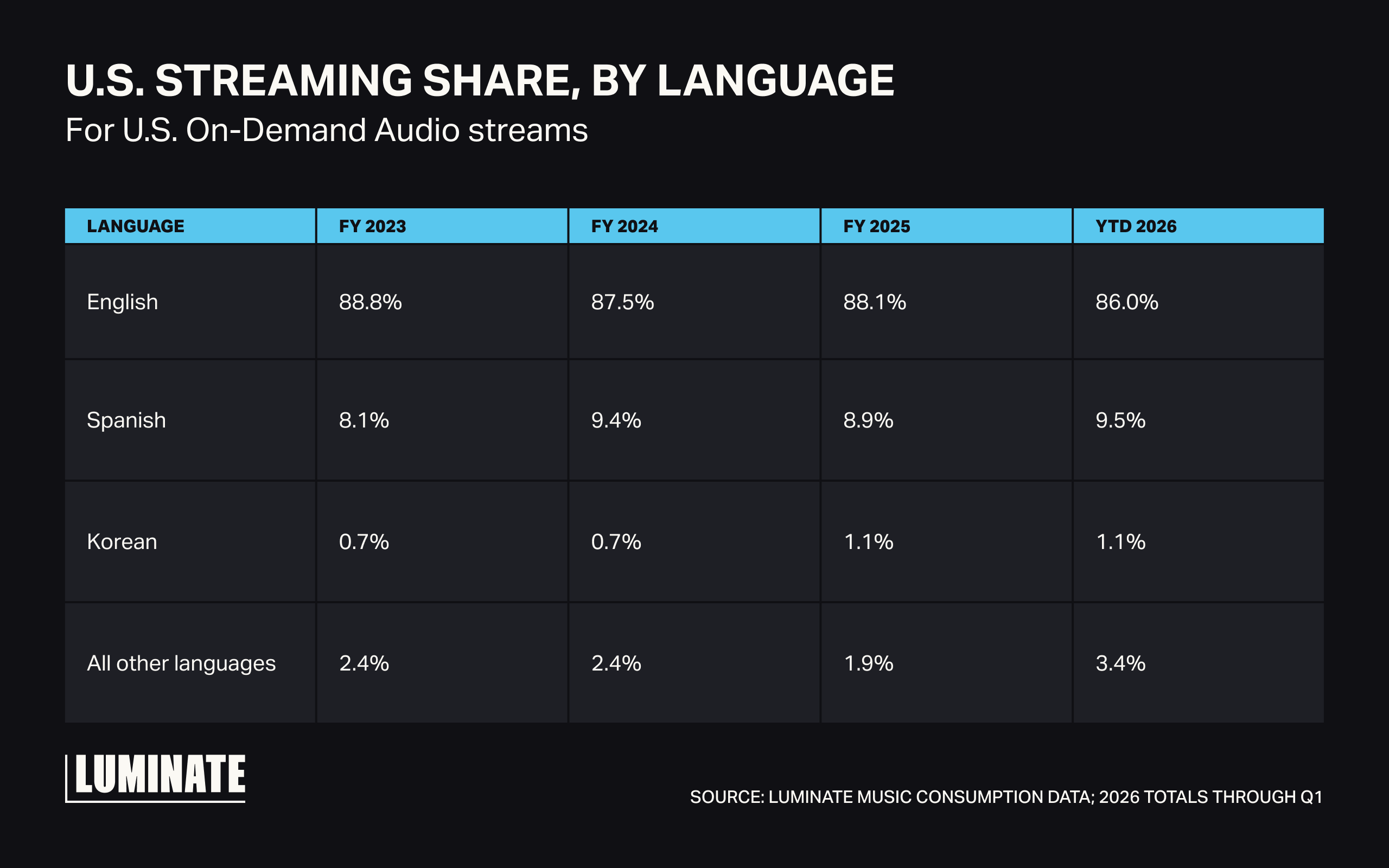
According to Luminate’s Q1 2026 "Beyond English: How the U.S. Music Streaming Market Is Diversifying," the domestic market share of English-language music is on a steady, long-term downward trajectory:
- English-Language Decline: Through Q1 2026, English-language music consumption in the U.S. fell to 86%, down 2.1 share points from 88.1% in Q1 2025.
- The Latin Boom: Spanish-language music now accounts for nearly 1 in 10 On-Demand Audio streams in the U.S., capturing a historic 9.5% market share. Boosted by Bad Bunny (currently the #2 overall ranked artist in the U.S.), Latin music hit an all-time high of 2.74 billion weekly U.S. streams during the week ending Feb. 12, 2026.
- K-Pop and Global Sounds: Korean-language streaming held a robust 1.1% market share in Q1, while all other non-English, non-Spanish, and non-Korean languages surged to 3.4%, up from 1.8% last year.
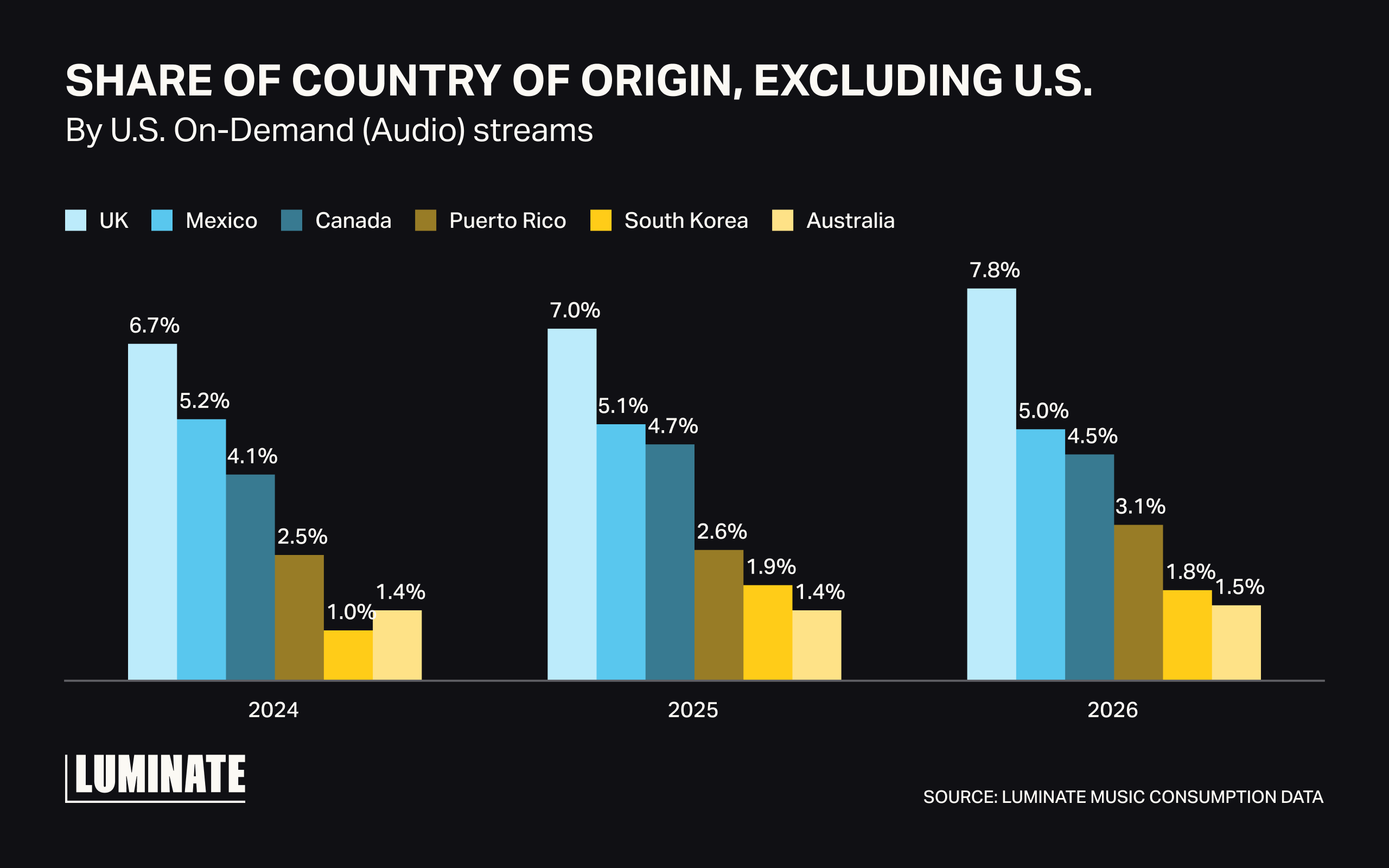
- International Anglo Gains: It’s not just non-English music gaining ground. Key international territories are chipping away at U.S. dominance, with gaining a UK market share increase of 0.8% led by breakout acts like Olivia Dean. There were notable U.S. market gains from Australia led by Tame Impala and Sweden led by Zara Larsson.
What This Means for Live Talent Buyers and Festival Promoters
For talent buyers, promoters, and festivals, the Luminate report offers a roadmap for booking profitable lineups in late 2026 and 2027.
Recalibrate Lineups for the "Casual Fan"
If 56% of U.S. music consumers are listening to Latin music, a token global act on a side stage at 2:00 PM will no longer cut it. Venues and festivals need to integrate Spanish, Korean, and global-language acts into prime, main-stage slots to draw the modern, younger ticket buyer.
Rewrite the Geography of Touring Routes
While major metropolitan areas like Los Angeles, Miami, New York, and Chicago remain obvious strongholds for international acts, the explosion of casual listenership means secondary and tertiary markets are now ripe for global music tours. Promoters who use localized streaming data to route international acts through non-traditional markets will find highly passionate, underserved fan bases.
Tap into High-Engagement Global Fandoms
Global music fans - especially in K-pop and Latin music - exhibit exceptionally high levels of consumer engagement. They don't just stream; they buy VIP packages, physical merchandise, and travel for experiences. Booking these acts provides live venues with a resilient revenue stream that protects against broader economic fluctuations in ticket sales.
What This Means for Music Marketers
Historically, the U.S. acted as a linguistic gatekeeper. International artists had to adapt to Western styles or sing in English to get on the radio or land on major playlists.
Today’s decentralized streaming infrastructure has completely bypassed that barrier.
Shift from Subculture to Mainstream
Luminate’s consumer research reveals that casual monthly listenership of Latin music in the U.S. skyrocketed from 41% in early 2024 to 56% in Q1 2026. This means more than half of the American population now casually listens to Latin music. Marketers can no longer isolate global sounds to specific heritage months or hyper-targeted geographic campaigns. Your core demographic are officially polyglots.
Lean into Cross-Border Collaborations & Multilingual Campaigns
Marketing and A&R teams must prioritize international scouting and cross-border collaborations. If more than half of your target audience listens to music in multiple languages, your brand partnerships, ad creatives, and social media campaigns need to reflect that multicultural reality.
Optimize for Hyper-Localized but Borderless Discoverability
With AI-driven search engines and algorithmic recommendations guiding fan discovery, your metadata and SEO strategies must look beyond domestic borders. Ensure your global tracks are optimized with multi-language tags, localized press releases, and targeted digital marketing that taps into international fan hubs within the U.S.
Read the full report free here.
Hypebot's Bottom Line
The American music ecosystem is no longer monolithic. It is global, diverse, and uniquely decentralized.
The old playbook of waiting for a record to clear domestic radio hurdles before booking a tour or launching a marketing campaign is dead.
As we await Luminate’s broader Midyear Report on July 15, "Beyond English: How the U.S. Music Streaming Market Is Diversifying" makes one thing very clear: those who adapt to the new polyglot demographic will thrive, and those who stick to the old, English-only model will be left behind.
Get all the latest Music Industry & Live Music News updated continuously from across the web under the Hypebot Industry News tab here.