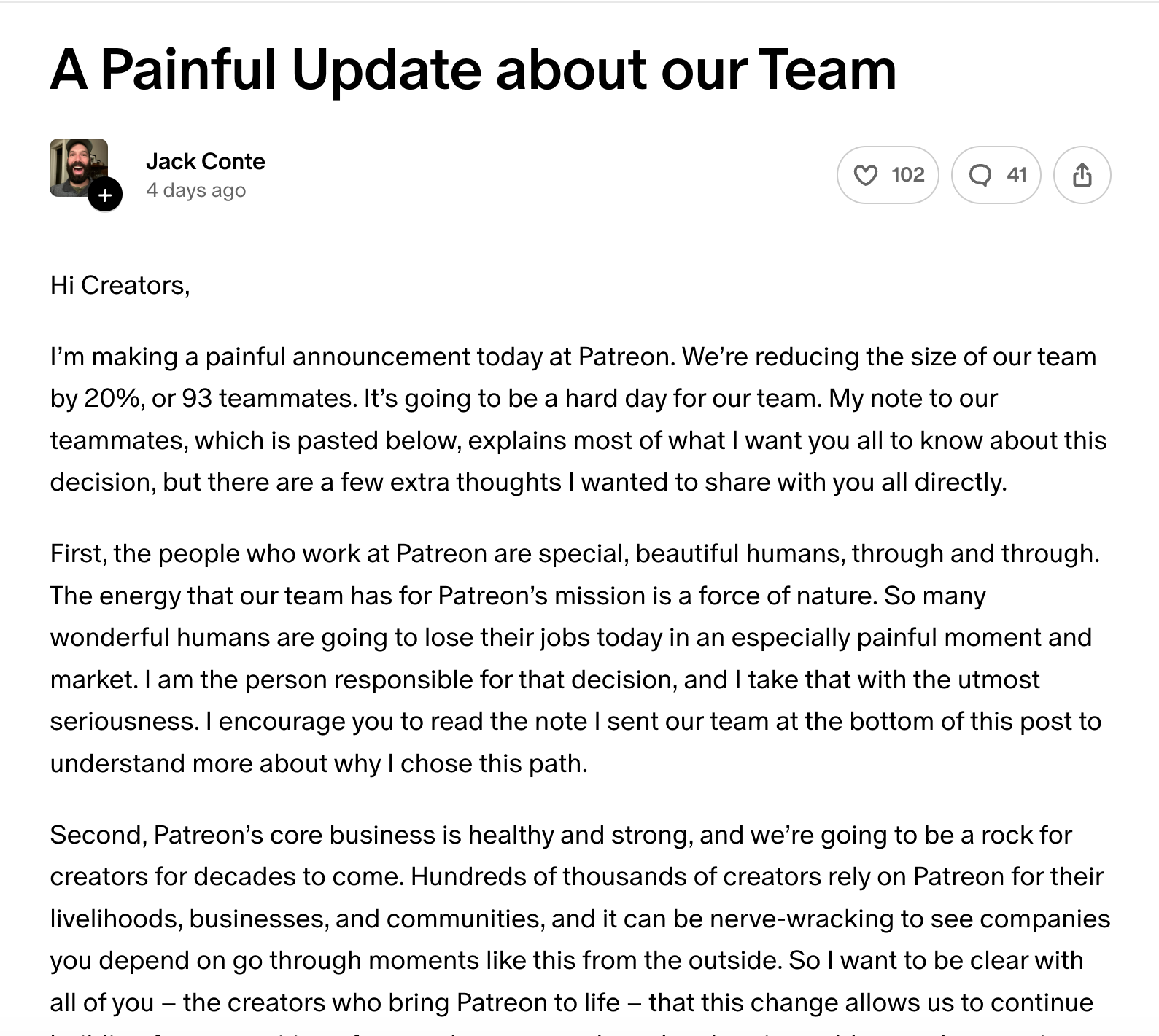
Patreon is cutting one-fifth of its workforce at a moment when its direct-to-fan business appears to be moving in the opposite direction.
The membership and creator-commerce platform laid off 93 employees on July 23, its largest workforce reduction to date. CEO and co-founder Jack Conte described the decision as painful but necessary, saying Patreon must reduce costs and reorganize itself to remain dependable amid a rapidly changing technology market.
At first glance, the announcement could look like another sign of trouble in the creator economy. Patreon says that is not what is happening.
In a message to employees and creators, Conte called Patreon’s core business “healthy and strong.” More than 300,000 creators currently earn money through the platform, with creators collectively generating billions of dollars annually. Patreon also says its membership, revenue and payment-processing volume continue to grow each month.
Private-market research firm Sacra estimates that Patreon generated $179 million in revenue during 2025, representing 28% year-over-year growth, according to Music Business Worldwide.
That makes the layoffs more notable. Patreon is not shrinking because fans have stopped supporting creators. It is shrinking while that support continues to expand.
+Read more: "15 Must-Have Tools to Market Music and Grow a Fan Base"
AI is not the reason — but it is part of the story
Conte explicitly rejected the idea that Patreon eliminated jobs because AI could simply replace the affected employees. He argued that artificial intelligence cannot substitute for human creativity, judgment, craftsmanship or the desire for human connection—the same qualities on which Patreon’s entire business depends.
Still, he acknowledged that AI has changed how the company builds products, communicates and organizes its workforce.
Patreon will now operate with a flatter organizational structure, fewer employees and teams more tightly focused on improving the creator and fan experience. Conte previously told The Verge that the company was “100 percent embracing” AI internally, warning that Patreon could be obsolete within three years if it failed to adopt the technology.
There is an obvious tension here. Patreon is defending human creativity as the foundation of its platform while using AI-driven changes in the technology business to help justify a leaner operating model.
Earlier in July, Patreon partnered with Cloudflare to block unauthorized AI crawlers from scraping creators’ work for training purposes. Its emerging position appears to be that AI should assist the businesses supporting creators without replacing (or freely consuming) the human work those businesses rely upon.
Direct-to-fan still depends on platforms
For independent musicians, Patreon’s growth remains encouraging. Recurring memberships, exclusive releases, digital products and fan communities can provide income that does not depend entirely on streaming volume, algorithms or touring.
But the layoffs offer an important reminder: “direct-to-fan” does not mean independent of technology companies.
Artists may have a closer relationship with their audiences, but the platforms facilitating those relationships still have investors, expenses, reorganizations and changing priorities. Patreon says its roadmap is staying intact and that the cuts will help it remain stable over the long term.
For creators building livelihoods on the platform, that promise matters. Direct fan support may be growing, but the infrastructure behind it is entering a leaner and increasingly AI-shaped era.
+Read more: "How Music Fans Are Becoming Parallel Creators (Sustainably)"

![New Bandcamp Layoffs: Why Artists Are Worried and Where to Turn [UPDATE]](https://storage.ghost.io/c/3a/95/3a957c06-c825-4057-9939-0a274cc16d23/content/images/size/w1304/format/webp/2026/07/Gemini_Generated_Image_5r7nps5r7nps5r7n.png)