

The music industry usually goes looking for trends where audiences are already listening. But by the time a new sound appears on streaming charts, producers may have spent years quietly building it.
That is the most useful finding in Made First, Heard Second, a new joint report from Chartmetric and Splice examining how hybrid genres emerge, travel and enter the mainstream. By combining Chartmetric’s artist and listener data with Splice’s creator searches and downloads, the report captures both ends of the process: how music is made, and how it is eventually heard.
Its conclusion is not simply that genre boundaries are disappearing. It is that new genres are being assembled from the inside out — and the creative process may offer an earlier view of music’s future than streaming data can.
The Biggest Genres Are Losing Ground
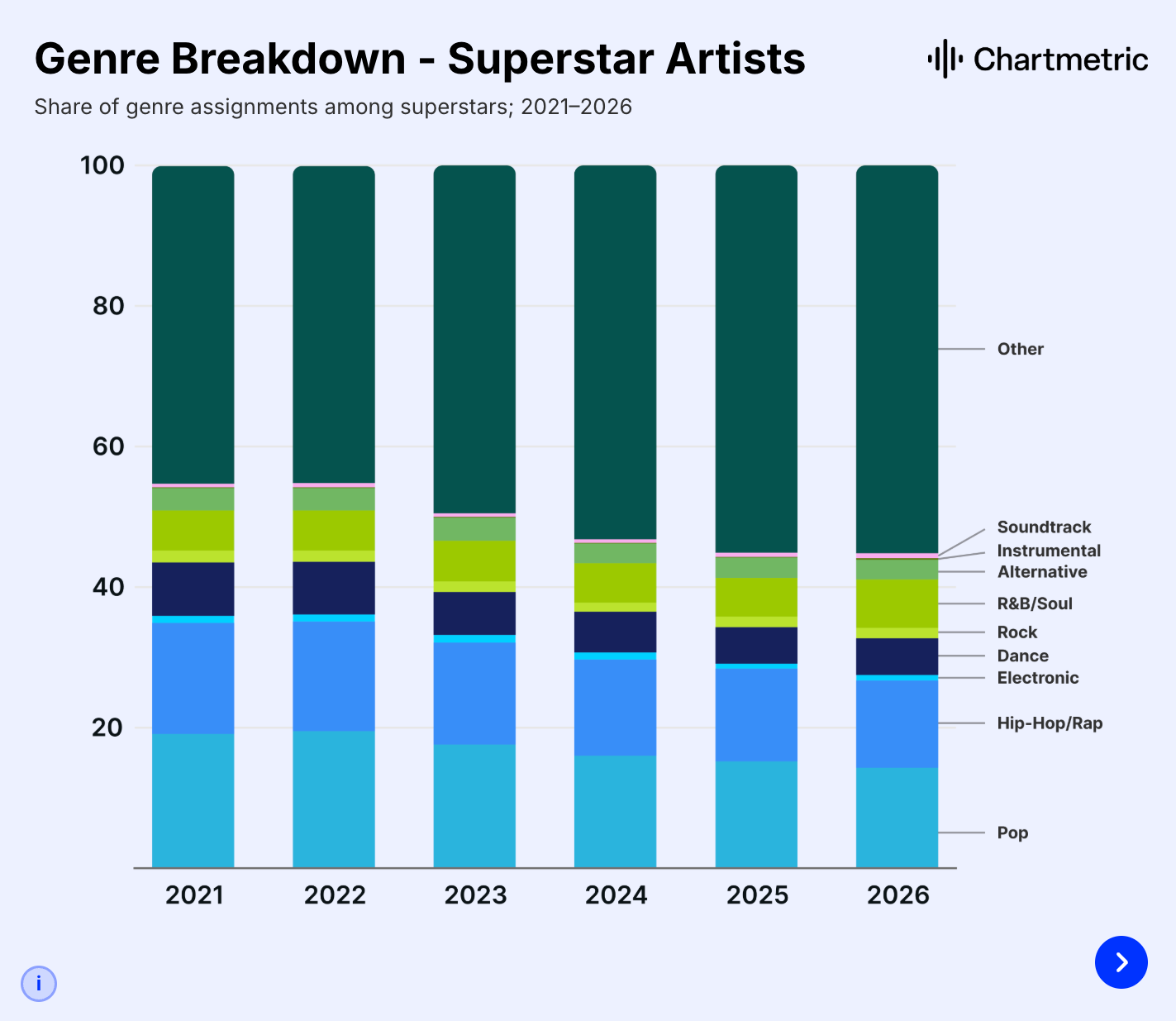
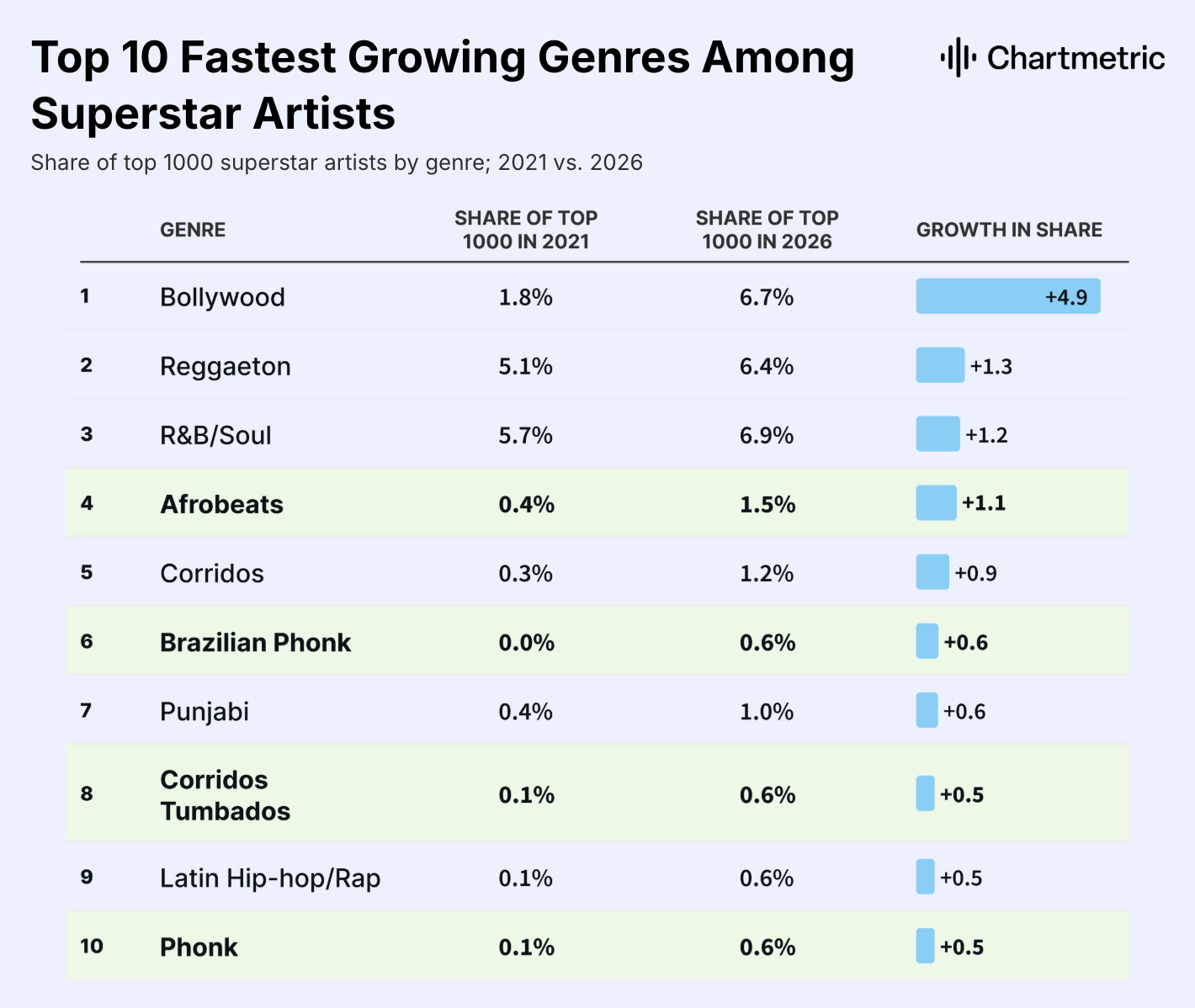
According to the Chartmetric and Splice report, the top 10 major genres accounted for 46% of genre assignments among superstar artists in 2021. Yet by 2026, that share had fallen to 35%.
The shift is even more pronounced among mid-level artists, where the top genres’ share declined from 39% to 27% over the same years.
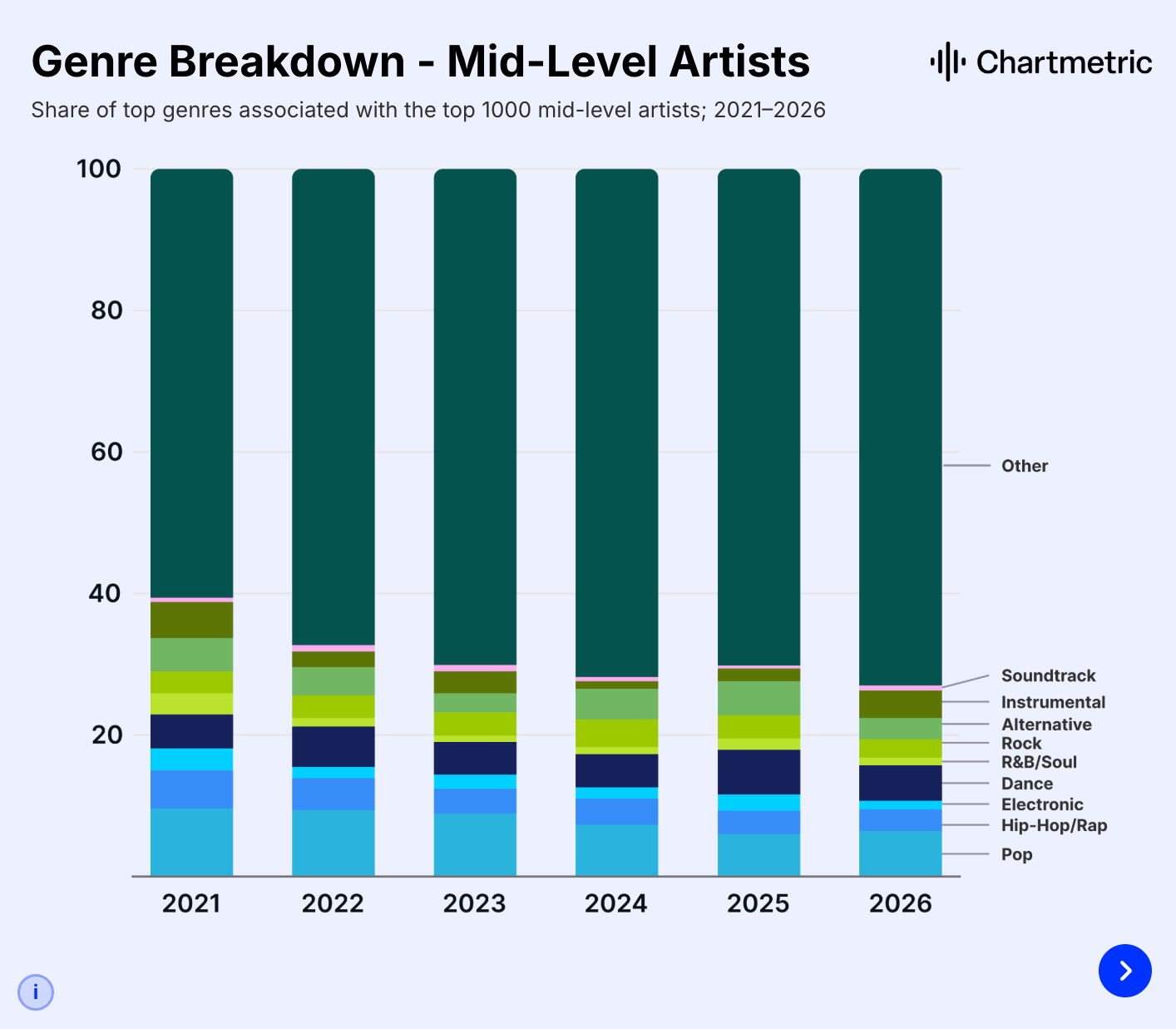
That does not mean Pop, Rock, Hip-Hop or Country are disappearing. It means more artists are being classified within the report’s broad “Other” category, which includes niche, regional, international, and emerging sounds. In 2026, it represented 55% of genre assignments among superstar artists and 73% among mid-level artists.
Importantly, those figures measure genre assignments (ie: not streams or market share). The report is documenting a diversification of the artist landscape, not the collapse of mainstream music. Producer behavior points in the same direction. On Splice, 57.5% of sample-pack downloads now fall outside its 10 leading genres, compared with 48% in 2021.
The average Splice user also downloads sounds from nearly 52 genres annually, up from fewer than 30 in 2018 — a 74% increase in seven years. The building blocks are becoming hybridized before the finished songs reach listeners.
+Read more: "Explaining the Wide Gap Between Country Stars and Everyone Else"
Producers May Be Music’s Early Warning System
This is where the findings become especially valuable to independent artists, managers and A&R teams.
Creator activity sometimes rises years before a genre registers among mainstream artists. Splice searches for Hyperpop grew 43% from 2022 to 2023, another 55% the following year and 37% after that. Search volume tripled between 2022 and 2025 before the sound became firmly established in Chartmetric’s superstar-level data.
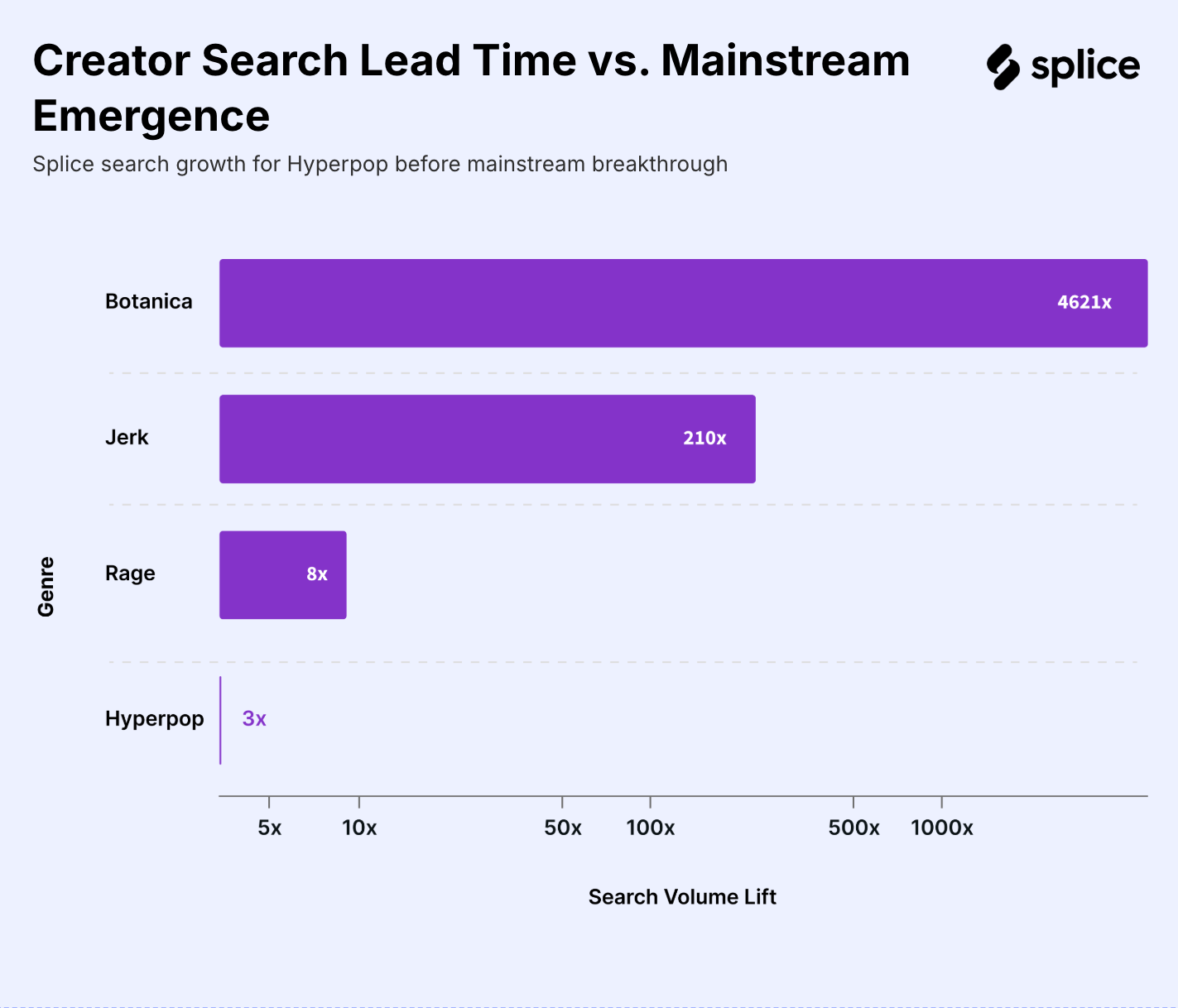
Afro House followed a similar trajectory. Splice search demand increased 134% from 2022 to 2023 and 437% the following year before the genre appeared among superstar artists in mid-2024. The report also identifies substantial search growth for still-emerging sounds including Botanica, Jerk, and Rage. None has yet produced equivalent superstar-level activity, meaning creator interest should be treated as a signal rather than a guaranteed prediction.
Still, the broader idea is compelling: If streaming analytics describe what listeners already want, production data may reveal what musicians are preparing to give them next.
The relationship also runs in reverse. Once Amapiano broke globally, creator searches surged as more producers attempted to understand and reinterpret the sound. Discovery becomes imitation, imitation becomes mutation, and the genre continues evolving.
Not Every Hybrid Genre Travels the Same Way
The report classifies 95 of the 151 genres represented among Chartmetric’s superstar artists as hybrids, separating them into two groups.
“Regional hybrids” combine styles within a particular cultural or geographic context. Although they can reach global listeners, their strongest audiences frequently become more concentrated in their home markets as they grow.
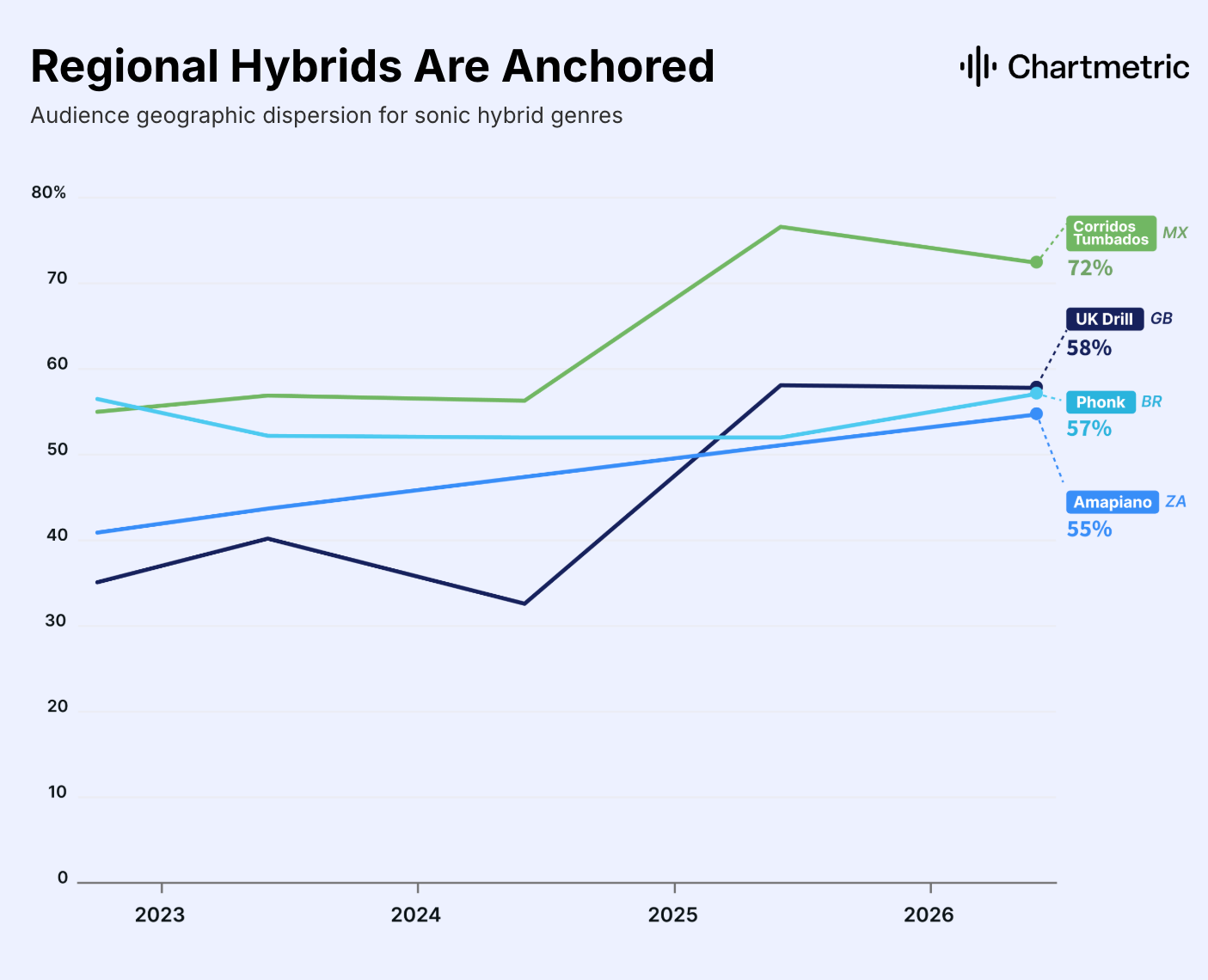
Corridos Tumbados combines Mexican Corrido traditions with trap and contemporary production. Mexico’s share of its Spotify audience grew from approximately 55% in 2022 to 72% in 2026, even as the genre became an international phenomenon.
Amapiano’s South African listener share increased from 41% to 55% during the same period, while UK Drill’s British audience grew from 35% to 58%.
“Sonic hybrids,” by contrast, are organized around an aesthetic or online community rather than one geographic home. Afro House, Hyperpop, Lo-fi, Jungle and Breakcore maintain more geographically dispersed audiences.
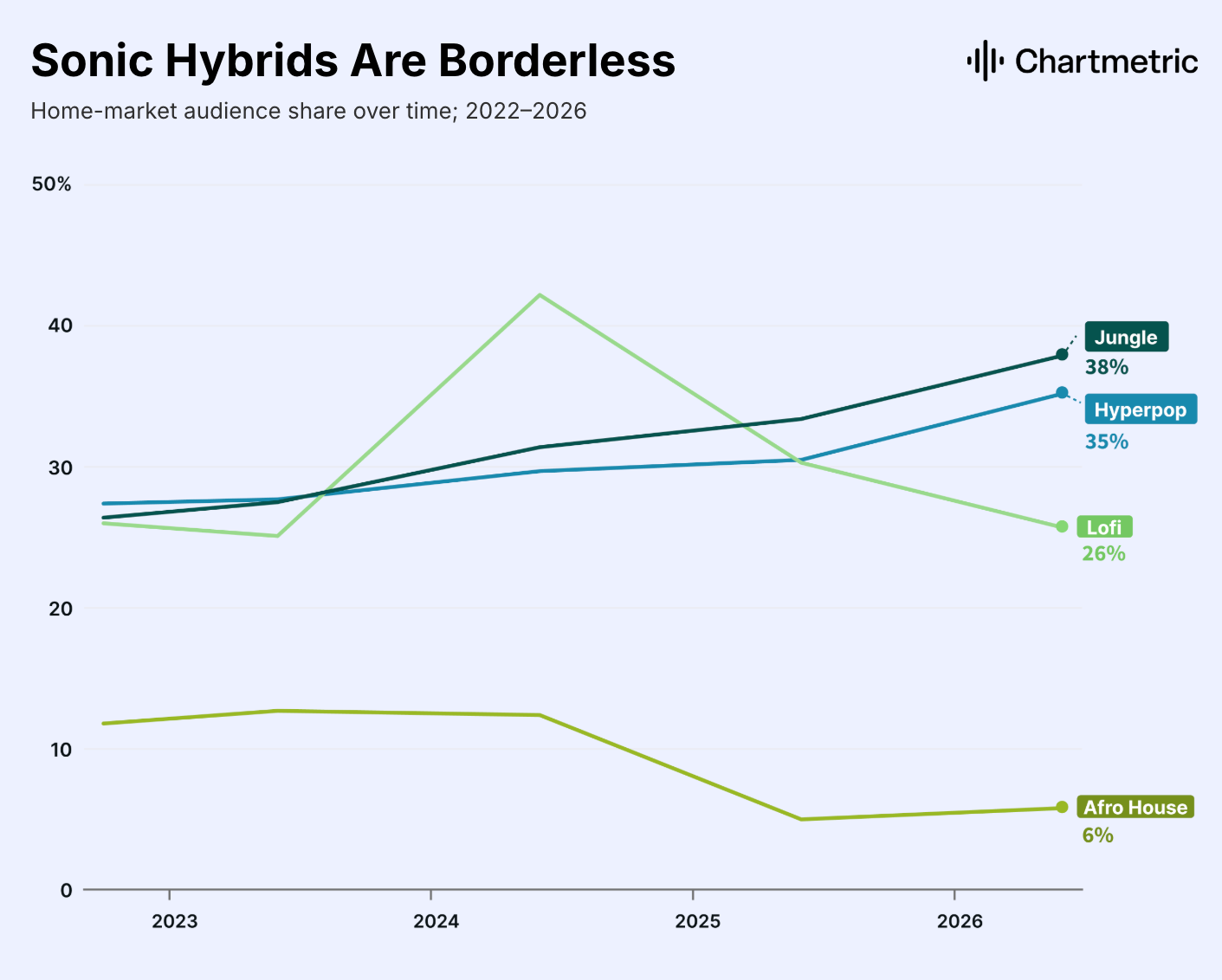
That distinction has practical implications. A regional hybrid may benefit from deep cultural roots and a strong home-market strategy. A sonic hybrid may grow through collaborations and online communities scattered across several countries.
+Read more: "World Cup 2026 Is FIFA's Most Musical Tournament to Date"
YouTube Spreads the Sound. Spotify Shows Where It Sticks.
The report also finds a revealing difference between platforms. Audiences for regional hybrids tend to be more geographically dispersed on YouTube but more concentrated on Spotify. Corridos Tumbados shows the widest gap, followed by Phonk, Amapiano, and UK Drill.
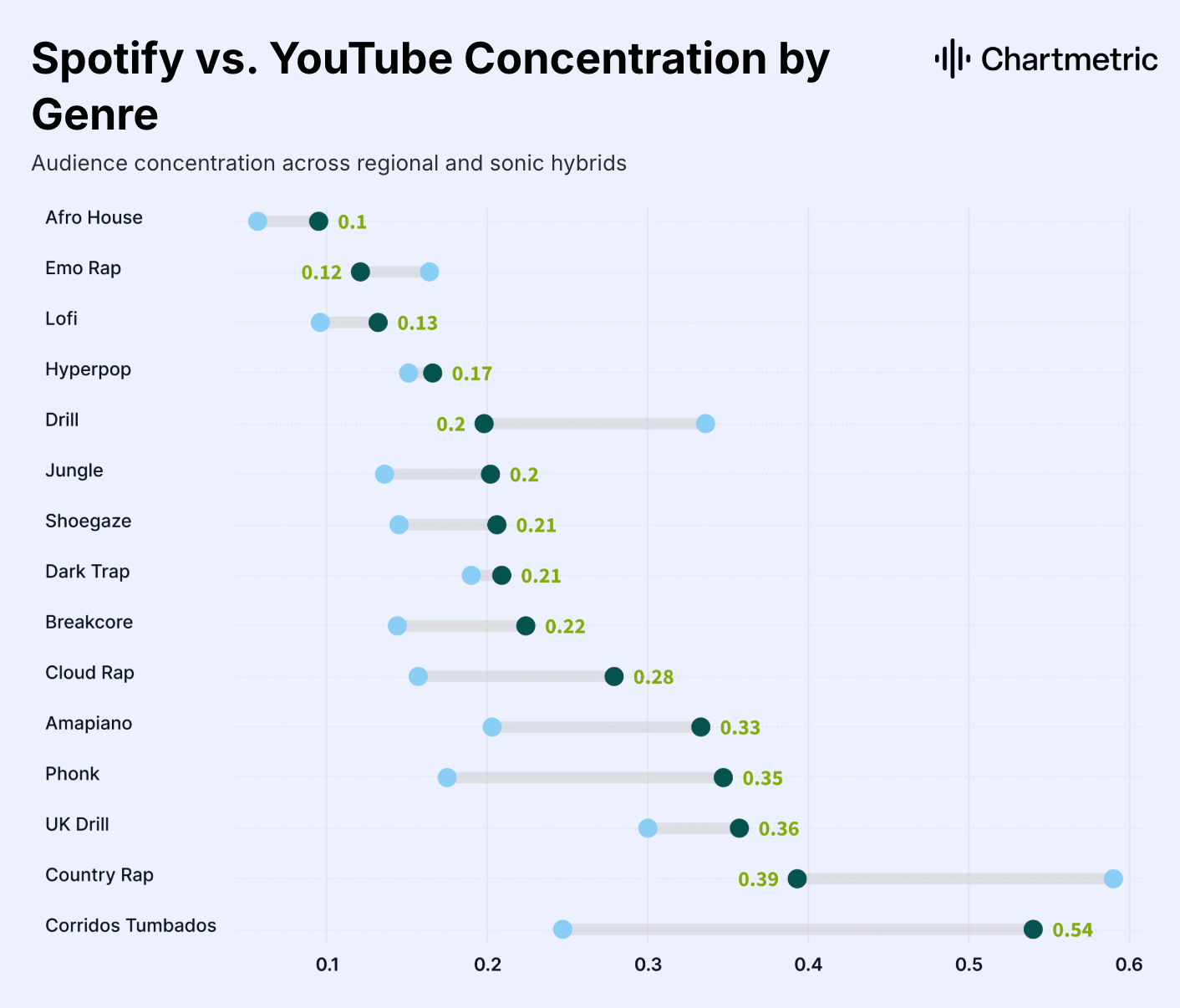
Chartmetric and Splice interpret YouTube as a measure of where a sound is being encountered, while Spotify more clearly shows where it has entered regular listening habits.
For independent artists, that is an important distinction. A globally distributed video audience does not necessarily mean a genre has developed equally committed fan communities everywhere. YouTube may create visibility; Spotify can reveal where curiosity is becoming repeat consumption.
Genres Aren’t Dying. They’re Multiplying.
In all this, it's fair to say that music may no longer be moving toward one dominant “next big genre.” Instead, dozens of highly specific sounds can grow alongside one another. Some combine regional traditions with contemporary production. Others revive older aesthetics for a new online generation.
Eventually, the fastest-growing hybrids mature into established scenes and make room for another wave of experimentation.
If you're an artist, that does not mean chasing every fast-rising tag or forcing unrelated influences into a song. It means recognizing that genre is becoming less of a creative restriction and more of a navigational tool — a way to find collaborators, communities and listeners.
The streaming charts still tell us what music has arrived. But the first signs of what comes next may be found in what producers are searching for before anyone knows what to call it.
+Read more: "The Data Behind the Expansion of Languages in the US Music Streaming Market"