


By Neil Shah (CEO, MusicAtlas) and Apolline Reymond (Founder, SoundsPro)
Music catalog acquisition has become increasingly sophisticated. Buyers have access to detailed royalty histories, financial models, legal diligence, rights databases, streaming analytics, and specialized advisors capable of examining an asset from nearly every conceivable angle.
But that sophistication arrives late in the process.
By the time a serious acquisition reaches diligence, a buyer may deploy lawyers, accountants, administrators, financial analysts, and rights specialists to determine exactly what is being acquired and what it should be worth. That work is necessary, but expensive and time-consuming. Which raises a simpler question at the other end of the funnel:
How much should you need to know before deciding a catalog is worth knowing everything about?
We recently explored that question using one of the most recognizable music assets imaginable: Bruce Springsteen’s Born in the U.S.A. What we found wasn’t an argument for more diligence. It was an argument for sequencing diligence more strategically.
Sony reportedly paid approximately $500 million for Bruce Springsteen’s masters and publishing catalog in 2021. We didn’t attempt to reverse-engineer that transaction. Instead, we used Born in the U.S.A. as a test case for a problem that exists at virtually every scale of music acquisition: buyers have limited time, analyst capacity, and diligence budgets.
Deep diligence is valuable precisely because music rights are complicated. A technical rights audit of even a relatively small catalog can cost thousands of dollars, while the legal, accounting, financial, and technical diligence surrounding an institutional acquisition can be considerably more expensive.
So perhaps the first question shouldn’t be, “Should we spend thousands of dollars auditing this catalog?”
The more useful question comes earlier: “How can we quickly understand whether this catalog is worth a deeper look?”
That distinction matters when a buyer isn’t evaluating one opportunity, but dozens or hundreds. You cannot investigate every asset with equal intensity. The acquisition process isn’t only a valuation problem. It’s a resource allocation problem.

At MusicAtlas, we analyzed Born in the U.S.A. using acoustic analysis alongside market signals including streaming persistence, cultural relevance, search behavior, UGC and short-form activity, licensing signals, historical transaction data, and long-tail performance patterns.
The interesting result wasn’t simply a valuation number. It was the shape of the asset underneath it.
Value was distributed across multiple works rather than residing exclusively in the title track. Different songs displayed different economic characteristics. That raises questions a headline streaming count or simple multiple can’t fully answer:
- How concentrated is the catalog’s value?
- Is demand persistent or fading?
- Does it have meaningful licensing potential?
- How does it compare with assets that have historically commanded premium valuations?
Those questions don’t replace royalty statements. But they can help determine which opportunities deserve the time and money required to answer the harder questions that follow. From a distance, Born in the U.S.A. is simply a famous 12-track album released in 1984. From a rights perspective, that simplicity quickly disappears.
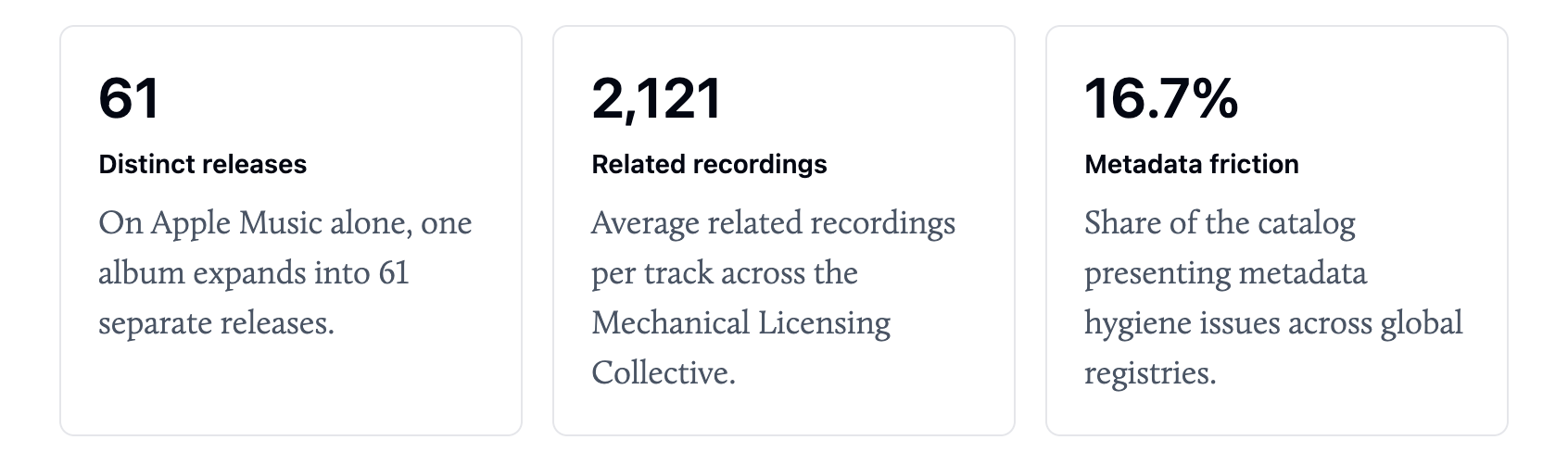
When SoundsPro examined the album’s underlying rights infrastructure, those 12 tracks expanded into 61 distinct releases on Apple Music alone. Across the Mechanical Licensing Collective, the analysis identified an average of 2,121 related recordings per track. And 16.7% of the catalog presented metadata hygiene issues across global registries.
A successful song doesn’t remain one song attached to one clean database record. Over decades it accumulates remasters, compilations, reissues, covers, alternate releases, identifiers, administrators, and relationships across different rights systems. Each manifestation can extend the commercial life of the music. It also expands the administrative surface surrounding it.
Suddenly the asset being acquired isn’t merely twelve songs and their associated cash flows. It’s a network of registrations, identifiers, recordings, ownership relationships, and administrative obligations built up over decades. That complexity is often a consequence of success. But it also argues for understanding what sits beneath the financial abstraction before assigning too much confidence to it.
The goal shouldn’t be to subject every opportunity to the deepest possible analysis. It should be to apply the right kind of intelligence at the right point in the decision. Early in the funnel, buyers can screen broadly: analyze demand, understand value concentration, look for durability, evaluate licensing characteristics, compare opportunities, and model different scenarios.
+Read more: "Your Song Is the Starting Pistol, Not the Finish Line"
Once an asset warrants serious consideration, go deep. Map registrations. Verify ownership relationships. Examine ISRC-to-ISWC connections. Identify metadata friction. Look for potential collection gaps. Understand the administrative burden that comes with the rights.
Only then should those perspectives converge with royalty histories, financial analysis, legal diligence, and dealmaking. The music industry doesn’t suffer from a shortage of data. The harder problem is deciding what information matters when.
If every potential acquisition requires expensive forensic analysis before a buyer can determine whether it is interesting, the acquisition funnel becomes unnecessarily narrow. If buyers rely only on reputation, historical royalties, headline streaming numbers, or simple multiples, they risk discovering important characteristics too late.
Technology shouldn’t replace the lawyers, accountants, administrators, analysts, relationships, and judgment that music transactions depend upon. It should help buyers decide where those scarce resources are most valuable.
That’s what Born in the U.S.A. showed us. From a distance, we could see demand, durability, concentration, licensing potential, and economic value. Up close, the same twelve songs became dozens of releases and thousands of related recordings connected through a much more complicated rights infrastructure.
A sophisticated buyer needs both views. The answer isn’t more diligence. It’s evaluating catalog value in the right order.
+Read more: "The 10 Most Valuable Artist Music Catalogs (for Now)"
NOTE
This OpEd draws on research conducted jointly by MusicAtlas and SoundsPro using Bruce Springsteen’s Born in the U.S.A. as a case study. The full research and methodology, including MusicAtlas’s commercial valuation analysis and SoundsPro’s technical rights analysis, are available in A Framework for Modern Music Catalog Acquisitions.
Neil Shah is the founder and CEO of MusicAtlas, a music search and catalog intelligence platform. He is a Grammy-nominated musician and technology executive whose background spans music, product, design, and company building.
Apolline Reymond is the founder of SoundsPro and a product, automation, and data specialist focused on building practical systems for complex operational workflows. Her background spans music technology, large-scale catalog ingestion, product operations, and program management.