

Co-Authored by Yaroslav Sizov of Muse Group & Solveig-Marie Oma
A concert is in two weeks. Suddenly, the conductor arrives with last-minute changes. A section has been shortened, dynamics have been adjusted, and several entries need to be corrected before the performance. For most musicians, this creates stress.
For a blind musician, it adds an entirely different layer of complexity.
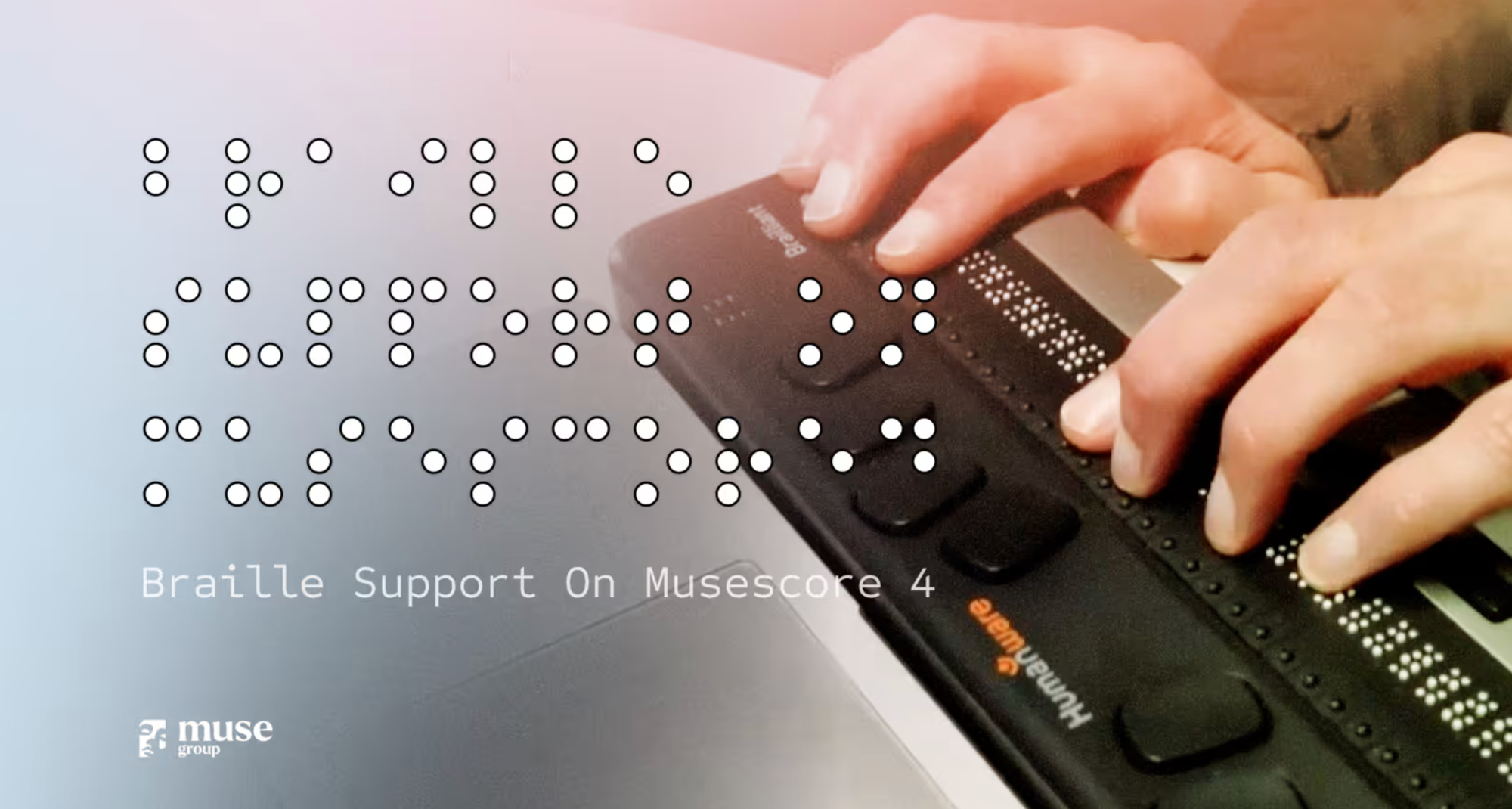
The preparation starts at a computer: finding the right file with scores, converting it into music Braille, and reading it one measure at a time on a refreshable Braille display, or embossed onto paper. By the time the first rehearsal begins, the part has to be in memory – a laptop and a screen reader are not things you bring to a music stand.
This shifts where the work happens. For sighted musicians, a lot of learning takes place with the score on the stand, during rehearsal. For blind musicians, a lot of it happens before – and how smoothly it goes depends on whether the digital tools in between actually behave the way they're supposed to.
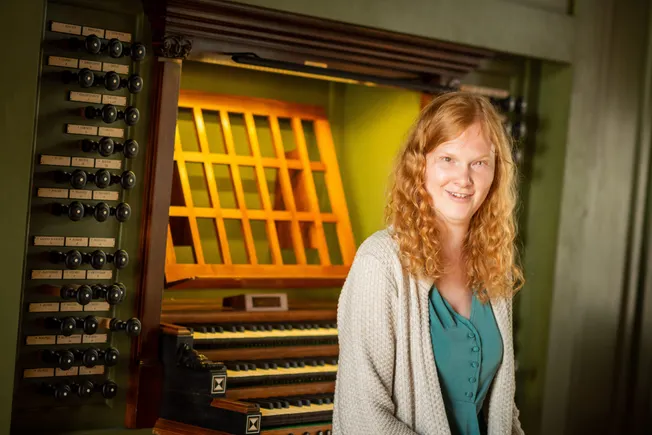
This is a daily reality of professional musicians without sight like Solveig-Marie Oma. She is originally from Norway. After losing her sight at the age of seven, she started playing piano, and switched to church organ a few years later. She later on graduated as a church musician. By fourteen, she had learned Braille music notation – something she now considers essential for working independently in classical music. Before that, she relied partly on learning by ear and partly on having music explained.
Today, she lives and works in Germany. Her freelance work spans organ playing for services and concerts, teaching music Braille, and consulting on accessibility. Two larger projects currently take up much of her time: ongoing work on music Braille with the DAISY Consortium, in cooperation with MuseScore and others, and a Norwegian initiative to make the country's hymnal accessible. In her spare time, she sings in a choir.
At first glance, the daily work of a blind music teacher or conductor may not seem very different from that of any other musician. The tasks remain the same: reading scores, preparing lessons, editing arrangements, organizing rehearsal materials, and learning large amounts of music under time pressure. The difference is that blind musicians often experience notation sequentially, moving through the music piece by piece using speech output or Braille.
Digital scores have become central to that process. Solveig-Marie often turns to services like MuseScore to find MusicXML files, which she then converts into music Braille using external tools. From there, the score can be read on a refreshable Braille display or embossed onto paper for use at the instrument. MuseScore Studio itself is something she is still learning, and uses primarily for composing and editing rather than for performance – but many blind and visually impaired musicians already rely on it for composing and teaching.
She explains:
“If I suddenly need an organ piece for a concert in a couple of weeks, it could already be too late to order a Braille score.”
Despite technological advances, many of the challenges still remain surprisingly basic. Music notation is fundamentally visual. Blind musicians cannot glance across multiple staves or quickly compare sections of a score. Braille music is linear by nature, meaning information must be processed sequentially rather than visually all at once.
Sometimes even smaller issues that don’t seem dramatic may cause inconvenience: an unlabeled button, inconsistent keyboard navigation, inaccessible PDFs, or poorly structured rehearsal materials.
Artificial intelligence may help change some of that. Solveig-Marie sees strong potential in AI-powered note recognition and score conversion, particularly when working with printed or PDF scores. She is also interested in AI-generated vocal tools that could make choir rehearsals easier for blind singers by delivering lyrics clearly alongside rehearsal tracks.
The problem is simple: when you receive only an audio file, there is no way to know precisely where a word falls in the phrase, where a syllable shifts on a melisma, or when a new line begins. In a large choral work – Bach, for instance – that disconnect between text and music doesn't just slow down learning. It can make independent preparation almost impossible, leaving singers dependent on someone else to walk them through the placement by ear.
AI-generated singing or lyric guidance could make learning music from audio alone easier.
However, for Solveig-Marie accessibility is less about futuristic technology and more about smaller day-to-day needs: being able to open a score, find the right measure, and make the correction before the rehearsal ends. Whether or not the last-minute changes before tomorrow's concert go smoothly will depend less on any new technology than on whether the tools already in use were built with them in mind.
Background: Accessibility Features in MuseScore
MuseScore Studio became the first mainstream music notation software to support live Braille translation and six-key Braille note input. These features were developed in partnership with the DAISY Consortium and Sao Mai Center for the Blind.
The software’s Braille view displays music notation in real time inside a dedicated panel below the score, allowing blind users to navigate music one measure at a time using refreshable Braille displays. MuseScore also supports Braille note entry using six keyboard keys (S, D, F, J, K, L), alongside keyboard navigation and screen-reader support.
You can find more info here.
Solveig-Marie Oma is a professional organist, music educator, and Braille music consultant.
Yaroslav Sizov is Head of Design and Brand at Muse Group, responsible for customer experience across its products, with accessibility key to creating a barrier-free digital environment for every musician. Previously, he led design for a banking app with 80M+ monthly users.