

By Jenny Morrison
In an industry where so many artists are screaming for attention across multiple platforms, music discovery is certainly a hot topic of discussion.
One of the most crucial tools for music discovery is Spotify playlists. Spotify itself says playlists are responsible for breaking thousands of artists. While Spotify curated playlists account for a significant portion of discovery, user-created playlists are still massive and eliminate the algorithmic gatekeeping of DSP playlists.
Getting featured on these user-generated playlists is so important for boosting a track's API (or Popularity Index), which can be a serious catalyst for gaining attention on Spotify. We can really break down music discovery on Spotify to three gatekeepers:
- Spotify editorial
- Spotify algorithm
- Independent playlist curators
Here we’re going to discuss how to pitch to the most accessible: independent playlist curators.
First, Do Some Research
Spotify announced that listeners have created nearly 9 billion playlists. That’s… overwhelming, but the good news is that your artist’s music doesn’t belong on all of them.
Heck, they don’t even belong on every playlist for their genre, just the important ones. The key here is to research. The first steps are to identify 3-5 artists that your artist is for fans of. (FFO) Then you’ll want to find user-created playlists that feature those artists. Another great research category might be by vibe, which is a little harder to define.
Many playlists are created for specific activities such as "cleaning," "driving," or even "focus." Just really consider the vibe of your music.

+Read more: "5 Signs a Spotify Playlist Is Fake (and How Playlist Bot Checkers Actually Work)"
Each playlist should ideally contain at least 20 tracks and your artist’s music should fit with both the vibe and the flow of the playlist. Think about it: if the playlist is all slow jams and you’re pitching a super upbeat song, well, you missed the mark. If the playlist is all chick lead singers and you’re pitching your boy band, your message is going to be ignored.
Ideally, you should make a list of playlists that would be a great fit for your artist. I keep mine in an Excel spreadsheet labeled by Playlist Title, Link, and Contact Info.
As a niche playlist curator, I have dozens of popular playlists featuring exclusively instrumental orchestral music. And you know what I get pitched nearly daily? Songs with vocals.
What an absolute waste of my time and theirs. I usually don’t respond because it’s not worth the effort. Sometimes I block them. But imagine if a music industry gatekeeper blocked you because you couldn’t be bothered to listen to a few minutes of a playlist. That would never be you, of course.
Don't Forget to Add Contact Information
Arguably the most challenging part of this endeavor is finding contact information for this playlist curator. You need somewhere to actually send this pitch after all. These are the three best practices for finding contact information for playlist curators.
- The Playlist Description: Some curators LOVE to support independent musicians and artists and will list their contact info for playlist consideration in the playlist description
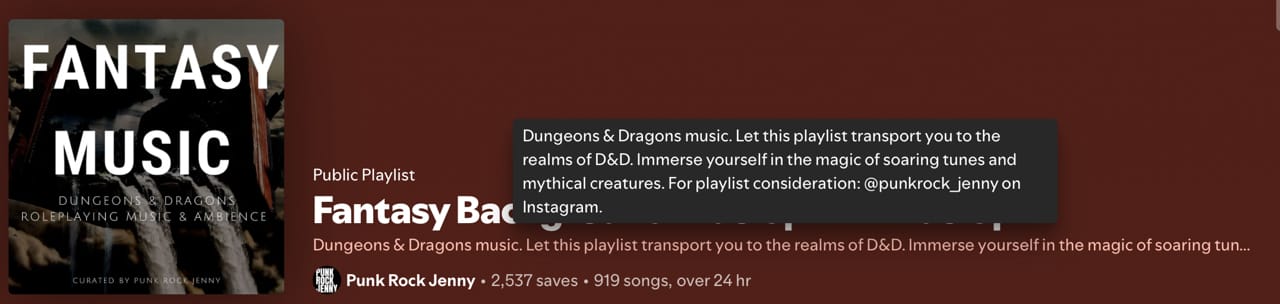
- Search the curator’s name on Google (or your search engine of choice): You never know what may pop up: their blog, their YouTube, their long-abandoned Tumblr.
- Search their name on Social Media: Instagram and TikTok are awesome places to send a cold DM and a lot of these playlist creators have coinciding Social Media pages.
Open With Something Personal
I always recommend opening with a quick introduction that shows the curator that you actually took the time to listen to their playlist and you “get it.” You could compliment their music taste, mention what it means to you, or even where you listen to this playlist.
Ie. “Dude, you obvs are super into new hip-hop,” “This playlist got me through some dark times,” or “I’ve been listening to this playlist every frickin’ day at the gym.”
But be authentic to you. If you don’t really listen to this playlist, then don’t lie.
Introduce the Artist and Song
Keep it brief: no more than one introductory sentence, followed by another sentence or two that introduces the artist. Include ONE SONG. Start with one. Hopefully, this is the start of a beautiful relationship with this person so you’ll have the opportunity to show off many more songs, but start with ONE. I can’t tell you how often someone pitches an entire album; I feel overwhelmed because I only have 2 minutes and end up not listening to a single song.
Disclose If You’re Using AI
If you are pitching AI-created music in any capacity, the right thing to do is disclose that. Let them know how you used it. Was it just the instrumental? Was it the vocals? Is the whole song AI-created? You’ve got to say that. A lot of curators (and music listeners) are still really put off by AI or have moral stances about it.
I’m not saying it’s right or wrong, but what I am saying is that you don’t want anyone to feel duped or mislead; that’s a great way to shatter your relationship with a mini-gatekeeper.

+Read more: "9 Live Music Marketing Trends Selling Out Shows In 2026"
Offer Something (and it Doesn’t Have to Be Money)
According to Robert Cialdini and decades of research on persuasion, reciprocity is super powerful. Sure, you can buy a spot in a playlist, but if you’re an up and coming artist, money is tight. Exposure also has value, as every business-savvy music artist understands.
So offer what you can. Can you shout-out their playlist on your artist’s Instagram Stories? Are you going to mention it on your Twitch stream? What about adding a link in your bio? Attention has value and if you offer something, people will want to return the favor.
Close with Gratitude and Accept the Outcome with Grace
You open with a compliment and you close with gratitude. Thank them for their time and consideration with kindness in a way that’s authentic to you. And let’s be real, they might say no. They might not even give a reason. They might just ignore you and your message may never even be seen or acknowledged.
And that’s okay; this isn’t your only playlist pitch and this isn’t your only gatekeeper. Don’t sweat it and thank them for their time and move on to the next.
Be Authentic and Don’t Have ChatGPT Write your Message
You see ChatGPT tells in the messages you receive all the time. “It’s not X, it’s Y.” “And honestly? That’s rare.” Ugh. Eyeroll. ChatGPT is an incredible tool, but I will say that it absolutely sucks the life out of the messaging. When I receive a message or pitch written by ChatGPT, I can’t help but think that this person didn’t even bother to type a message to me themselves.
Use your voice. I want to network and connect with YOU. Not ChatGPT. Chatty and I already have a rapport thank you very much.
What About Those Paid Services for Playlist Payments?
They’re real. They’re out there, but I’d rather establish real connections with individuals in the music industry — even if they’re a tastemaker. The same people who are curating playlists are the ones who are creating content on TikTok and those TikToks get posted to Reels, and the cycle of influence continues.
Grab your free exposure and playlist placement and go get your music heard.
Jenny Morrison is a professional musician and content creator with over a decade of experience teaching Music Business at the collegiate level. Her career encompasses songwriting, session work, and touring in the children’s music industry. She is an award-winning educator who develops engaging and innovative curriculum that reflects the dynamic nature of the music industry.