

By Gavi Shohet Zabin, Founder/CEO of SRND AI
An artist posts a TikTok -> it gets 200,000 views -> a playlist adds your song. Streams jump 40%. Release day is the biggest day of the artist’s career -> everyone celebrates.
Then two weeks later, the graph comes back down.
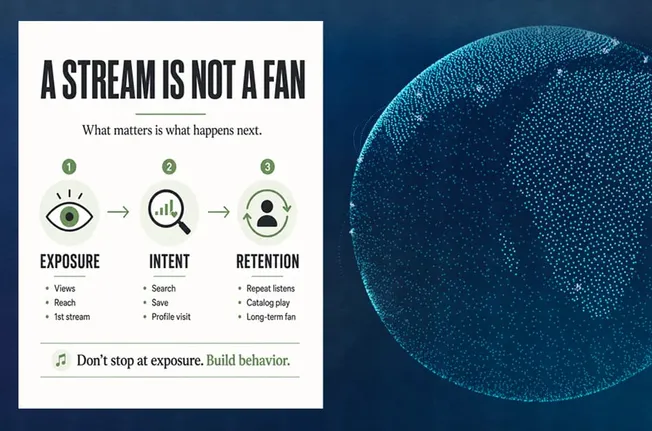
This is one of the biggest mistakes I see in independent music marketing: we treat activity as progress because activity is easier to measure. Views, impressions, streams, monthly listeners, and playlist reach tell you that something happened. They do not necessarily tell you that you built anything.
As both an independent artist myself and the founder of SRND AI, I spend a lot of time thinking about a different question: So what did the listener do next?
That question sounds simple, but it changes how you evaluate almost every piece of music marketing. Let's talk about it.
1. A million impressions can still produce almost nothing
Social media has trained artists to think in reach. The assumption is straightforward: more people see the song, more people stream the song. But the relationship is not nearly that clean.
A 2026 study published in Marketing Science examined what happened when Universal Music Group removed its catalog from TikTok during the companies’ licensing dispute. Researchers compared UMG tracks with Sony and Warner tracks and found something surprising.
For UMG songs that had already been available on TikTok, generally more established songs and artists, removal from TikTok actually corresponded with a 2% to 3% increase in consumption on other streaming platforms. For less-popular UMG tracks that had not previously been available on TikTok, the effect went the other direction: streams declined by 1% to 3%, consistent with TikTok helping with discovery.
That does not mean TikTok is good or bad for music. It means attention is not the same thing as demand. For one artist, a short-form video may introduce thousands of people to a song they would never have heard. For another, people may consume the satisfying part of the song inside the video and never leave the platform.
So “the video got 500,000 views” is not the result. It is the beginning of the analysis. Did profile visits rise? Did people search for the artist? Did saves move? Did the back catalog move? Did those listeners come back three weeks later?
That is where the useful information starts.
+Read more: "The 88% Problem: Why Most Music Fails Before Anyone Hears It"
2. Even a stream can be misleading
The same problem exists inside Spotify. A listener hearing your song because it appeared in a playlist is not behaving the same way as someone typing your name into search and choosing your record. Spotify itself separates those behaviors.
Its “monthly active listeners” are people who intentionally streamed an artist from places like the artist profile, release pages, their library or their own playlists. “Programmed listeners,” on the other hand, have heard the artist through programmed sources such as editorial playlists, Discover Weekly, Radio, Autoplay or other listeners’ playlists.
Here is the part artists should tune in on: Monthly active listeners make up only 33% of an artist’s total audience on average, but generate 60% of streams and 80% of merch purchases through Spotify. Spotify explains the segments here.
That changes the way I look at a campaign for example:
- Campaign A produces 20,000 streams but almost nobody intentionally comes back,
- Campaign B produces 6,000 streams but creates hundreds of listeners who save the record, explore the catalog and return on their own.
I would rather have Campaign B. The first campaign rented someone's attention, but the second changed their behavior.
3. Playlist placement is the beginning of the job, not the end
This does not make playlists unimportant; in fact, they can be enormous discovery engines.
Spotify says that Fresh Finds generated more than 65 million artist discoveries in 2024, and nearly 70% of Fresh Finds streams that year represented listeners discovering an artist for the first time. Artists also saw new listeners and international streams more than double, on average, a month after their first Fresh Finds placement.
That is powerful, but the most interesting part of a playlist placement is what happens after the playlist.
- Does somebody hear the song on Fresh Finds and forget the artist’s name?
- Or do they open the profile, play another record, save the song and come back?
The playlist generated both listeners, but only one is beginning to become a fan. This is why I think artists should stop evaluating promotion as isolated events. The TikTok post affects the Spotify visit. The Spotify visit affects the save. The save affects the next release. The next release can reactivate somebody who disappeared six months earlier.
A career is a chain of behaviors. Most marketing reports are simply snapshots.
4. The smallest number on your dashboard may matter most
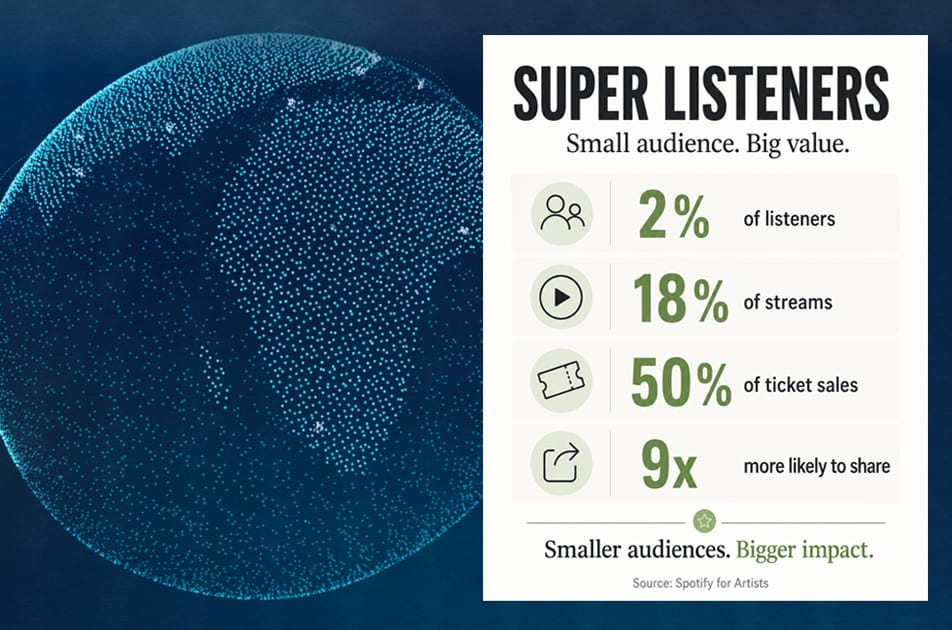
Spotify’s data on its most engaged audience makes this even clearer. “Super listeners” account for only about 2% of an artist’s monthly listeners, but they generate more than 18% of monthly streams.
Spotify goes further to say that they also account for 50% of ticket sales through Spotify and are nine times more likely to share an artist’s music than other listeners. More than half are still streaming the artist six months after discovering them.
Think about what that means: An artist could obsess over increasing monthly listeners from 50,000 to 60,000 while ignoring the few hundred people who may be disproportionately responsible for streams, sharing, tickets and long-term value.
5. Release Day is also over-measured
There is another number artists place too much psychological weight on: first-week streams. Obviously, momentum around release matters, but Spotify says 75% of a release’s first-year streams happen after its first month.
And yet, a huge amount of independent marketing behaves as if the campaign expires seven days after the song comes out. Pre-save, release post, run ads, pitch playlists. A week of content, and then everyone starts thinking about the next record.
That is backwards. The first month should give you information that makes the next months smarter.
- Which city responded disproportionately?
- Which piece of content produced intentional listeners instead of views?
- Which fans disappeared and came back?
- Did listeners who found the single explore another song?
- Which audience deserves another touch?
This is actually one of the reasons I built SRND AI. Artists already have dashboards full of information. The missing layer is often what comes between the dashboard and the next action.
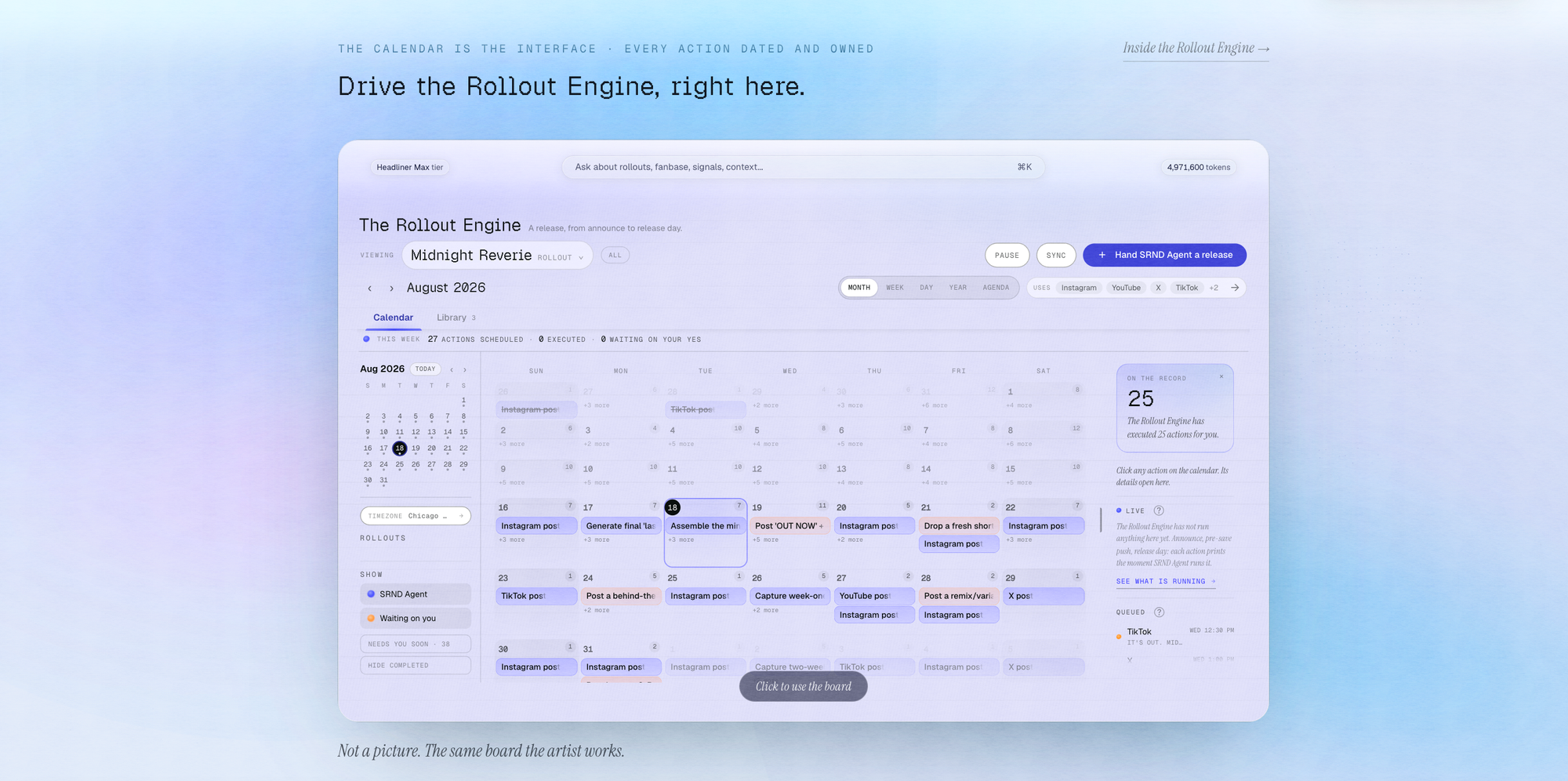
SRND Agent is designed around that loop: read what is happening, decide what should happen next, execute the marketing work, measure the response, and keep adjusting. It can run a release across 121 defined marketing actions, but the important part to me is not the number of actions. It is that the next action can be informed by what the last one actually changed.
I think that distinction will become increasingly important as artists get access to more automation, because automating bad measurement just lets you make the wrong decision faster.
+Read more: "5 Playlist Pitching Regrets From an Artist Turned Curator"
The question I would ask after every campaign
There is a simple test artists can use without any complicated model: If I stopped spending money and posting about this song tomorrow, what would I still own?
A listener who will never come back? Or a save? A follower? An email address? A fan relationship? Someone who will recognize your name when the next song appears? That is the difference between buying a number and building an audience.
The job of music marketing is to make their behavior different because they encountered it. So after your next release, do not only ask: How many people listened?
Ask: How many gave me a reason to believe they’ll listen again?
That number is usually smaller, but it may also be the one your career is actually being built on.
19-year-old creative and entrepreneur Gavi “Bimpin” Shohet Zabin is the Founder and CEO of SRND AI, a Chicago-based music technology company building an operating system that plans, executes and adapts artist marketing and release campaigns. He is also an independent recording artist and producer under the name Bimpin, giving him firsthand experience both building artist-marketing technology and releasing music himself.