

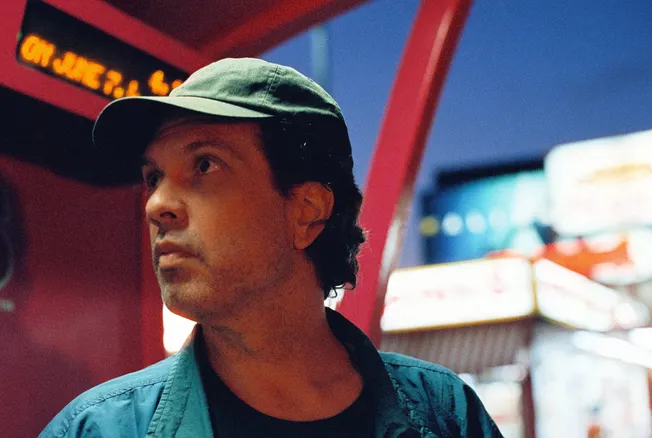
Black Marble is the synthwave pop project of NYC-based songwriter and producer Chris Stewart. His newest record, Life in Small Spaces — which comes out next month and of which, two singles have been released — is unmistakably written for his audience's ears, yet the subject matter is almost a letter to and about the music industry itself.
Stewart writes about his experience of disillusionment and disappointment as he navigated the music business from the seat of an artist on the rise for so many years. It's honest and truthful, and unique, and in no way does this exposé of analysis take away from the resonance and chops of the songwriting itself. Part of that is because it's a "live sounding" album. It's raw, and in that conscious approach to production, that much more authentic.
I knew that Black Marble was also starting a long string of tour dates in support of the record launch, and that Stewart has taken to the road quite a bit in his career. So we talk about all that and more.
Here's our conversation. Enjoy!
Hypebot: Hey Chris, thanks for taking the time to answer some questions. Congrats on Life in Small Spaces, which comes out next month. What is different about this record versus your past albums?
Chris: "Sonically it's much more of a guitar and bass sort of old-school, underground sounding pop record. A bit more lo-fi than the last two records but probably still a bit more produced than the first or second one."
I think it took the last two records to make this one. I couldn't have made this one before now because I didn't have the production experience or songwriting skills to write these compact songs, honestly."
H: What connects the live show to the record for you? Or vice versa, do they inform each other in some way?
C: "Well much more so than in the past, I'm thinking of making songs I want to play live. When I first started I just wanted to make songs people would like when listening to headphones on the subway, whereas now, I know I'm going to play these songs on the road, that's the fun part of being in a band, the touring."
So I'm always thinking about when I'm writing whether or not something would be a good live song."
H: On that note, I watched this live show you did that was captured in full in 2024 and you’re playing the guitar the whole time. Yes there’s a synth player on stage, but in a weird way I’m surprised you’re not wielding a synth in your live performance considering the album material! I’m just curious what drove the decision to play these songs on guitar live? And is that still the case today?
C: "Ha yeah I get that, I suppose I just like playing guitar on stage. It feels fun to sing and play guitar. It's a bit more unwieldy to sing and play keyboards, always looking down and picking out notes. It doesn't make for the most engaging performance and I'm always trying to find ways to be more comfortable and in the zone on stage. With guitar it's easier to be expressive and sing and play at the same time."
H: One thing that gets talked about with this new LP is that there’s some pondering and commentary on the music industry itself, particularly economics and the longevity of an artist’s standing. You’ve said: “The life of an artist goes on after your moment ends, you know? So who do you want to be in the end and how do you want to be seen by the people that know you?” Can you expand on that?
C: "Sure. When you're in music long enough you start to realize about half, maybe more than half of your peers are in it as a game they are playing to see who can become a more popular band. Every social media post, every picture every video posted exists solely to give the impression that the band is a big and popular band because in order to become a big and popular band, these people have deduced, the way to do it is trick people into thinking you're that way already, which, to a certain extent works."
In the end though you can only go as far as other people will take you. For me, I don't want to try and trick people into thinking I'm cooler than them, that sort of 'exclusivity angle.' That's more like seeing music like politics; operating as though the listeners are stupid and you're selling them a fantasy. I don't think so lowly of people. I feel like if you're not deep in the music game you don't even notice people being like this, because I didn't. But yeah once you're in you see how many people do everything they do with a political calculation first and foremost."
It makes me wonder if other creative disciplines, writing, acting, filmmaking are the same way."
"I don't want to try and trick people into thinking I'm cooler than them, that sort of 'exclusivity angle.' That's more like seeing music like politics; operating as though the listeners are stupid and you're selling them a fantasy. I don't think so lowly of people."
H: Do songs generally come to you fast while you’re writing or are they laborious and slow?
C: "Pretty fast but I have albums worth of unfinished songs. At a certain point if it's not working I just set it aside. Sometimes I can come back to it later and hear what it needs with fresh ears. Like months or even years later."
H: What is uncompromising to you creatively, and what is malleable?
C: "What's uncompromising, or can't be compromised if I understand correctly, is that I'm writing songs for me and the people that are like me. Whoever we are. We exist as a big group floating above my head and I'm writing for us. What's malleable is what the songs sound like. As long as they speak to me they will speak to us."
H: Do songs evolve on the road at all, it strikes me that with the drum machine parts programmed there’s not a lot of flexibility to stretch those tracks out but I’m curious if you write “live versions” of your songs that include vamps or extensions at all?
C: "Yeah it's more adapting them for a three-piece live setup that changes them but I've always been okay with those changes and most of the time I really like the live version adaptations. I feel like they come out a bit leaner and meaner sometimes, but honestly a good portion of the songs sound pretty similar live to recorded."
H: Are there songs from either this or past records that trip you up playing live?
C: "Not really, no. When I first started playing live shows I was so bad at playing that I would like, go out to the car and practice playing the parts in between other bands' sets. I was so nervous and prone to making mistakes. Now I can play well enough to pick up songs fairly quickly."
I almost forgot about those days, it's good to remember how far you've come every once in a while, haha!"
H: Do you think touring is essential for artists today?
C: "It probably is if you want to make a living as an original band, but I feel like there's so many ways to be involved with music whether scoring or songwriting or teaching that don't involve touring that could be a nice and stable way to have a career in music without trying to be a 'band' in the classical way."
"When I first started playing live shows I was so bad at playing that I would like, go out to the car and practice playing the parts in between other bands' sets. I was so nervous and prone to making mistakes."
H: What’s something you’ve learned by spending time on the road?
C: "How America as a country is like a cardboard box you throw 80 stupid people and like 20 smart people into and say: 'Okay you smarter ones, go ahead and take advantage of the stupid ones.' The whole PT Barnum thing, there's a sucker born every minute. That's really internalized here. When someone rips you off you feel stupid more than you feel outraged."
In other countries, if businesses lie and steal from their customers the citizens would be up in arms. Here it's like: 'Oh you bested me again Postmates. You said the food would come in 36 minutes and the second I paid for it you changed the time to an hour and 12 minutes. Silly me.' It's like, no that's just like a lie. Everyone here is a thief and a liar and are brainwashed into thinking that makes them smart. It's not like you're the stupid one if you don't want to participate. But you can get tricked into thinking you are."
On tour in Europe, I realized how young my country is and that it's an extension of these much older places where people seem to be a little more laid back and have internalized some wisdom we seem to currently lack just because they've been around so much longer, I think. I think there's some good things about the States also but I feel like they have things a bit more wired in other places about how to live with a certain dignity."
H: As a fan, who are some artists you’ve seen play live recently that have blown you away?
C: "I have been so busy with the record, it's sad to say I haven't been able to get out to shows recently!"
H: Ah too bad, well when you do go out, what's your favorite post-concert food to eat?
C: "Well it depends on where I am. In NYC, it's a slice of Pizza, in LA it's tacos and in Europe it's Kebab."
Life in Small Spaces by Black Marble comes out August 21st on Sacred Bones. Pre-order or Pre-save here.