

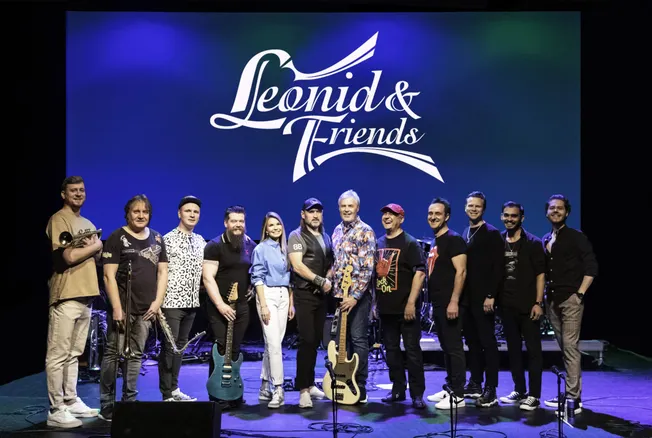
If you haven't already heard of them (and no, you wouldn't be blamed), Leonid & Friends is an 11-piece band from Moscow that became famous by recording freakishly accurate covers of Chicago songs on YouTube.
If you're already thinking, okay... where is this going? Yeah, that's what I thought when I first heard about this group.
The thing is... they're selling out almost every show. And the US general population doesn't exactly love Russia right now, so what is happening here?
Well, the group spent its spring appearing on Pollstar's LIVE75 chart alongside major touring acts, and even opened for Jerry Seinfeld at Los Angeles' Greek Theatre, and now another lengthy American run is fully underway with sold-out shows already scattered across the schedule.
It's not just a viral internet thing. This thing has legs. Because somewhere along the way, Leonid & Friends stopped merely benefiting from viral attention, and made a crazy good booking decision to go find their audiences in theaters housed in smaller, stranger markets.
Immokalee, FL. Shipshewana, IN. Del Mar, CA. Danville, VA. Red Bank, NJ. Glenside, PA. St. Charles, IL.
+Read more: "Why Is Gig Booking Still in the Age of Dinosaurs?"
The tour map didn't start in New York and end in Los Angeles
Paladin Artists agent Gil Jacobs recently told Pollstar that Leonid & Friends often performs particularly well in secondary and tertiary markets. Secondary and tertiary live music markets are typically the smaller, non-major cities where artists tour after playing primary metropolitan hubs.
Apparently, this Russian troupe has toured so widely in the last 12 months that there are only two US states they haven't been featured in. Now that even rivals some of the most stalwart DIY road hogs out there.
On one run, Jacobs recalls booking three or four Iowa shows alone. His explanation is uncomplicated and makes total sense: plenty of fans live outside major music cities, and many would rather see a band at the theater down the road than drive hours into a metropolis.
Newark, OH. Champaign, IL. Des Moines, IA. Albuquerque, NM. Salem, OR. Redwood City, CA. Temecula, CA.
New York, LA, and Dallas still matter. They just aren't treated as the only places that matter. The band's official schedule currently marks shows in Skokie, Stafford, Dallas, and Anaheim as sold out, among others; Pollstar also reports that a Milwaukee date sold out its original theater months early and was moved into the larger Riverside Theater.
Virality created the audience. Touring mapped it.
Leonid & Friends' story began almost accidentally. Founder Leonid Vorobyev gathered musicians to record a Chicago cover in 2014 as he was contemplating retirement. Videos followed. One particularly successful performance of "25 or 6 to 4" eventually reached Jacobs.
When he finally became involved, the band's first small US run expanded from roughly three dates to six or seven, and that's where this approach naturally began for the team. They did well enough that Jacobs brought them back twice more in 2019. The operation has essentially been collecting evidence ever since: play the market, see what happens, return where demand exists.
The lesson here isn't just to "book random small towns and hope for the best." It's that the traditional hierarchy of touring markets may tell you less about your audience than it once did, and that scarcity can actually be an asset.
The internet isn't confined to urban areas. A fan who discovers you on YouTube, TikTok, Spotify, or Instagram doesn't have to live in Brooklyn. Digital discovery flattened that part of the music business years ago. Touring maps have been slower to catch up, but the show in this case is simple enough to be the perfect test case.
Jacobs describes a live show without huge lasers or elaborate production: musicians, the band's name on a screen, and an audience largely fueled by online videos, recommendations, and word of mouth.
Who else is looking beyond the usual cities?
There are signs of the same calculation elsewhere. The Offspring's future US headline dates will intentionally target markets the group historically hadn't played, and for the same reason. The band's demand has shifted along with its prime demographic.
CAA's Lindsey Myers said a cross-country Darius Rucker arena tour proved successful partly because it invested in audiences he hadn't fully developed before. Similarly, Live Nation's Alex Vyskocil pointed to Three Days Grace playing roughly 25 Canadian dates across major and secondary markets and said longer, deeper routing can actually help touring economics work.
The phenomenon is important enough that Britain's new Liveline Fund specifically includes money to extend tours into secondary and tertiary markets that rising costs have caused artists to skip. Music Venue Trust says its programs supported more than 75 new events across 28 secondary and tertiary towns and cities during the first three months of 2026 alone.
In other words, the opportunity exists at the same moment the touring industry is in danger of retreating from it.
+Read more: "For Stevie Wonder, It’s Always Been About the Whole Album"
It seems the afterthought should be the strategy
Major markets still offer obvious advantages: press, industry presence, and a dense concentrations of listeners. But they also offer every other tour in America happening at the same time. A Wednesday night in Los Angeles can mean competing against dozens of worthwhile shows. A Wednesday night in a smaller city might mean being the show.
That doesn't make every tertiary-market date sensible. Artists still have to look at ticketing data, streaming geography, social engagement, email lists, venue history, and the brutal mathematics of gas, hotels, and crew, when tour planning. But Leonid & Friends offers another variable worth considering: How much does an audience value being noticed?
Perhaps the band's original breakthrough was lucky. You can't exactly schedule a viral YouTube video. But they've leveraged this, halfway across the world, in the smartest way possible.
Get caught up on Hypebot's tour announcement analysis series, Touring Radar.